
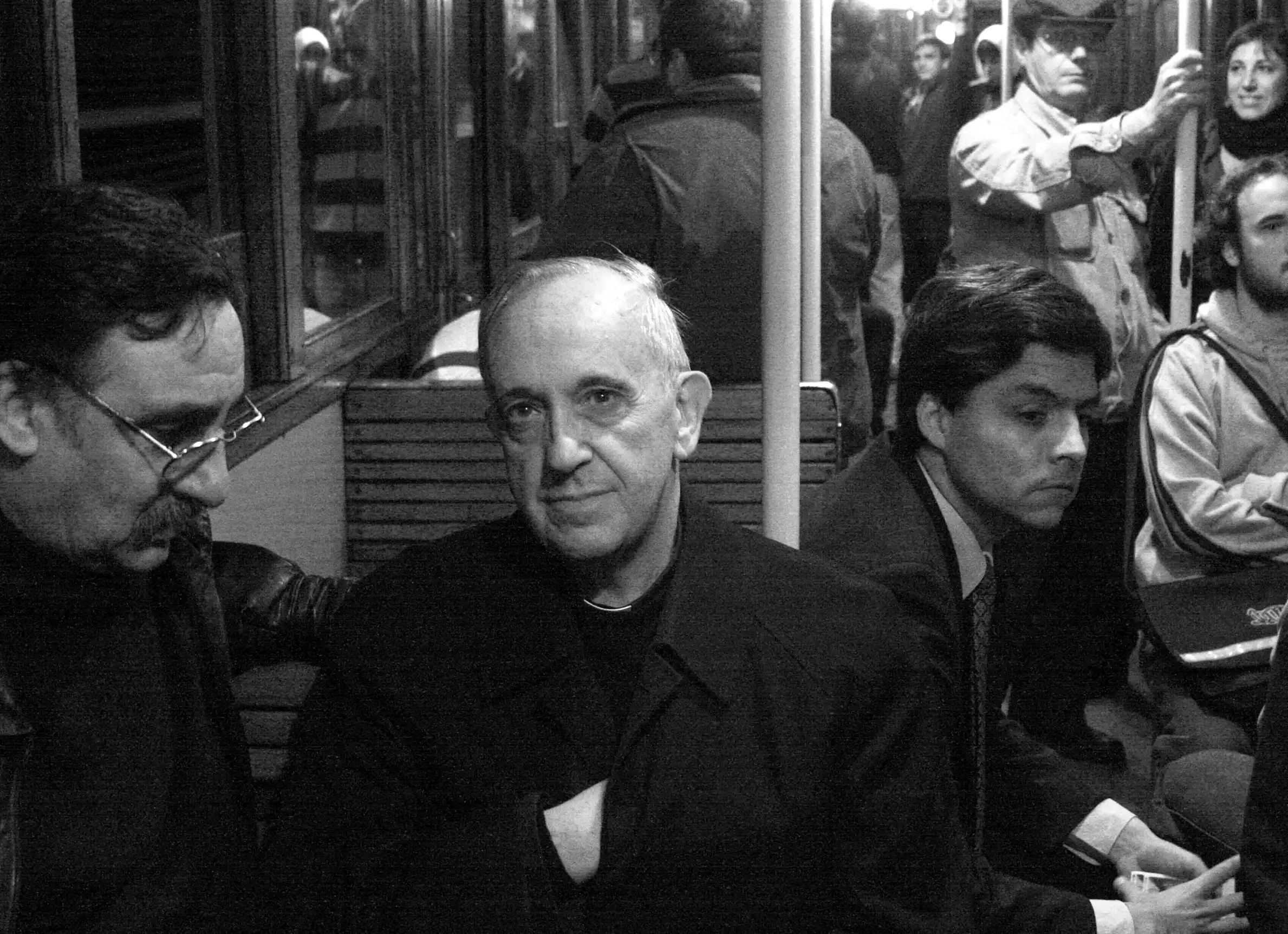
Pope Francis Public Transport 1998 Poster | Black and White Catholic Wall Art
In 1998, a photograph was taken on the Buenos Aires underground that no one planned, no one staged, and no one could have predicted would one day be seen by hundreds of millions of people. The man in the picture was Jorge Mario Bergoglio — then Archbishop of Buenos Aires, later the 266th Pope of the Catholic Church — sitting among ordinary commuters on the subte, in simple clerical attire, indistinguishable from the people around him except for the collar. He had no motorcade, no security detail, no deference paid to his position. He was simply there, on the train, with everyone else. Fifteen years later, when Cardinal Bergoglio became Pope Francis, this photograph became one of the defining documents of his papacy: the image that explained, before any encyclical or public address, exactly who this man was and what kind of church he intended to represent.
What You will Receive
- Made to order, museum-grade art print. Frame not included unless stated.
- Printed on 200 GSM premium matte paper for crisp detail and zero glare.
- Archival giclée inks that resist fading for decades.
- Multiple size options. Use the selector above.
- Protective packaging: rigid mailer or sturdy tube.
Print Quality
Every print is produced using state-of-the-art giclée technology on heavyweight 200 GSM matte paper. The non-reflective surface eliminates glare while the archival pigment inks deliver rich, accurate colours designed to last a lifetime.
Size Guide
For walls above furniture, choose a print roughly two thirds to three quarters the width of the piece below it. Smaller sizes up to 11x14 inches suit gallery walls. Larger formats of 18x24 inches and above create striking focal points.
Verified Customer Reviews
Shipping
Every order is printed on demand. Processing takes 3 to 5 business days, then ships free worldwide with tracking.
| Region | Processing | Delivery | Total |
|---|---|---|---|
| USA | 3 to 5 days | 2 to 6 days | 5 to 11 days |
| Canada | 3 to 5 days | 5 to 10 days | 8 to 15 days |
| UK and Europe | 3 to 5 days | 5 to 10 days | 8 to 15 days |
| Australia and NZ | 3 to 5 days | 8 to 15 days | 11 to 20 days |
| Asia | 3 to 5 days | 7 to 15 days | 10 to 20 days |
| Rest of world | 3 to 5 days | 10 to 20 days | 13 to 25 days |
📦 Packaging
Prints up to 12x18 inches ship flat in rigid cardboard mailers with backing board. Larger prints are rolled in sturdy tubes with protective end caps. Every package includes moisture barriers and Handle With Care labels.
Returns and Replacements
- 30 day return window from delivery. No questions asked.
- Report damage within 48 hours with photos for a free replacement.
- Full refunds for eligible returns in original condition.
- Cancel before production starts for a complete refund.
- Return shipping covered for defective or incorrect items.
Need help? info.merchfuse@gmail.com
How to Care for Your Print
Follow these steps to keep your print looking gallery fresh for decades.
Handling
Allow rolled prints to relax flat for 30 to 60 minutes. Handle by the edges with clean, dry hands and avoid touching the printed surface.
Placement
Avoid direct sunlight, heat sources and high humidity areas. North facing walls receive less UV. Use LED or incandescent lighting instead of fluorescent.
Framing
Use acid free mats and UV protective glass or acrylic for maximum longevity. Leave a small gap between print and glazing for airflow.
Cleaning
Dust framed glass with a soft cloth. Spray the cloth, not the glass. For unframed prints, use a dry microfibre cloth and never apply liquids to the surface.
Climate
Keep temperature at 18 to 24 degrees C and humidity at 40 to 60 percent. Avoid attics, basements and garages where conditions swing widely.
Storage
Store flat in acid free folders, interleaved with tissue paper, in a cool dark place. Never fold. Check stored prints annually.
⚠️ Avoid
- Prolonged direct sunlight or fluorescent lighting.
- Bathrooms, kitchens and areas above heat sources.
- Tape, adhesives or liquids applied directly to the print.
- Rolling with the image facing inward as this can crack the ink layer.
- Extreme or rapid temperature and humidity changes.
📊 Expected Lifespan
- 100+ years when framed with UV protective glazing and indirect light.
- 50 to 75 years when framed with standard glass and indirect light.
- 25 to 50 years when stored correctly in darkness.
There are photographs that document power, and photographs that document the renunciation of power. The second kind is rarer and harder to make, because power rarely consents to being documented in its absence. The 1998 Buenos Aires subway photograph of Jorge Mario Bergoglio belongs entirely to the second category. At the time it was taken, Bergoglio had been Archbishop of Buenos Aires for less than a year — appointed by Pope John Paul II in February 1998 to lead one of the most important dioceses in Latin America. He could have travelled as his predecessors travelled, with the institutional apparatus of the Church providing the insulation from ordinary life that seniority confers. Instead, he took the train. Not occasionally, not for show, not as a calculated act of humility for the cameras. Simply as a matter of practice, because this is how the people of Buenos Aires moved through their city, and he saw no reason why he should move differently. This Pope Francis black and white wall art documents that practice at the moment when it was still private — before the world was watching, before the image carried the weight of a papacy, when it was simply a photograph of a man on a train.
The significance of the image deepened dramatically on March 13, 2013, when the College of Cardinals elected Bergoglio as the 266th Pope of the Catholic Church — the first Jesuit, the first from the Americas, the first from the Southern Hemisphere in the two-thousand-year history of the institution. Within hours of his election, the Buenos Aires subway photograph was circulating globally as the image that explained who this new Pope was: not the distant, ceremonially elevated figure of tradition, but someone who had spent decades choosing proximity over privilege, the ordinary over the institutional, the people over the position. The photograph had been taken fifteen years earlier with no knowledge of what it would eventually mean, which is precisely what makes it so powerful as a document. Candid photographs of private integrity are different in kind from photographs of public performance, and this vintage Pope Francis photography print is candid in the deepest sense — it catches its subject in a moment of private consistency, before anyone was paying attention.
Black and white is the only register in which this image should exist. Colour photography would fix the image in a specific moment, a specific decade, a specific cultural context — the particular palette of late-1990s Buenos Aires, the specific hues of the subway carriage, the colour of Bergoglio’s clerical attire. Monochrome removes all of that and leaves what actually matters: the composition, the contrast, the relationship between the seated figure and the space around him, the quality of attention in his posture. In this Pope Francis Buenos Aires subway black white print, the Archbishop of Buenos Aires sits with the ease and ordinariness of a man who has made a decision about how to live and is simply living it. There is no performance, no self-consciousness, no awareness of the camera’s significance. This is the visual definition of integrity: behaviour that is identical whether observed or unobserved, documented or undocumented.
As Catholic wall art Pope Francis print, this image speaks to a tradition of documentary photography that has always understood the Church best when it photographed it at its most human rather than its most institutional. The great ecclesiastical photographs of the twentieth century — the images of parish priests in the favelas, of nuns at work in hospitals, of missionaries in the field — derived their power from exactly the quality that makes this image so compelling: the visible gap between the institutional weight of the role and the human simplicity of the person carrying it. Pope Francis, as a subject, has always offered that gap in its widest and most dramatic form: a man who leads a global institution of 1.3 billion faithful while choosing to travel by public transport, live in a guesthouse rather than the Apostolic Palace, and carry his own briefcase. This vintage Pope Francis photography print documents that choice at its origin — before the papacy, before the global attention, before the symbolism had accumulated. It shows the man, not the Pope.
The matte finish of the 200 GSM museum-grade paper on which this Pope Francis public transport 1998 poster is printed is exactly right for the documentary quality of the image. It suppresses surface glare and gives the print the look and gravity of an archival photograph — the kind of image that belongs in a museum or a private collection rather than a commercial display. The tonal range of the black and white photography, from the deep shadow of the subway carriage interior to the lighter grey of the clerical collar and the pale highlights of the faces of surrounding passengers, is reproduced at full 300 DPI resolution across all seven sizes, from 9×11″ for a discreet study wall to 24×36″ for a room-defining display.
For anyone for whom the image of a religious leader choosing ordinariness over privilege carries personal, spiritual, or political resonance — and for the very large number of people worldwide for whom Pope Francis represents something genuinely new in the history of institutional religion — this black and white Catholic wall art is not a piece of devotional merchandise. It is a document of a value that is rare in any institution and extraordinary in one as ancient and ceremonially laden as the Catholic Church. It belongs on the walls of people who understand that the most powerful statement any leader can make is not a speech, an encyclical, or a formal photograph, but the daily, undocumented choice of how to live.
Why This Pope Francis Black and White Wall Art Stands Out
- Historical significance: Taken in 1998 — the year Jorge Mario Bergoglio was appointed Archbishop of Buenos Aires — this photograph documents his lifelong practice of taking public transport rather than using the institutional privileges of his position; it became globally iconic after his election as Pope on March 13, 2013.
- Subject & legacy: Pope Francis, the 266th Pope of the Catholic Church, is the first Jesuit, the first from the Americas, and the first from the Southern Hemisphere; his papacy has been defined by radical simplicity and identification with the poor and marginalised — all of which this photograph anticipated and embodied.
- Black and white documentary treatment: Monochrome photography removes period context and colour distraction, leaving only the essential composition — a man of institutional power choosing to live like the people around him — and gives this vintage Pope Francis photography print the timeless gravity of an archival document.
- Print quality: 200 GSM museum-grade matte paper, fade-resistant archival inks, glare-free finish — available in seven standard frame-ready sizes from 9×11″ to 24×36″.
- Sizes & options: Seven frame-ready sizes from $9.90. Digital download (300 DPI, PDF/JPG) at $3.90.
- Perfect gift for: Catholics, Christians, and people of faith; admirers of Pope Francis; anyone inspired by humility and servant leadership; documentary photography collectors; social justice advocates; students of modern Church history.
Where to Hang This Catholic Wall Art Pope Francis Print
The deep tonal range of this Pope Francis public transport 1998 poster — the dark interior of the Buenos Aires subte, the lighter planes of faces and collar, the documentary grain of the photography — integrates naturally into any interior that values substance over decoration. Against white or off-white walls it reads as a gallery-quality photographic document; against dark green, navy, charcoal, or warm grey it acquires the gravity of a museum print. A slim black frame without mat gives it the severity and directness of press photography; a dark walnut frame with a narrow white mat gives it the warmth of a private archival photograph. In a home or office, in a church meeting room, in a study or a library, this vintage Pope Francis photography print adds the specific quality of looking at a genuinely important image — one that documents not an event but a character, not a moment but a life.
More from MerchFuse
The history of the Pope as a subject for serious art is long and extraordinarily rich, and no artist in the twentieth century explored it with more intensity or more unsettling insight than Francis Bacon. The Francis Bacon — Pope Innocent X art poster expressionist portrait print is the dark counterpart to this documentary photograph: where the 1998 Buenos Aires subway image shows a Pope choosing ordinariness and proximity, Bacon’s series based on Velázquez’s portrait of Pope Innocent X shows the papacy as a structure of psychological terror and institutional isolation — the screaming figure trapped within the gold and scarlet of its own authority. The two images speak to each other across five centuries of Catholic history, and together they constitute a meditation on what the papacy means and what it costs. For the great tradition of documentary black and white photography applied to cultural subjects — the candid image of the significant individual in an unguarded, undirected moment — the Bob Dylan Don’t Look Back vintage movie poster iconic 1967 film print is the secular companion piece: D.A. Pennebaker’s documentary captured Dylan in 1965 with exactly the same quality of unplanned revelation that this photograph brings to its subject — both images derive their authority from the fact that they were not arranged for the camera.
Print & Material Details
Every MerchFuse museum quality Catholic wall art photography print is produced on 200 GSM museum-grade matte paper with fade-resistant archival inks that hold the full dynamic range of the black and white tonal scale — from the deepest shadow in the subway carriage to the brightest highlight on clerical white — across all seven sizes from 9×11″ to 24×36″. Standard frame dimensions throughout. The 300 DPI digital download (PDF/JPG) is available for $3.90.
This is a fan-inspired tribute print celebrating a historically significant and widely published documentary photograph. It is not affiliated with, endorsed by, or officially licensed by the Holy See, the Vatican, or any associated Catholic institution.
Related products
Price range: $3.90 through $74.90
Price range: $3.90 through $74.90
Price range: $3.90 through $74.90
Price range: $3.90 through $74.90
Price range: $3.90 through $74.90
Price range: $3.90 through $74.90
Price range: $3.90 through $74.90
Price range: $3.90 through $74.90