
Classic Van Gogh still life – Plaster Statuette 1887 Gallery Print
This Van Gogh still life captures the artist’s 1887 shift toward vibrant color and bold brushwork. Features post-impressionist wall art printed on museum-grade matte paper.
What You Will Receive
- Made to order, museum-grade art print. Frame not included unless stated.
- Printed on 200 GSM premium matte paper for crisp detail and zero glare.
- Archival giclée inks that resist fading for decades.
- Multiple size options. Use the selector above.
- Protective packaging: rigid mailer or sturdy tube.
Print Quality
Every print is produced using state-of-the-art giclée technology on heavyweight 200 GSM matte paper. The non-reflective surface eliminates glare while the archival pigment inks deliver rich, accurate colours designed to last a lifetime.
Size Guide
For walls above furniture, choose a print roughly two thirds to three quarters the width of the piece below it. Smaller sizes up to 11×14 inches suit gallery walls. Larger formats of 18×24 inches and above create striking focal points.
Verified Customer Reviews
Shipping
Every order is printed on demand. Processing takes 3 to 5 business days, then ships free worldwide with tracking.
| Region | Processing | Delivery | Total |
|---|---|---|---|
| USA | 3–5 days | 2–6 days | 5–11 days |
| Canada | 3–5 days | 5–10 days | 8–15 days |
| UK & Europe | 3–5 days | 5–10 days | 8–15 days |
| Australia & NZ | 3–5 days | 8–15 days | 11–20 days |
| Asia | 3–5 days | 7–15 days | 10–20 days |
| Rest of world | 3–5 days | 10–20 days | 13–25 days |
📦 Packaging
Prints up to 12×18 inches ship flat in rigid cardboard mailers with backing board. Larger prints are rolled in sturdy tubes with protective end caps. Every package includes moisture barriers and Handle With Care labels.
Returns and Replacements
- 30-day return window from delivery. No questions asked.
- Report damage within 48 hours with photos for a free replacement.
- Full refunds for eligible returns in original condition.
- Cancel before production starts for a complete refund.
- Return shipping covered for defective or incorrect items.
Need help? info.merchfuse@gmail.com
How to Care for Your Print
Follow these steps to keep your print looking gallery fresh for decades.
Handling
Allow rolled prints to relax flat for 30 to 60 minutes. Handle by the edges with clean, dry hands and avoid touching the printed surface.
Placement
Avoid direct sunlight, heat sources and high humidity areas. North-facing walls receive less UV. Use LED or incandescent lighting instead of fluorescent.
Framing
Use acid-free mats and UV protective glass or acrylic for maximum longevity. Leave a small gap between print and glazing for airflow.
Cleaning
Dust framed glass with a soft cloth. Spray the cloth, not the glass. For unframed prints, use a dry microfibre cloth and never apply liquids to the surface.
Climate
Keep temperature at 18–24 °C and humidity at 40–60%. Avoid attics, basements and garages where conditions swing widely.
Storage
Store flat in acid-free folders, interleaved with tissue paper, in a cool dark place. Never fold. Check stored prints annually.
⚠️ Avoid
- Prolonged direct sunlight or fluorescent lighting.
- Bathrooms, kitchens and areas above heat sources.
- Tape, adhesives or liquids applied directly to the print.
- Rolling with the image facing inward as this can crack the ink layer.
- Extreme or rapid temperature and humidity changes.
📊 Expected Lifespan
- 100+ years when framed with UV protective glazing and indirect light.
- 50–75 years when framed with standard glass and indirect light.
- 25–50 years when stored correctly in darkness.
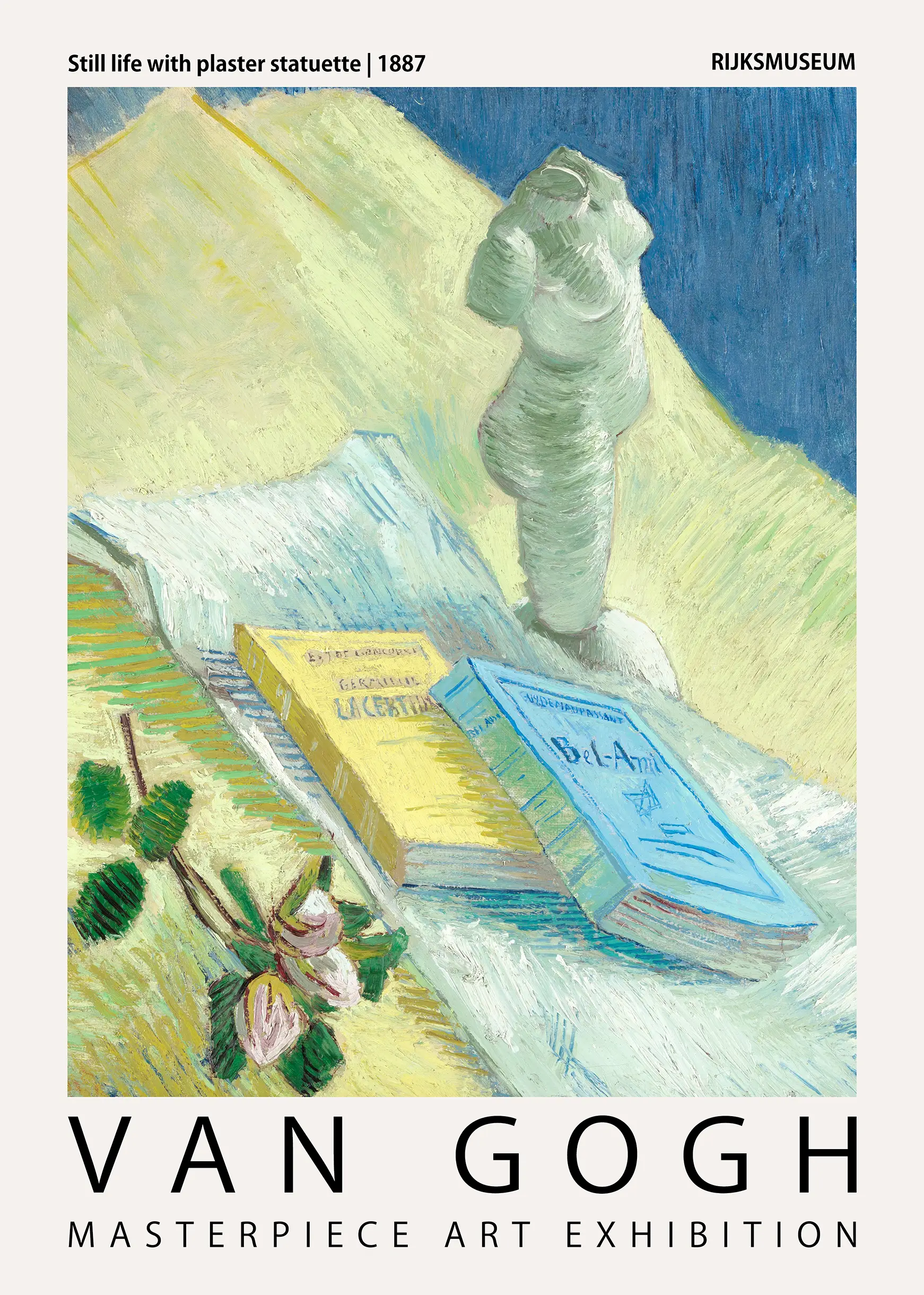
This Van Gogh still life represents a pivotal moment in the artist’s career, specifically during his prolific residency in Paris between 1886 and 1888. During this period, the artist moved away from the somber, earthy tones of his earlier Dutch works and began experimenting with the vivid palettes and light-filled compositions of the Impressionists and Neo-Impressionists. This specific painting, created in late 1887, serves as a rigorous exploration of color theory and symbolic arrangement.
The Symbology of Naturalist Literature
At the heart of the composition are two novels that reveal much about the artist’s intellectual life: ‘Germinie Lacerteux’ by Edmond and Jules de Goncourt, and ‘Bel-Ami’ by Guy de Maupassant. These books were cornerstones of the Naturalist movement in French literature, a style that aimed for gritty, unvarnished realism. By including these specific titles in a Van Gogh still life, the artist aligns his visual goals with the literary goals of the era—capturing life with raw, honest intensity. The bright yellow covers of the books provide a sharp, rhythmic contrast against the cooler tones of the tabletop and the blue background.
The Composition of a Van Gogh still life
The focal point of the piece is a small plaster female torso, a common tool for anatomical study in the late 19th century. This statuette represents the academic tradition of art, yet the artist treats it with a decidedly modern flair. Rather than smooth, classical shading, the torso is rendered with short, thick strokes of pale green and white, echoing the texture of the surrounding environment. To the left, a single rose lies on the table, its delicate petals providing a soft counterpoint to the rigid plaster and the geometric lines of the books. This juxtaposition of the natural, the academic, and the modern is a hallmark of this period in his development.
Color Theory and Impasto Techniques
As seen in this Van Gogh still life, the use of complementary colors is deliberate and impactful. The heavy use of chrome yellow in the background and on the book covers is set against deep cerulean and cobalt blues, creating a visual vibration that was revolutionary at the time. The brushwork is rhythmic and directional, with the background strokes following the diagonal lines of the table, drawing the eye upward toward the statuette. This technique, known as impasto, gives the print a tactile quality that mirrors the original canvas held at the Rijksmuseum.
When you display a Van Gogh still life in your home or office, you are not just hanging a decoration; you are showcasing a piece of art history. This 1887 plaster statuette print works exceptionally well in settings that favor mid-century modern or minimalist aesthetics, as the bold colors provide a necessary focal point without cluttering the visual field. The vintage French literature decor aspect adds a layer of sophistication for book lovers and historians alike.
Quality and Material Specifications
Our commitment to quality ensures that every print meets the highest archival standards. We use 200 GSM museum-grade matte paper, which provides a smooth, non-reflective surface that perfectly captures the nuanced color shifts of the original painting. The inks are fade-resistant archival pigments, applied using professional large-format printers to ensure sharp detail and depth. Whether you choose the physical print or the high-resolution digital download, you are receiving a faithful reproduction of this historic work.
- Paper: 200 GSM museum-grade matte finish.
- Inks: Fade-resistant archival, professional large-format.
- Framing: Ships unframed, standard frame-ready.
- Digital download: 300 DPI high-resolution file available.
This specific Van Gogh still life from the Rijksmuseum collection remains one of the most studied examples of his Parisian evolution. It captures the energy of a city in the midst of an artistic explosion and the personal growth of a painter finding his unique voice. This is fan-inspired artwork and an original artistic interpretation. It is not affiliated with, endorsed by, or officially licensed by any studio, production company, label, artist, photographer, or rights holder.
Price range: $3.90 through $74.90
Price range: $3.90 through $59.90
Price range: $3.90 through $74.90
Price range: $3.90 through $74.90