Vintage movie posters represent one of the most actively traded categories in the broader field of paper ephemera collecting. As demand has grown over the past four decades, so too has the market for reproductions, reprints, and outright forgeries. For serious collectors, learning to authenticate vintage movie posters is not optional — it is the foundational skill that separates an informed acquisition from a costly mistake. This guide covers the physical, chemical, and historical markers that distinguish a genuine theatrical release poster from a later reproduction.
What Makes a Movie Poster “Vintage”?
In collector terminology, a vintage movie poster generally refers to an original theatrical release poster printed prior to 1980. The pre-1980 threshold is widely used because it predates the mass proliferation of high-quality offset reproduction posters and marks the transition away from the National Screen Service (NSS) distribution model that governed US theatrical poster circulation since the 1940s.
Collectors broadly recognise four major eras:
- Silent Film Era (pre-1927): Printed almost exclusively using stone lithography, producing rich, layered colour with tactile texture. Surviving examples are extremely rare and considered museum-grade.
- Golden Age Hollywood (1930s–1950s): The most heavily collected era. NSS-distributed one-sheets from this period are the benchmark against which all authentication is measured.
- New Hollywood (1960s–1970s): Bolder graphic design influenced by psychedelic and pop art. Offset printing became dominant, introducing the CMYK dot structure familiar to modern collectors.
- Post-1980 theatrical: Not technically “vintage,” but original one-sheets from landmark 1980s films are increasingly sought after.

Original vs. Reproduction: Key Differences
The US theatrical poster market was historically controlled by the National Screen Service, which supplied cinemas with marketing materials and required their return after a film’s run. Posters that escaped this cycle — through purchase, oversight, or otherwise — are the originals that appear at auction today.
Standard original US formats include the one-sheet (27″ × 41″ for pre-1985 examples), the half-sheet (22″ × 28″ landscape), the insert (14″ × 36″ portrait), and the lobby card (11″ × 14″ sets of eight).
Reproductions differ across several measurable dimensions. Paper weight is typically heavier on modern reprints. Colour saturation is often exaggerated — digital printing renders vibrancy that period inks could not achieve. Genuine originals also exhibit registration imperfections: slight misalignments between colour layers from mid-century printing tolerances. Reproductions, produced from scanned sources, typically display perfect registration.
The Paper Test — What to Look For
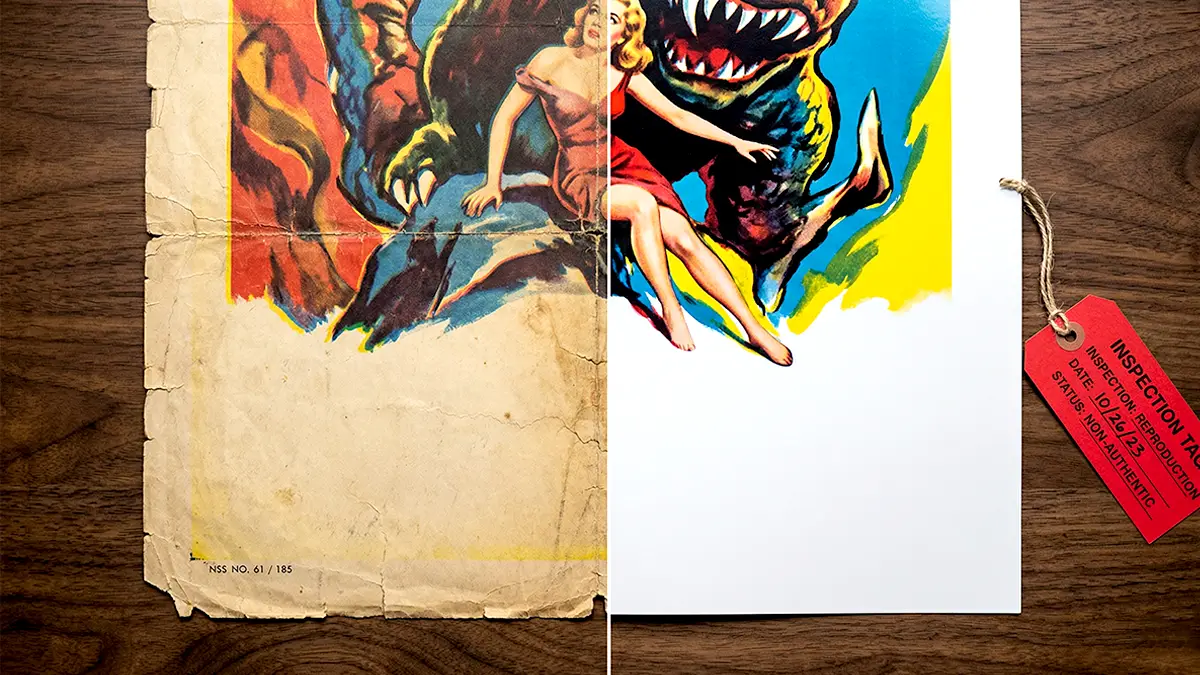
Fold lines are among the most telling indicators. Authentic theatrical posters were folded for shipping, producing crease patterns along consistent axes. These develop a characteristic aging patina — slight darkening along the crease — that is effectively impossible to replicate artificially.
Paper chemistry is equally diagnostic. Pre-1970s posters were printed on acidic paper that yellows predictably, producing warm amber toning in light areas. This follows paper fibre grain and is non-uniform — brighter near the centre, darker at edges. Reproductions on modern acid-free stock remain uniformly white with no gradient toning.
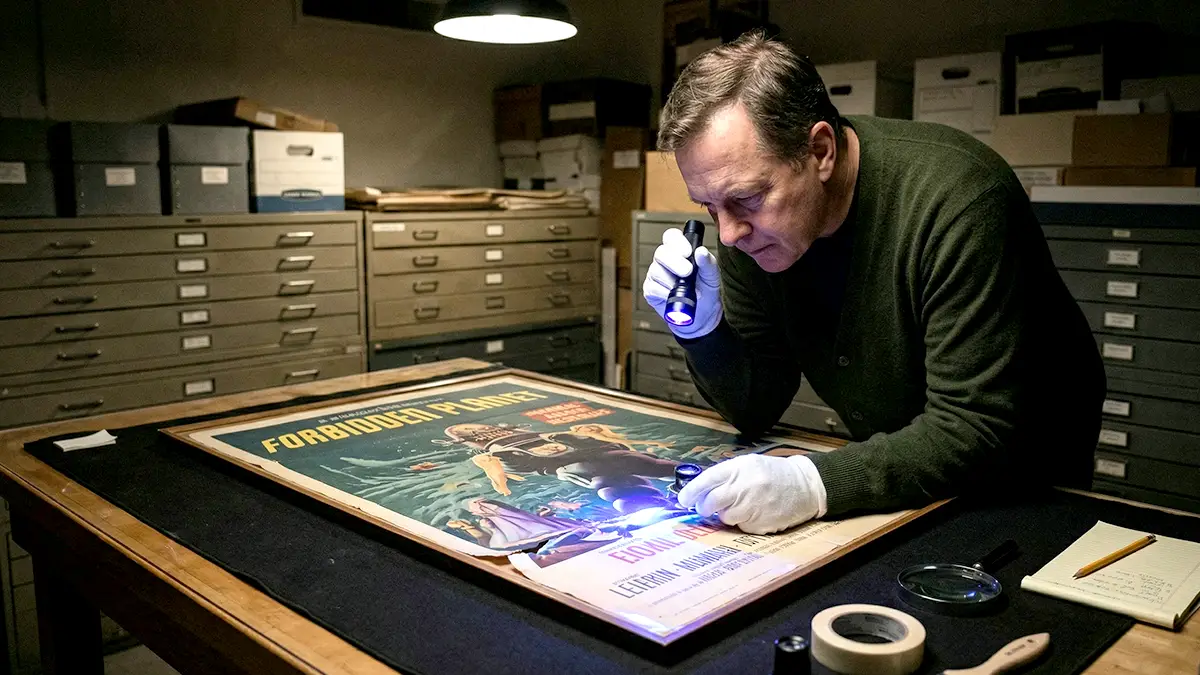
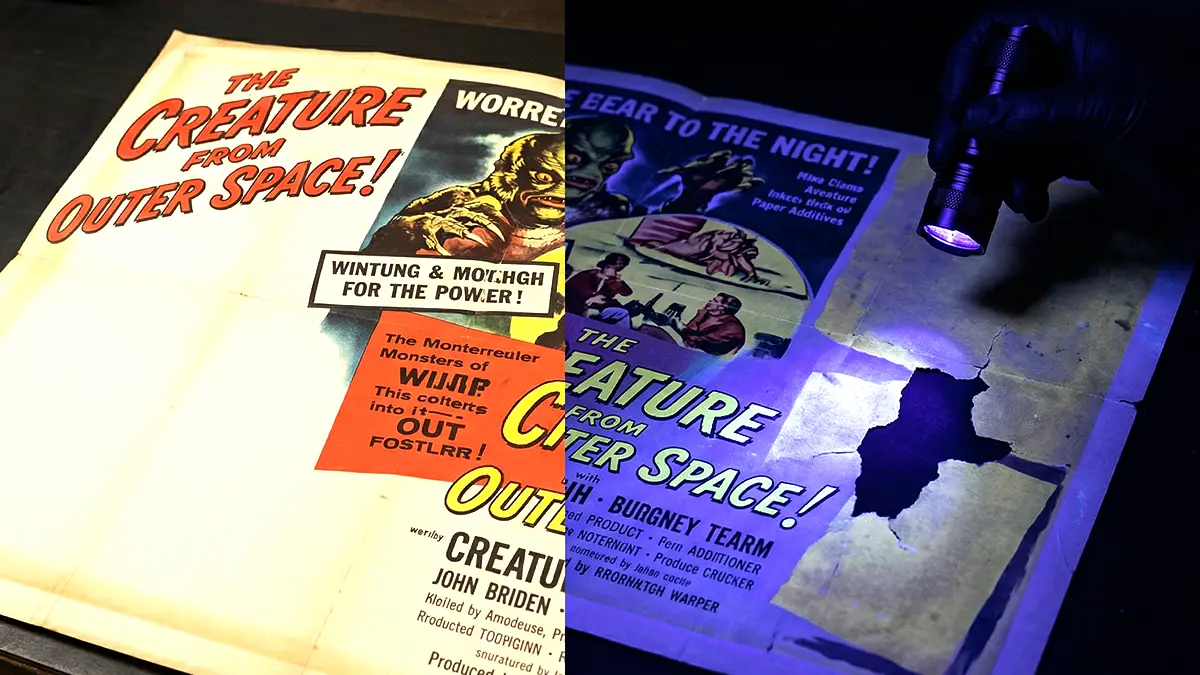
A UV/blacklight lamp (365nm) is indispensable for advanced examination. Modern optical brighteners — present in paper manufactured after approximately 1960 — fluoresce bright blue-white. Genuine pre-war posters appear dull or yellowish under UV. UV light also reveals restoration work: professionally repaired tears fluoresce differently from surrounding original paper.
Printing Methods Through the Decades
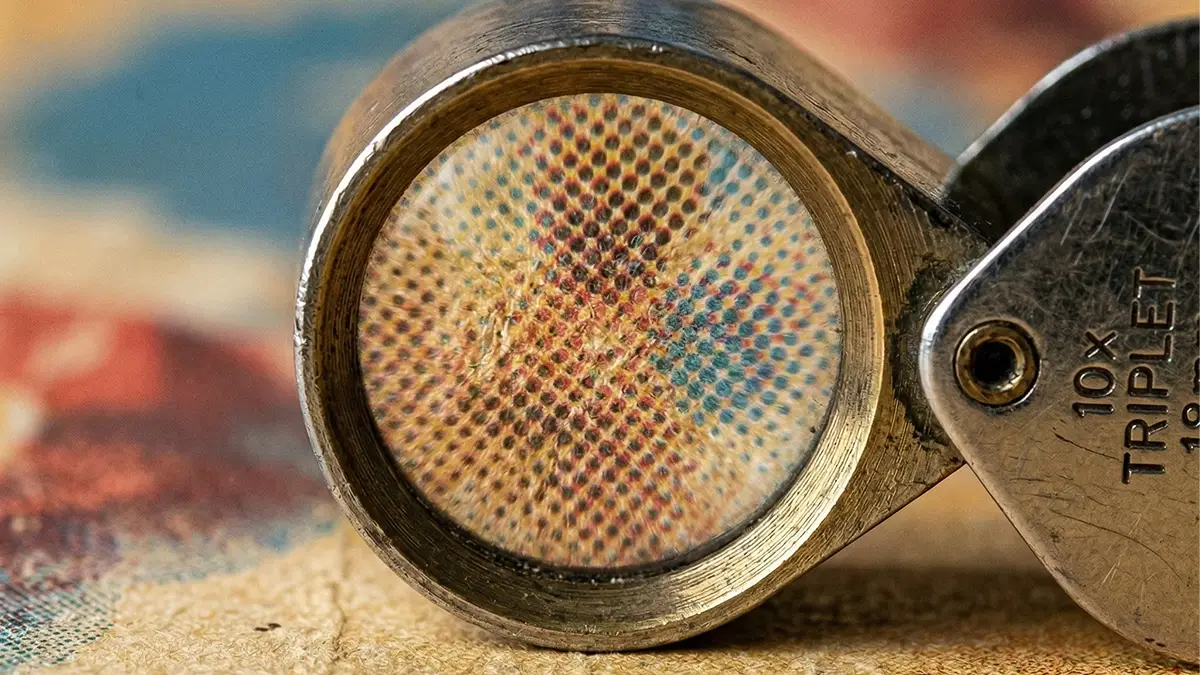
A 10× loupe magnifier is sufficient to distinguish the major printing methods used across collecting eras.
Stone lithography (dominant through the late 1930s) produces images without halftone dot patterns. Under magnification, it appears as continuous tone fields with soft, irregular edges — a product of the stone matrix and hand-inking process.
Offset lithography, standard from the 1940s and dominant by the 1950s, uses a CMYK halftone dot structure. Original offset-printed posters display halftone dots that are relatively large, slightly irregular, and arranged in rosette patterns at 65–100 lines per inch.
Modern digital reprints display either inkjet dot patterns (random droplets, no rosette) or extremely fine halftone screens at 150–300 lines per inch. These are visually distinct from period originals and are among the most reliable authentication markers available without laboratory access.
Size Standards for Original US Movie Posters
Dimensional accuracy is a critical authentication variable. Deviations from NSS size specifications are a reliable indicator of non-original material.
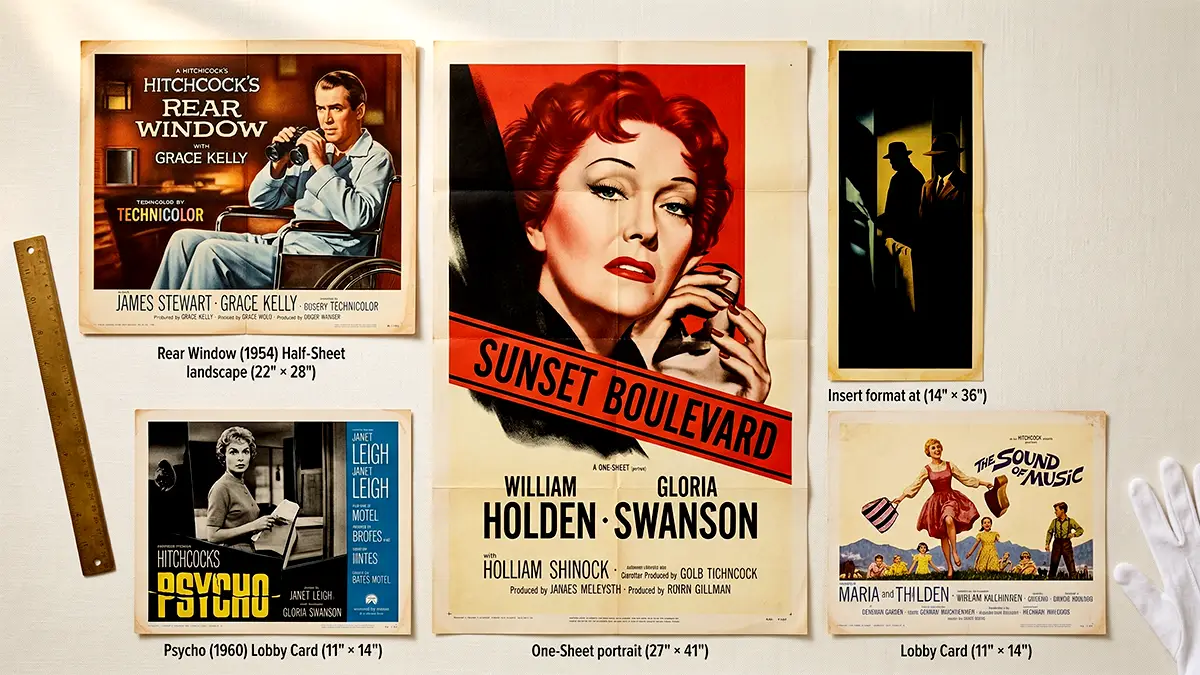
| Format | Dimensions | Orientation | Notes |
|---|---|---|---|
| One-Sheet (pre-1985) | 27″ × 41″ | Portrait | Most common format collected |
| One-Sheet (post-1985) | 27″ × 40″ | Portrait | Height reduced by 1″ |
| Half-Sheet | 22″ × 28″ | Landscape | Used in cinema lobby displays |
| Insert | 14″ × 36″ | Portrait | Tall narrow display case format |
| Lobby Card | 11″ × 14″ | Landscape | Sets of 8: 1 title + 7 scene cards |
Size inconsistency is a significant red flag. Reproductions are frequently produced at slightly reduced dimensions to fit standard printing equipment — detectable with any standard measuring tape.
Expert Authentication Resources
In the United States, Heritage Auctions maintains one of the largest publicly accessible databases of graded and authenticated movie posters, including condition reports and provenance documentation. Posteritati, a New York-based specialist gallery, publishes condition standards used across the collector community. Reel Art Press has produced scholarly volumes on theatrical poster history that serve as bibliographic references.
The Library of Congress Moving Image Section holds extensive NSS documentation that can cross-reference print runs, distribution formats, and release graphics for specific titles. The LAMP (Lobby Card Authentication & Movie Posters) community guidelines provide a practical framework for small-format theatrical materials.
Red Flags That Indicate a Reproduction
The following characteristics — individually or in combination — consistently indicate a reproduction rather than an original theatrical release item:
- Absent NSS number: Most US one-sheets from the 1940s–1970s carry an NSS job number in the bottom border. Its absence warrants scrutiny.
- Unnaturally vivid colour saturation: Colours brighter or more uniform than reference originals suggest modern printing.
- Perfect condition with no aging: Genuine originals show toning, edge wear, handling marks, or fold lines. A mint pre-1960 poster with no signs of aging is statistically improbable.
- Uniform paper thickness: Original period stock exhibits slight thickness variation. Reproduction commercial paper is dimensionally uniform.
- Inkjet or digital dot patterns: Visible under a 10× loupe; inconsistent with any pre-1990s printing technology.
- Non-standard dimensions: Any size deviation from known NSS format specifications is a red flag.
- Modern UV fluorescence: Bright blue-white glow under a 365nm lamp indicates optical brighteners absent from pre-1960s paper manufacturing.
- “Reprint” text in fine print: Often obscured or trimmed from examples offered as originals.
- Absent printer’s marks: Studio-era posters include printer attribution, union bug marks, and studio legal notices that reproductions frequently omit.
- Lamination or surface coating: Original theatrical posters were never laminated. Any applied gloss indicates post-production alteration.
Building a Trustworthy Collection
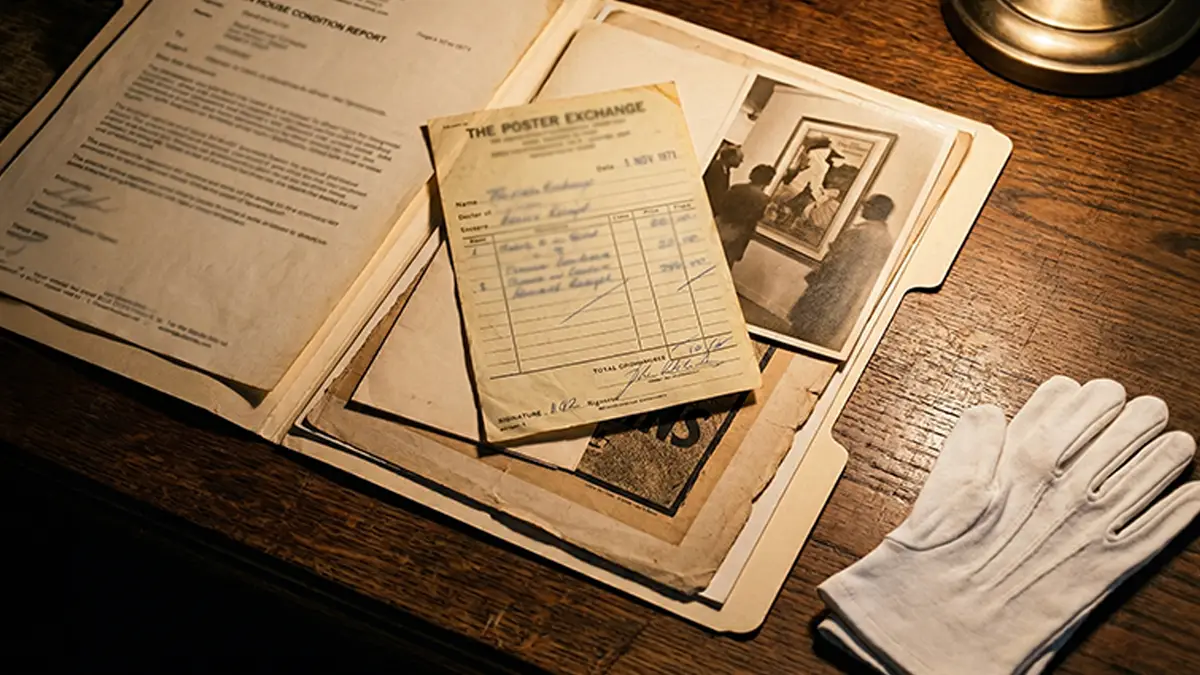
Provenance documentation — the paper trail tracing a poster’s ownership from its point of origin — is the strongest single indicator of authenticity. Auction house records, estate documentation, dealer invoices, and exhibition records all contribute. Collectors acquiring significant pieces should request all available documentation and preserve it alongside the physical artefact.
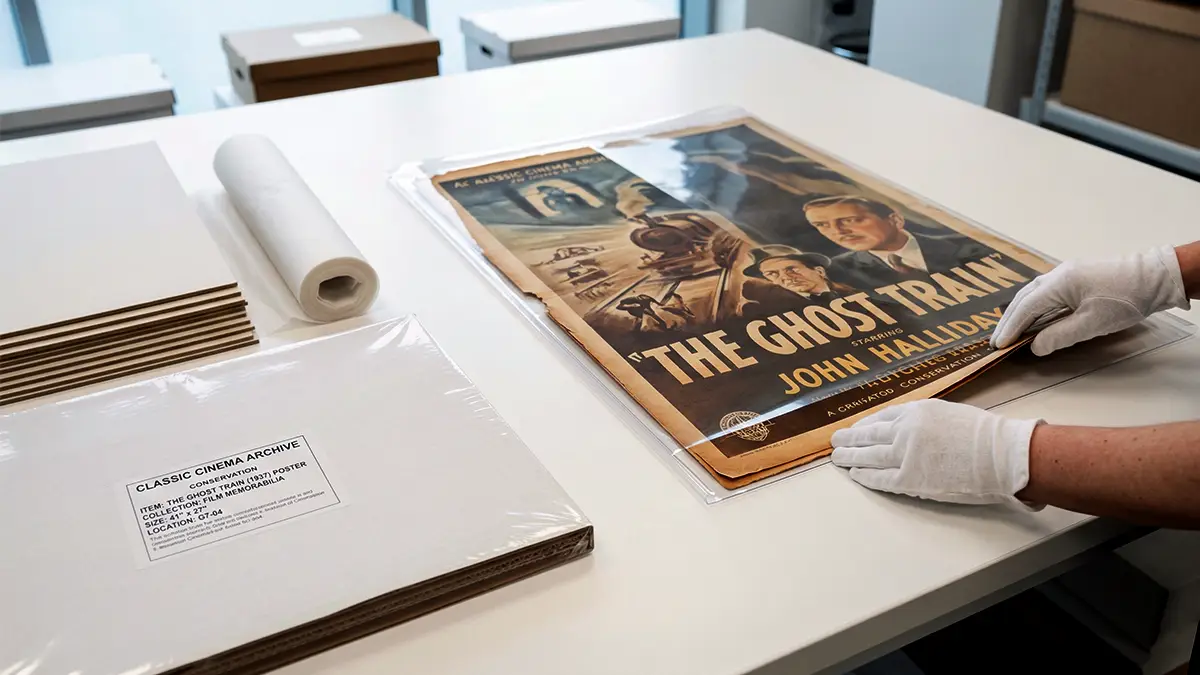
Authenticated originals require controlled storage. Industry-standard practice calls for acid-free backing boards, polyester (Mylar) encapsulation or archival sleeves, and stable-humidity, low-light environments. Linen backing — in which the poster is adhered to a stable linen support — is widely used for display-grade examples and, when performed by a qualified conservator, does not diminish value.
Established collector communities maintain active forums, authentication discussions, and peer review processes that assist both novice and experienced collectors. Participation in these communities remains one of the most effective long-term protections against acquiring inauthentic material.