
Muhammad Ali Print — Ali vs Sonny Liston Black and White Wall Art
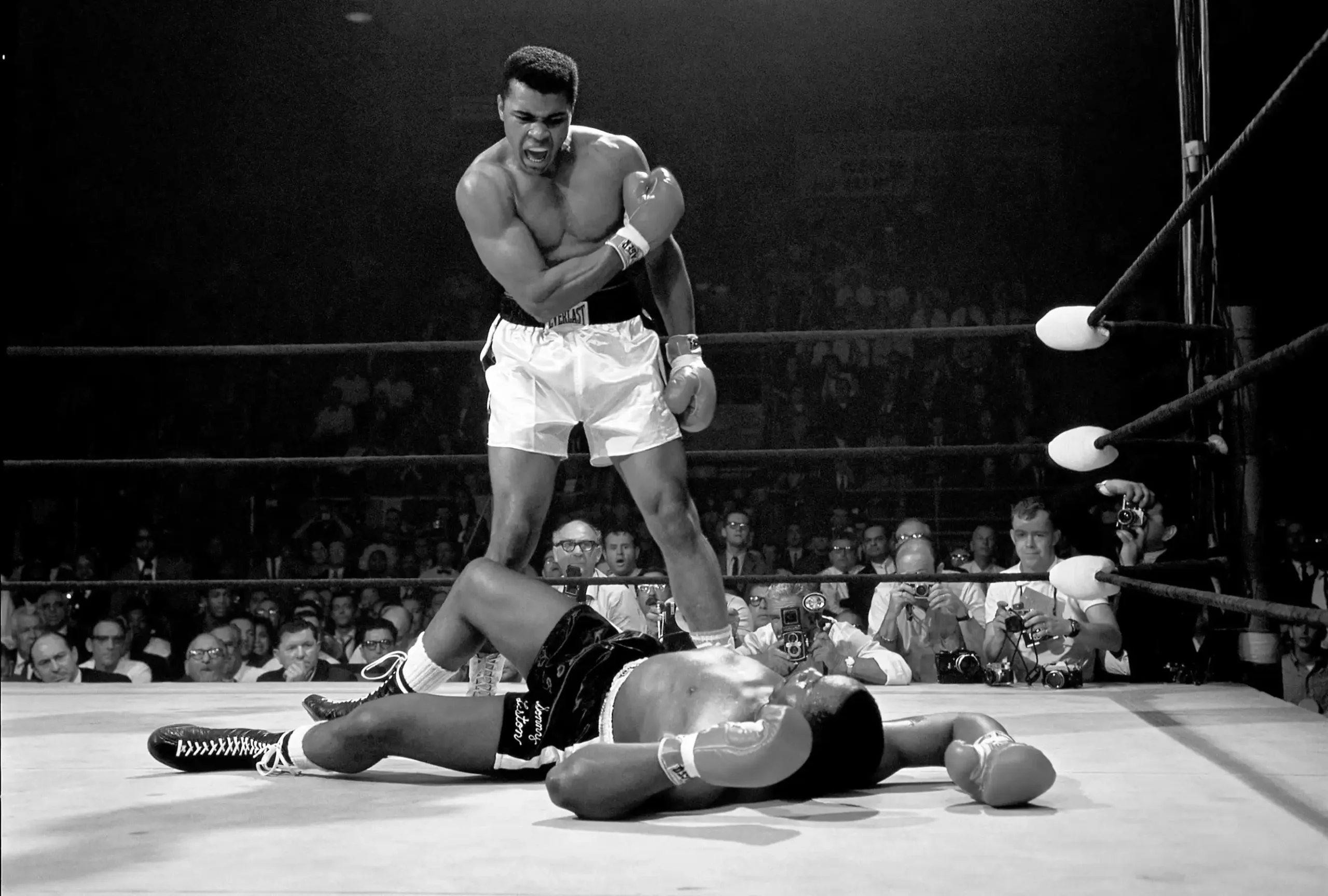
There are perhaps five or six sports photographs that have moved entirely beyond the category of sports photography. They no longer document an event — they have become the event, standing in for the whole of what they captured so completely that the original moment seems, now, to exist primarily as the occasion for the photograph. Neil Leifer’s image of Muhammad Ali standing over a fallen Sonny Liston on the night of May 25, 1965, in Lewiston, Maine, is one of those photographs. Ali is caught in the second after the first-round knockout, arm extended, mouth open in something between a shout and a command, looking down at a man who has just become the visual proof of everything Ali had said about himself. Below him, Liston is flat on the canvas, one arm raised in a gesture that reads, simultaneously, as defence and surrender. The composition — the standing figure and the fallen one, the arena lights catching the sweat on Ali’s skin, the crowd a grey blur behind both men — is so formally perfect that it seems designed rather than captured. This Muhammad Ali vs Sonny Liston print brings that composition to your wall in the only format it has ever truly belonged: black and white, large, museum quality.
Printed on 200 GSM museum-grade matte paper with fade-resistant archival inks, this Muhammad Ali black and white wall art delivers the full tonal range of great sports photography — available in seven frame-ready sizes from $9.90. Digital download (300 DPI, PDF/JPG) at $3.90.
What You will Receive
- Made to order, museum-grade art print. Frame not included unless stated.
- Printed on 200 GSM premium matte paper for crisp detail and zero glare.
- Archival giclée inks that resist fading for decades.
- Multiple size options. Use the selector above.
- Protective packaging: rigid mailer or sturdy tube.
Print Quality
Every print is produced using state-of-the-art giclée technology on heavyweight 200 GSM matte paper. The non-reflective surface eliminates glare while the archival pigment inks deliver rich, accurate colours designed to last a lifetime.
Size Guide
For walls above furniture, choose a print roughly two thirds to three quarters the width of the piece below it. Smaller sizes up to 11x14 inches suit gallery walls. Larger formats of 18x24 inches and above create striking focal points.
Verified Customer Reviews
Shipping
Every order is printed on demand. Processing takes 3 to 5 business days, then ships free worldwide with tracking.
| Region | Processing | Delivery | Total |
|---|---|---|---|
| USA | 3 to 5 days | 2 to 6 days | 5 to 11 days |
| Canada | 3 to 5 days | 5 to 10 days | 8 to 15 days |
| UK and Europe | 3 to 5 days | 5 to 10 days | 8 to 15 days |
| Australia and NZ | 3 to 5 days | 8 to 15 days | 11 to 20 days |
| Asia | 3 to 5 days | 7 to 15 days | 10 to 20 days |
| Rest of world | 3 to 5 days | 10 to 20 days | 13 to 25 days |
📦 Packaging
Prints up to 12x18 inches ship flat in rigid cardboard mailers with backing board. Larger prints are rolled in sturdy tubes with protective end caps. Every package includes moisture barriers and Handle With Care labels.
Returns and Replacements
- 30 day return window from delivery. No questions asked.
- Report damage within 48 hours with photos for a free replacement.
- Full refunds for eligible returns in original condition.
- Cancel before production starts for a complete refund.
- Return shipping covered for defective or incorrect items.
Need help? info.merchfuse@gmail.com
How to Care for Your Print
Follow these steps to keep your print looking gallery fresh for decades.
Handling
Allow rolled prints to relax flat for 30 to 60 minutes. Handle by the edges with clean, dry hands and avoid touching the printed surface.
Placement
Avoid direct sunlight, heat sources and high humidity areas. North facing walls receive less UV. Use LED or incandescent lighting instead of fluorescent.
Framing
Use acid free mats and UV protective glass or acrylic for maximum longevity. Leave a small gap between print and glazing for airflow.
Cleaning
Dust framed glass with a soft cloth. Spray the cloth, not the glass. For unframed prints, use a dry microfibre cloth and never apply liquids to the surface.
Climate
Keep temperature at 18 to 24 degrees C and humidity at 40 to 60 percent. Avoid attics, basements and garages where conditions swing widely.
Storage
Store flat in acid free folders, interleaved with tissue paper, in a cool dark place. Never fold. Check stored prints annually.
⚠️ Avoid
- Prolonged direct sunlight or fluorescent lighting.
- Bathrooms, kitchens and areas above heat sources.
- Tape, adhesives or liquids applied directly to the print.
- Rolling with the image facing inward as this can crack the ink layer.
- Extreme or rapid temperature and humidity changes.
📊 Expected Lifespan
- 100+ years when framed with UV protective glazing and indirect light.
- 50 to 75 years when framed with standard glass and indirect light.
- 25 to 50 years when stored correctly in darkness.
The history of sports photography has a handful of images that have outlived sport itself — photographs so compositionally powerful, so charged with human meaning, that they function as works of art in the oldest sense: representations of something universal caught in the skin of something specific. The 1965 Ali–Liston rematch, fought in a converted hockey rink in Lewiston before a crowd of fewer than 2,500 people, produced the most famous such image in the history of boxing, and arguably in the history of sports photography entire. Neil Leifer, positioned at ringside at precisely the right angle, made an image of Muhammad Ali standing over a fallen Sonny Liston that has been reproduced more times than any other boxing photograph and that still, after sixty years, has the quality of stopping you. This Muhammad Ali print is that image — rendered in the high-contrast black and white monochrome that is its natural element, printed at the resolution and on the paper stock that the image demands.
What the Muhammad Ali vs Sonny Liston print captures is not simply a sporting moment but a statement. Ali had spent the months before the fight arguing, with characteristic insistence, that he was the greatest fighter who had ever lived. The first-round knockout — the so-called “phantom punch,” disputed by commentators at the time and analysed by sports historians ever since — ended the fight before most of the crowd had properly settled in their seats. And then Leifer made his photograph, and the argument was over. The image said, more clearly than any words could, exactly what Ali had been saying: here is a man who has beaten the most feared fighter of his era so completely that the beaten man is flat on the canvas while the winner is already demanding acknowledgement from the world. The composition — Ali’s outstretched arm, his open mouth, the ringside lights, the fallen Liston — is not the image of a boxing match. It is the image of a man who was right about himself.
As vintage sports photography print, this Muhammad Ali black and white wall art belongs to a specific and distinguished tradition. The great sports photographs of the mid-twentieth century — shot in black and white, published in Life and Sports Illustrated, printed in the darkroom and hung in gymnasiums and offices and bars — were never merely documentary. They were arguments, made in light and shadow, about what sport was for: the test of a human being against another human being, the drama of preparation and training and nerve made visible in a single fraction of a second. This boxing photography print is in that tradition. The black and white treatment strips away everything that would locate the image in 1965 — the colour of the ring, the specific palette of the arena — and leaves the pure grammar of the photograph: two bodies, one standing and one fallen, light coming from above, the crowd irrelevant in the background.
The Muhammad Ali print as wall art works with particular force in spaces that have been thought about carefully. In a home gym or training space, it is the obvious choice — the image of what training is for, hanging on the wall above the weights and the heavy bag, a reminder that the fight is the point. In a living room or study, it is one of those photographs that anchors a wall the way a piece of music anchors a room — defining the space around it, giving it a particular gravity. In a bar or restaurant, it has the quality that great sports photography always carries in that context: it gives people something to look at, something to agree about, something to argue about. The Ali–Liston photograph has been argued about since 1965 and has lost none of its argumentative energy. Hanging it is an invitation to the conversation.
Black and white is the only format for this image. The original Leifer photograph was shot on colour film — there is a colour version, and it is a fine photograph. But the monochrome version has become the definitive one, because black and white gives the image the quality it needs: the flat, formal, documentary authority of a historical record, combined with the graphic power of a composition that would hold its own in any gallery. The high-contrast tonal range of this vintage sports photography print — the white of Ali’s shorts and boots against the darkness of the canvas, the grey of the arena crowd, the specific luminosity of Ali’s skin under the ring lights — is precisely what museum-quality archival printing on 200 GSM matte paper is designed to reproduce. Every shade in Leifer’s original is present. The image does not fade, does not yellow, does not lose resolution at any of the seven available sizes.
For boxing fans, for collectors of sports photography, for anyone who wants to put a genuinely significant image on their wall — not a poster, not a reproduction of a reproduction, but the photograph itself at print quality — this Muhammad Ali vs Sonny Liston print is the definitive choice.
Why This Boxing Photography Print Stands Out
- The definitive sports photograph: Neil Leifer’s Ali–Liston image is one of the most reproduced sports photographs in history — and the most formally powerful boxing photograph ever made. This print brings it to your wall at museum quality.
- Black and white treatment: Monochrome strips away the period detail and gives the image its full documentary authority — the high-contrast formal grammar of great mid-century sports photography.
- Vintage sports photography print: Printed in the tradition of the great darkroom prints that hung in gyms, bars, and offices in the 1960s — but on modern 200 GSM museum-grade matte paper with archival inks that will not fade or yellow.
- Print quality: 200 GSM museum-grade matte paper, fade-resistant archival inks, glare-free finish — seven standard frame-ready sizes from 9×11″ to 24×36″ at 300 DPI throughout.
- Sizes & options: Seven frame-ready sizes from $9.90. Digital download (300 DPI, PDF/JPG) at $3.90.
- Perfect for: Boxing fans; sports photography collectors; home gyms and training spaces; living rooms, studies, and home bars; gifts for boxing enthusiasts and sports history admirers; anyone who wants a genuinely significant photograph on their wall.
Where to Hang This Muhammad Ali Black and White Wall Art
The compositional strength of this boxing photography print — the vertical drama of the standing figure above the fallen one, the ringside lights catching the sweat and muscle and movement — reads powerfully at any scale. In a home gym it functions as both decoration and motivation: the image of what the work is for, distilled to a single fraction of a second. On the main wall of a living room or study, mounted in a wide black frame with a generous mat, it carries the authority of a gallery print — visitors will stop and look, and then want to talk about it. Above a bar cart or in a bar area, it has exactly the right combination of historical weight and visual drama. A thin black floating frame gives it a sharp, editorial quality; a wider museum mat and light wood frame gives it the gallery treatment the photograph has always deserved.
More from MerchFuse
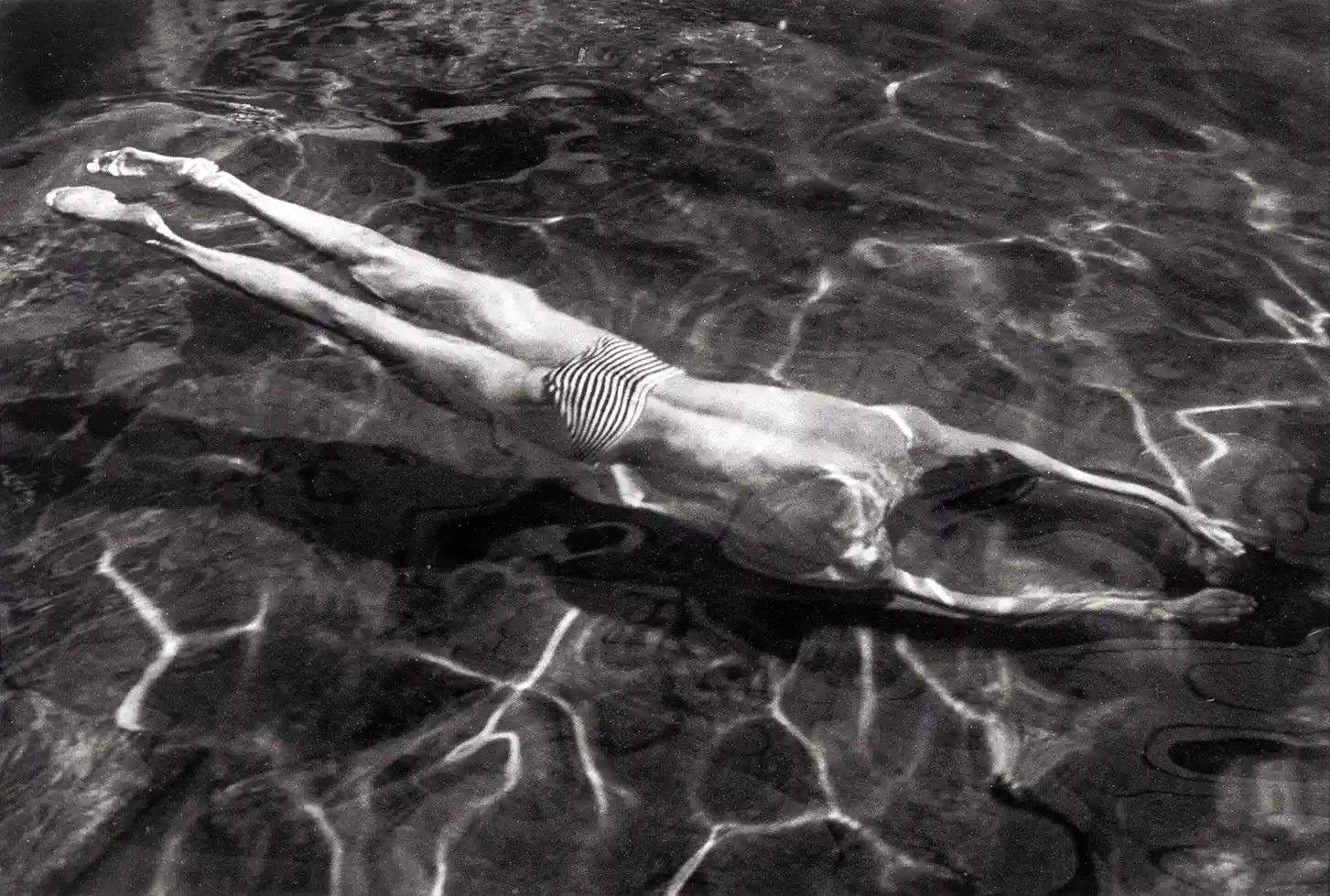
The Ali–Liston image is the defining photograph of Ali in victory, but the full visual history of Muhammad Ali runs much wider and deeper than any single fight. The Muhammad Ali boxing legend poster — iconic underwater training photo captures a completely different register of the Ali visual archive: Ali in training, submerged in a swimming pool, the image equal parts athletic documentary and surrealist art — the greatest heavyweight in history, preparing for the fight in the most unexpected way. For the wider story of Ali at the peak of his powers in the ring, the When We Were Kings movie poster — Muhammad Ali intense close-up art is the essential companion piece: the documentary film about the Rumble in the Jungle, and the portrait of Ali in the year he reclaimed the heavyweight championship, made into wall art of equal ambition. For collectors who want to extend the boxing photography theme beyond Ali, the Jack Dempsey vs Carpentier boxing poster — vintage heavyweight art print reaches back to 1921 and the first sports event to draw a million-dollar gate, capturing the older tradition of boxing poster art that Ali’s generation would eventually transform into photography.
Print & Material Details
Every MerchFuse vintage sports photography print is produced on 200 GSM museum-grade matte paper with fade-resistant archival inks that hold the full tonal scale of the original black and white photography — from the deepest shadow to the brightest highlight — across all seven sizes from 9×11″ to 24×36″. Standard frame dimensions throughout. The 300 DPI digital download (PDF/JPG) is available for $3.90.
Related products
Price range: $3.90 through $74.90
Price range: $3.90 through $74.90
Price range: $3.90 through $74.90
Price range: $3.90 through $74.90
Price range: $3.90 through $74.90
Price range: $3.90 through $74.90
Price range: $3.90 through $74.90
Price range: $3.90 through $74.90