
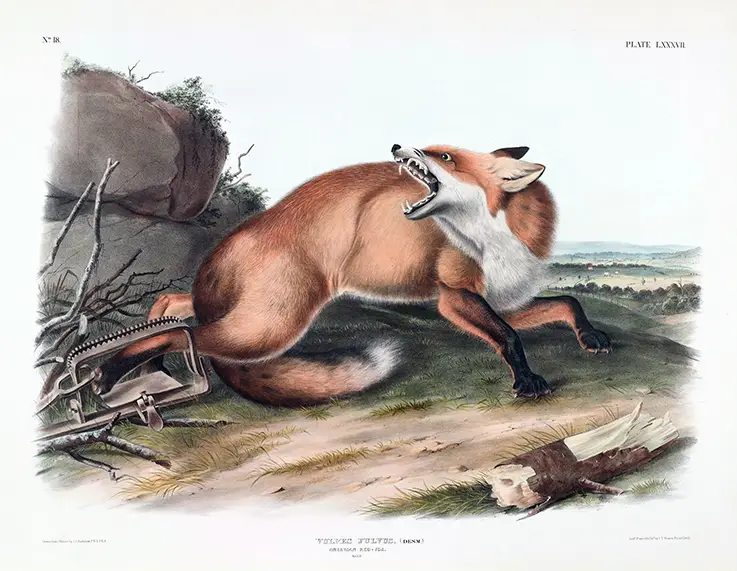
Classic Audubon Fox Print – American Red Fox 1846 Wildlife Wall Art
Audubon Fox Print features a highly detailed 1846 lithograph of a snarling American Red Fox in the wild. This vintage wildlife lithograph is produced on museum-grade matte paper using archival inks.
What You Will Receive
- Made to order, museum-grade art print. Frame not included unless stated.
- Printed on 200 GSM premium matte paper for crisp detail and zero glare.
- Archival giclée inks that resist fading for decades.
- Multiple size options. Use the selector above.
- Protective packaging: rigid mailer or sturdy tube.
Print Quality
Every print is produced using state-of-the-art giclée technology on heavyweight 200 GSM matte paper. The non-reflective surface eliminates glare while the archival pigment inks deliver rich, accurate colours designed to last a lifetime.
Size Guide
For walls above furniture, choose a print roughly two thirds to three quarters the width of the piece below it. Smaller sizes up to 11×14 inches suit gallery walls. Larger formats of 18×24 inches and above create striking focal points.
Verified Customer Reviews
Shipping
Every order is printed on demand. Processing takes 3 to 5 business days, then ships free worldwide with tracking.
| Region | Processing | Delivery | Total |
|---|---|---|---|
| USA | 3–5 days | 2–6 days | 5–11 days |
| Canada | 3–5 days | 5–10 days | 8–15 days |
| UK & Europe | 3–5 days | 5–10 days | 8–15 days |
| Australia & NZ | 3–5 days | 8–15 days | 11–20 days |
| Asia | 3–5 days | 7–15 days | 10–20 days |
| Rest of world | 3–5 days | 10–20 days | 13–25 days |
📦 Packaging
Prints up to 12×18 inches ship flat in rigid cardboard mailers with backing board. Larger prints are rolled in sturdy tubes with protective end caps. Every package includes moisture barriers and Handle With Care labels.
Returns and Replacements
- 30-day return window from delivery. No questions asked.
- Report damage within 48 hours with photos for a free replacement.
- Full refunds for eligible returns in original condition.
- Cancel before production starts for a complete refund.
- Return shipping covered for defective or incorrect items.
Need help? info.merchfuse@gmail.com
How to Care for Your Print
Follow these steps to keep your print looking gallery fresh for decades.
Handling
Allow rolled prints to relax flat for 30 to 60 minutes. Handle by the edges with clean, dry hands and avoid touching the printed surface.
Placement
Avoid direct sunlight, heat sources and high humidity areas. North-facing walls receive less UV. Use LED or incandescent lighting instead of fluorescent.
Framing
Use acid-free mats and UV protective glass or acrylic for maximum longevity. Leave a small gap between print and glazing for airflow.
Cleaning
Dust framed glass with a soft cloth. Spray the cloth, not the glass. For unframed prints, use a dry microfibre cloth and never apply liquids to the surface.
Climate
Keep temperature at 18–24 °C and humidity at 40–60%. Avoid attics, basements and garages where conditions swing widely.
Storage
Store flat in acid-free folders, interleaved with tissue paper, in a cool dark place. Never fold. Check stored prints annually.
⚠️ Avoid
- Prolonged direct sunlight or fluorescent lighting.
- Bathrooms, kitchens and areas above heat sources.
- Tape, adhesives or liquids applied directly to the print.
- Rolling with the image facing inward as this can crack the ink layer.
- Extreme or rapid temperature and humidity changes.
📊 Expected Lifespan
- 100+ years when framed with UV protective glazing and indirect light.
- 50–75 years when framed with standard glass and indirect light.
- 25–50 years when stored correctly in darkness.
The Audubon Fox Print remains a significant example of 19th-century scientific illustration, documenting the American Red Fox (Vulpes fulvus) with unprecedented anatomical rigor. Originally published in 1846 as part of John James Audubon’s ambitious project, The Viviparous Quadrupeds of North America, this plate captures a raw and visceral moment in the life of a forest predator. The image shows a male red fox with its rear leg firmly gripped by a heavy iron trap, its body coiled in a mixture of pain and defensive aggression. This antique fox illustration is a departure from the static poses common in natural history catalogs of the era, choosing instead to portray the animal in a state of high emotional and physical tension.
Significance of the Audubon Fox Print in Natural History
As a foundational piece of John James Audubon art, this lithograph was produced during a period when the documentation of North American fauna was transitioning from hobbyist sketches to rigorous scientific study. The collaboration between Audubon and the Reverend John Bachman resulted in a series of plates that provided a definitive look at the mammals of the continent. The Audubon Fox Print is particularly noted for its rendering of the fox’s fur, which transitions from deep burnt sienna and ochre to the creamy whites of the underbelly and the dark charcoal tones of the lower limbs. Every whisker and muscle fiber is visible, a testament to the meticulous stone lithography process used in the mid-1800s.
Technical Restoration and Material Quality
Our reproduction of this vintage wildlife lithograph has undergone a careful digital restoration process to ensure clarity while preserving the authentic character of the original 1846 publication. We focus on maintaining the subtle chromatic variations and the fine line work that defined the imperial folio editions. To ensure this artwork endures for years to come, we utilize the following specifications:
- 200 GSM museum-grade matte paper for a non-reflective, premium finish.
- Fade-resistant archival inks that maintain color integrity over time.
- 300 DPI high-resolution capture of the original lithographic plate.
- Standard frame-ready dimensions for ease of installation.
The terrain depicted in the Audubon Fox Print provides a somber backdrop to the central drama. Rough rock formations and skeletal branches frame the fox, while a distant vista shows a rolling topography under a pale sky. This environmental detail was a hallmark of Audubon’s style, providing context for the species’ habitat. By integrating this natural history wall decor into a study, library, or office, you bring a sense of historical inquiry and traditional aesthetic to the room. The print serves as a conversation piece regarding early American naturalism and the evolution of wildlife conservation.
For those interested in the history of North American exploration, the American Red Fox 1846 plate represents the culmination of years of field research. John James Audubon art often reflected the harsh realities of the frontier, including the interactions between humans and animals. The presence of the steel trap in this Audubon Fox Print is a direct reference to the fur trade and the environmental pressures of the 19th century. This specific print is favored by collectors who appreciate the intersection of biology, history, and fine art, as it avoids the sanitized depictions of nature often found in modern décor.
The Audubon Fox Print is also available as a high-resolution digital download for those who prefer to manage their own printing or use the image for educational purposes. At 300 DPI, the digital file retains the sharpness necessary for large-format reproduction. Whether you select the physical print or the digital version, you are receiving an accurate representation of one of the most famous plates from the Quadrupeds series. The snarling defiance of the fox and the detailed rendering of its anatomy make this one of the most striking images in the entire Audubon catalog.
This is fan-inspired artwork and an original artistic interpretation. It is not affiliated with, endorsed by, or officially licensed by any studio, production company, label, artist, photographer, or rights holder.
Price range: $3.90 through $74.90
Price range: $3.90 through $74.90
Price range: $3.90 through $74.90
Price range: $3.90 through $74.90