
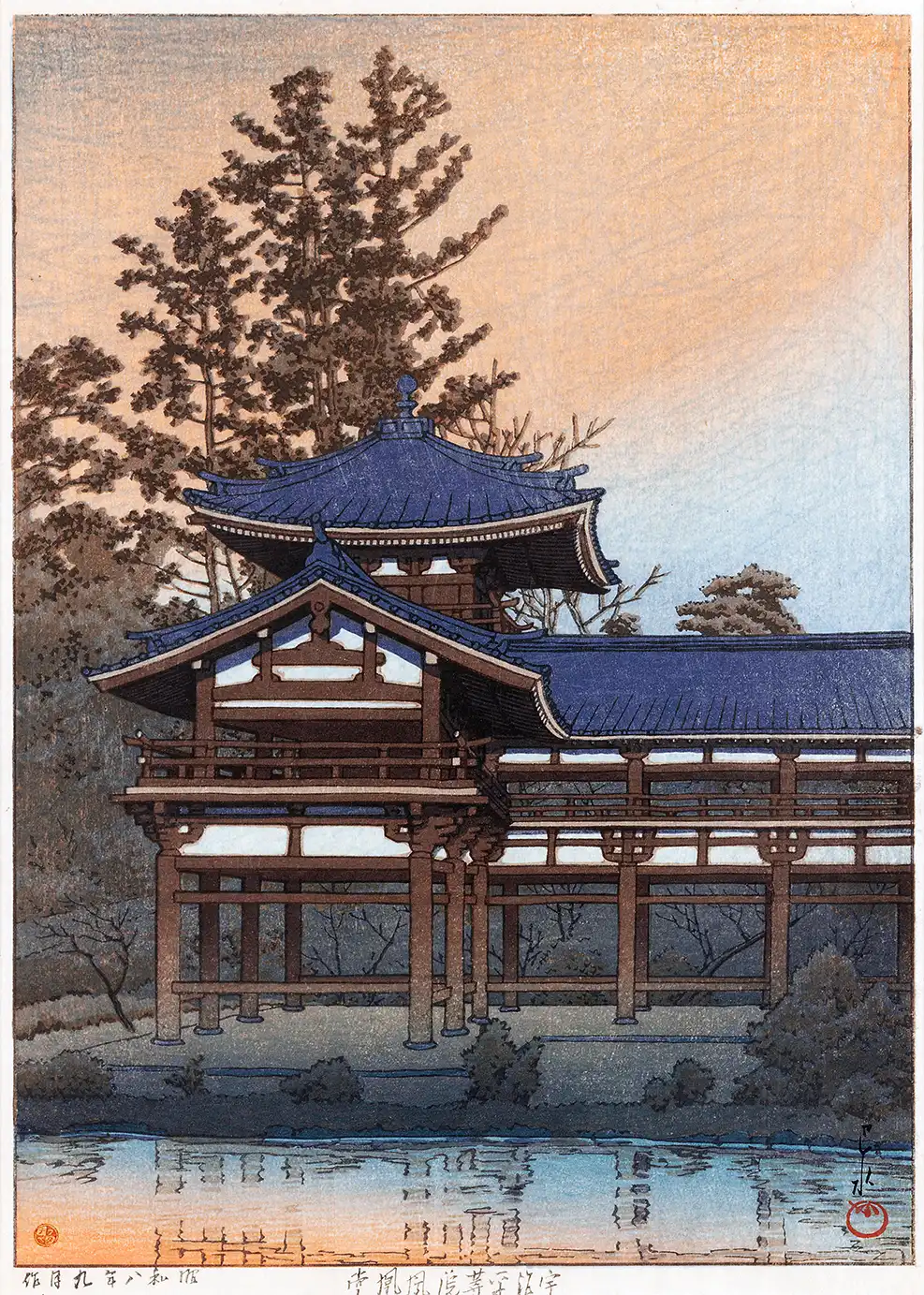
Byodo-in Temple Print – Authentic: 1933 Uji Kyoto Woodblock Wall Art
The Byodo-in Temple Print provides a meticulous visual record of the 1933 Uji landscape at dusk. This archival Shin-hanga wall decor is produced on museum-grade matte paper for long-lasting clarity.
What You Will Receive
- Made to order, museum-grade art print. Frame not included unless stated.
- Printed on 200 GSM premium matte paper for crisp detail and zero glare.
- Archival giclée inks that resist fading for decades.
- Multiple size options. Use the selector above.
- Protective packaging: rigid mailer or sturdy tube.
Print Quality
Every print is produced using state-of-the-art giclée technology on heavyweight 200 GSM matte paper. The non-reflective surface eliminates glare while the archival pigment inks deliver rich, accurate colours designed to last a lifetime.
Size Guide
For walls above furniture, choose a print roughly two thirds to three quarters the width of the piece below it. Smaller sizes up to 11×14 inches suit gallery walls. Larger formats of 18×24 inches and above create striking focal points.
Verified Customer Reviews
Shipping
Every order is printed on demand. Processing takes 3 to 5 business days, then ships free worldwide with tracking.
| Region | Processing | Delivery | Total |
|---|---|---|---|
| USA | 3–5 days | 2–6 days | 5–11 days |
| Canada | 3–5 days | 5–10 days | 8–15 days |
| UK & Europe | 3–5 days | 5–10 days | 8–15 days |
| Australia & NZ | 3–5 days | 8–15 days | 11–20 days |
| Asia | 3–5 days | 7–15 days | 10–20 days |
| Rest of world | 3–5 days | 10–20 days | 13–25 days |
📦 Packaging
Prints up to 12×18 inches ship flat in rigid cardboard mailers with backing board. Larger prints are rolled in sturdy tubes with protective end caps. Every package includes moisture barriers and Handle With Care labels.
Returns and Replacements
- 30-day return window from delivery. No questions asked.
- Report damage within 48 hours with photos for a free replacement.
- Full refunds for eligible returns in original condition.
- Cancel before production starts for a complete refund.
- Return shipping covered for defective or incorrect items.
Need help? info.merchfuse@gmail.com
How to Care for Your Print
Follow these steps to keep your print looking gallery fresh for decades.
Handling
Allow rolled prints to relax flat for 30 to 60 minutes. Handle by the edges with clean, dry hands and avoid touching the printed surface.
Placement
Avoid direct sunlight, heat sources and high humidity areas. North-facing walls receive less UV. Use LED or incandescent lighting instead of fluorescent.
Framing
Use acid-free mats and UV protective glass or acrylic for maximum longevity. Leave a small gap between print and glazing for airflow.
Cleaning
Dust framed glass with a soft cloth. Spray the cloth, not the glass. For unframed prints, use a dry microfibre cloth and never apply liquids to the surface.
Climate
Keep temperature at 18–24 °C and humidity at 40–60%. Avoid attics, basements and garages where conditions swing widely.
Storage
Store flat in acid-free folders, interleaved with tissue paper, in a cool dark place. Never fold. Check stored prints annually.
⚠️ Avoid
- Prolonged direct sunlight or fluorescent lighting.
- Bathrooms, kitchens and areas above heat sources.
- Tape, adhesives or liquids applied directly to the print.
- Rolling with the image facing inward as this can crack the ink layer.
- Extreme or rapid temperature and humidity changes.
📊 Expected Lifespan
- 100+ years when framed with UV protective glazing and indirect light.
- 50–75 years when framed with standard glass and indirect light.
- 25–50 years when stored correctly in darkness.
The Byodo-in Temple Print provides a meticulous visual record of the historic Phoenix Hall in Uji, captured during the height of the Japanese Shin-hanga movement in 1933. This specific rendering focuses on the architectural geometry of the Amida Hall, commonly known as Hoodo. The composition utilizes a low-angle perspective that emphasizes the horizontal breadth of the wooden corridors and the weight of the multi-tiered gable roofs. Rendered with the precision characteristic of early twentieth-century woodblock artisans, the image documents the structural integrity of the Heian-period temple complex as it appeared nearly a century ago.
Historical Significance of the Byodo-in Temple Print
Founded in 1052 by Fujiwara no Michinaga, the Byodo-in remains one of the few surviving examples of Heian architecture. This Byodo-in Temple Print documents the site before modern restorations, showcasing the weathered patina of the wood and the specific saturation of the indigo roof tiles that define its profile. The hall was originally designed to represent the Pure Land Paradise, and the 1933 artist utilizes color gradients to reinforce this celestial association. The reflection in the foreground pond is not merely a stylistic choice but a literal representation of the Aji-ike pond, designed to simulate the palace of the Buddha.
The Shin-hanga Movement and Visual Aesthetic
Collectors of fine Japanese woodblock art often seek out the Byodo-in Temple Print for its adherence to the ‘New Prints’ philosophy. Unlike the traditional Ukiyo-e style, Shin-hanga integrated Western elements such as atmospheric perspective and realistic light effects. You can observe this in the sky, where the transition from a soft peach horizon to a pale blue zenith suggests the cooling temperatures of a Kyoto evening. The use of negative space in the water allows the viewer to focus on the rhythmic repetition of the wooden support pillars, a hallmark of traditional Buddhist temple construction.
The vegetation surrounding the hall consists of tall, dark conifers that provide a vertical counterpoint to the sprawling architecture. These trees are rendered with deep charcoal and forest green pigments, creating a stark silhouette against the fading daylight. Owning a Byodo-in Temple Print allows enthusiasts to appreciate the delicate balance between man-made structures and the natural environment of the Uji-Renge district. Every line in the wood grain of the temple is visible, highlighting the technical skill required to carve the original wooden blocks used for these impressions.
Technical Specifications and Archival Standards
Our reproduction of this 1933 Japanese woodblock art adheres to strict museum standards to ensure the longevity of the image. The Byodo-in Temple Print is produced using the following specifications:
- Paper: 200 GSM museum-grade matte paper with a smooth, glare-free finish.
- Inks: Professional-grade archival inks resistant to UV degradation and fading.
- Clarity: High-resolution scans that preserve the original woodblock texture and ink bleed.
- Format: Standard sizing suitable for immediate framing in professional or home galleries.
The Byodo-in Temple Print is an essential addition for those interested in vintage Buddhist architecture or the history of Kyoto’s religious sites. Because the original work was created during an era of significant cultural shift in Japan, the print serves as a bridge between ancient spiritual traditions and modern artistic techniques. The saturation of the blue pigments in the roof tiles is particularly noteworthy, as it mimics the natural mineral dyes used by traditional printers. Whether displayed in a formal study or a quiet living space, this print provides a focal point of historical inquiry and geographic beauty.
As part of our commitment to quality, the Byodo-in Temple Print undergoes a rigorous color-matching process to ensure the peach and indigo tones remain true to the 1933 original. The lack of human figures in the composition directs all attention to the silence of the temple grounds, inviting a contemplative viewing experience. This piece of Shin-hanga wall decor functions as a portal into the pre-war landscape of Japan, offering a view that remains largely unchanged in its spiritual essence today.
Order your Byodo-in Temple Print today to secure a piece of Japanese heritage. This is fan-inspired artwork and an original artistic interpretation. It is not affiliated with, endorsed by, or officially licensed by any studio, production company, label, artist, photographer, or rights holder.
Price range: $3.90 through $74.90
Price range: $3.90 through $74.90
Price range: $3.90 through $74.90
Price range: $3.90 through $74.90