
Classic Hasui Kawase Snow Print – 1933 Nezu-Gongen Shrine Japanese Art
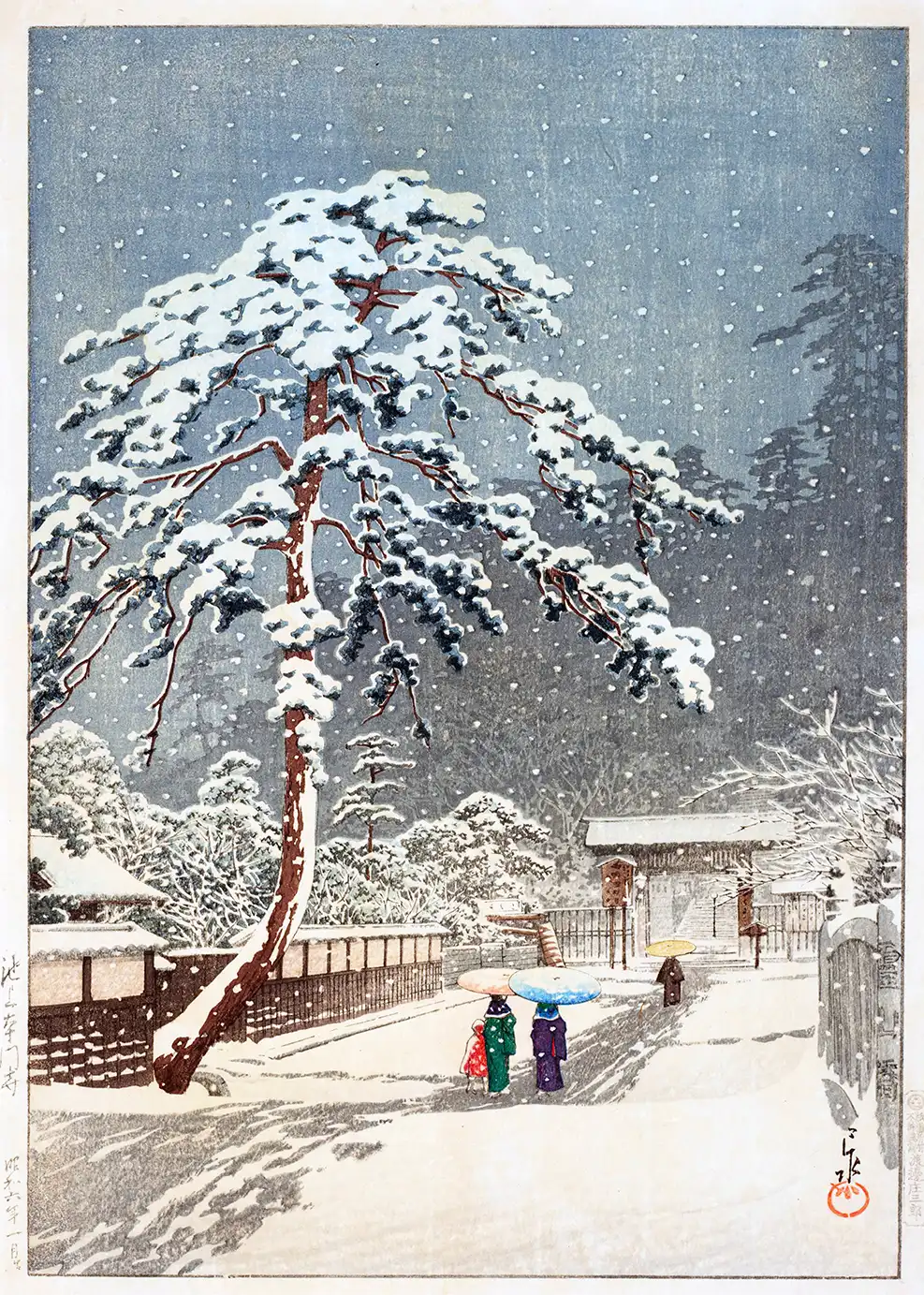
This Hasui Kawase Snow Print captures the quiet stillness of a winter morning at Tokyo’s Nezu-Gongen Shrine. This shin-hanga woodblock art is produced on museum-grade matte paper for an authentic finish.
What You Will Receive
- Made to order, museum-grade art print. Frame not included unless stated.
- Printed on 200 GSM premium matte paper for crisp detail and zero glare.
- Archival giclée inks that resist fading for decades.
- Multiple size options. Use the selector above.
- Protective packaging: rigid mailer or sturdy tube.
Print Quality
Every print is produced using state-of-the-art giclée technology on heavyweight 200 GSM matte paper. The non-reflective surface eliminates glare while the archival pigment inks deliver rich, accurate colours designed to last a lifetime.
Size Guide
For walls above furniture, choose a print roughly two thirds to three quarters the width of the piece below it. Smaller sizes up to 11×14 inches suit gallery walls. Larger formats of 18×24 inches and above create striking focal points.
Verified Customer Reviews
Shipping
Every order is printed on demand. Processing takes 3 to 5 business days, then ships free worldwide with tracking.
| Region | Processing | Delivery | Total |
|---|---|---|---|
| USA | 3–5 days | 2–6 days | 5–11 days |
| Canada | 3–5 days | 5–10 days | 8–15 days |
| UK & Europe | 3–5 days | 5–10 days | 8–15 days |
| Australia & NZ | 3–5 days | 8–15 days | 11–20 days |
| Asia | 3–5 days | 7–15 days | 10–20 days |
| Rest of world | 3–5 days | 10–20 days | 13–25 days |
📦 Packaging
Prints up to 12×18 inches ship flat in rigid cardboard mailers with backing board. Larger prints are rolled in sturdy tubes with protective end caps. Every package includes moisture barriers and Handle With Care labels.
Returns and Replacements
- 30-day return window from delivery. No questions asked.
- Report damage within 48 hours with photos for a free replacement.
- Full refunds for eligible returns in original condition.
- Cancel before production starts for a complete refund.
- Return shipping covered for defective or incorrect items.
Need help? info.merchfuse@gmail.com
How to Care for Your Print
Follow these steps to keep your print looking gallery fresh for decades.
Handling
Allow rolled prints to relax flat for 30 to 60 minutes. Handle by the edges with clean, dry hands and avoid touching the printed surface.
Placement
Avoid direct sunlight, heat sources and high humidity areas. North-facing walls receive less UV. Use LED or incandescent lighting instead of fluorescent.
Framing
Use acid-free mats and UV protective glass or acrylic for maximum longevity. Leave a small gap between print and glazing for airflow.
Cleaning
Dust framed glass with a soft cloth. Spray the cloth, not the glass. For unframed prints, use a dry microfibre cloth and never apply liquids to the surface.
Climate
Keep temperature at 18–24 °C and humidity at 40–60%. Avoid attics, basements and garages where conditions swing widely.
Storage
Store flat in acid-free folders, interleaved with tissue paper, in a cool dark place. Never fold. Check stored prints annually.
⚠️ Avoid
- Prolonged direct sunlight or fluorescent lighting.
- Bathrooms, kitchens and areas above heat sources.
- Tape, adhesives or liquids applied directly to the print.
- Rolling with the image facing inward as this can crack the ink layer.
- Extreme or rapid temperature and humidity changes.
📊 Expected Lifespan
- 100+ years when framed with UV protective glazing and indirect light.
- 50–75 years when framed with standard glass and indirect light.
- 25–50 years when stored correctly in darkness.
This Hasui Kawase Snow Print serves as a definitive example of the Shin-hanga movement, illustrating the artist’s ability to capture atmospheric conditions with mathematical precision. Originally produced in 1933, this work depicts the Nezu-Gongen Shrine during a heavy snowfall. The composition is anchored by a massive, snow-laden pine tree in the foreground, its boughs sagging under the weight of the accumulation. The verticality of the trunk creates a strong structural element that guides the viewer’s eye toward the architectural details of the shrine in the background.
Examining the Hasui Kawase Snow Print Palette
The color palette of the Hasui Kawase Snow Print is dominated by cool tones. Deep blues and grays define the overcast sky, while the white of the snow is rendered with subtle shading to provide a sense of volume. The artist integrates small bursts of color through the clothing and umbrellas of the figures walking toward the shrine. A figure in a green kimono and another in purple provide a sharp contrast against the monochromatic winter environment. These figures carry traditional umbrellas, one in a pale yellow and another in light blue, which act as focal points within the lower half of the frame.
Technical execution in the Hasui Kawase Snow Print involves complex layering techniques characteristic of high-end woodblock printing. The falling snow is represented by small, unprinted white circles that scatter across the entire image, creating a layered depth that suggests a continuous flurry. The texture of the tree bark is achieved through intricate line work, showing the dark, rugged surface of the wood emerging from beneath the heavy white drifts. The architectural gate, or torii, and the surrounding shrine buildings are rendered with straight, clean lines that emphasize the permanence of the structure against the fleeting nature of the storm.
Historical Context and Shin-hanga Tradition
Hasui Kawase was a leading figure in the early 20th-century revival of traditional Japanese woodblock printing. Unlike the older Ukiyo-e style, Shin-hanga focused on light, mood, and realistic depictions of nature. This Hasui Kawase Snow Print highlights the artist’s preference for ‘meisho’ or famous places, documented during his extensive travels across Japan. The Nezu-Gongen Shrine, also known as Nezu Jinja, is one of Tokyo’s oldest and most respected religious sites. By choosing this location, the artist connects the viewer to the cultural heritage of the Edo period while utilizing modern techniques of shading and perspective.
The collaborative process behind the Hasui Kawase Snow Print involved the artist, the block carver, and the printer, all overseen by the publisher Watanabe Shōzaburō. The precision required to align the various woodblocks for each color—a process known as kento—is evident in the sharp borders and consistent registration of the final image. Each element, from the distant silhouettes of trees in the background to the fine footprints in the foreground snow, contributes to a cohesive narrative of a winter morning in pre-war Japan.
Technical Specifications and Display
Every reproduction of this Hasui Kawase Snow Print is crafted with high-resolution digital scanning to preserve the original woodblock textures. We utilize 200 GSM museum-grade matte paper, which provides a heavy, high-quality feel and prevents glare when displayed under glass. The archival inks used are formulated to resist fading, ensuring that the subtle blues and vibrant kimono colors remain stable over time. This print is sized to fit standard frames, allowing for easy integration into a home office, study, or gallery wall.
When selecting a location for the Hasui Kawase Snow Print, consider environments with neutral tones to allow the cool blues of the artwork to stand out. It functions effectively in minimalist or Japandi-style interiors where the focus is on natural textures and quiet aesthetics. This print serves not only as a decorative element but as a historical document of a specific era in Japanese printmaking history.
This is fan-inspired artwork and an original artistic interpretation. It is not affiliated with, endorsed by, or officially licensed by any studio, production company, label, artist, photographer, or rights holder.
Price range: $3.90 through $59.90
Price range: $3.90 through $59.90
Price range: $3.90 through $59.90
Price range: $3.90 through $59.90