
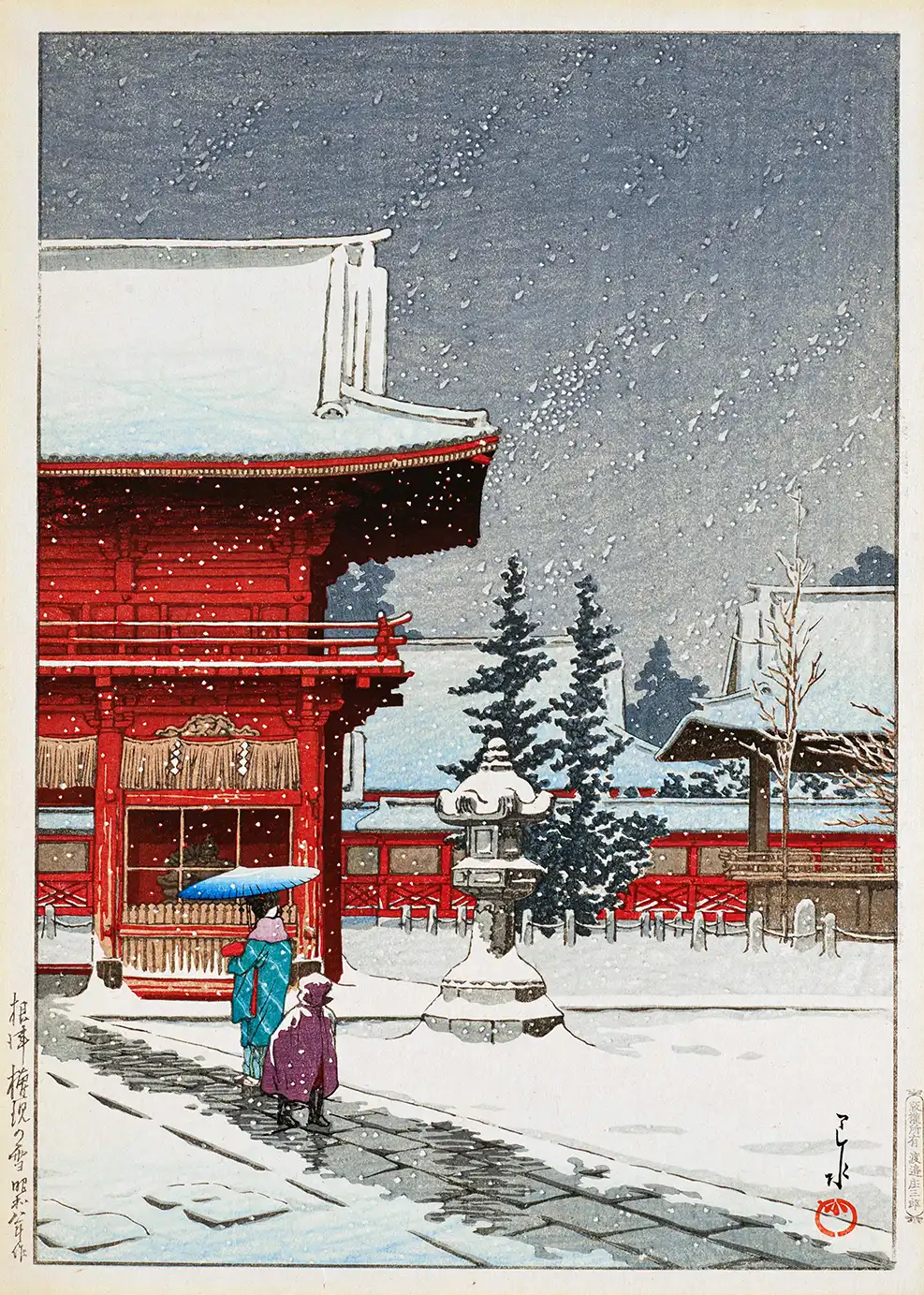
Classic Hasui Kawase Snow Print: 1933 Nezu-Gongen Shrine Woodblock Art
This Hasui Kawase Snow print captures a serene winter evening at the historical Nezu-Gongen Shrine in Tokyo. Our archival ukiyo-e reproduction is rendered on 200 GSM museum-grade matte paper for superior detail.
What You Will Receive
- Made to order, museum-grade art print. Frame not included unless stated.
- Printed on 200 GSM premium matte paper for crisp detail and zero glare.
- Archival giclée inks that resist fading for decades.
- Multiple size options. Use the selector above.
- Protective packaging: rigid mailer or sturdy tube.
Print Quality
Every print is produced using state-of-the-art giclée technology on heavyweight 200 GSM matte paper. The non-reflective surface eliminates glare while the archival pigment inks deliver rich, accurate colours designed to last a lifetime.
Size Guide
For walls above furniture, choose a print roughly two thirds to three quarters the width of the piece below it. Smaller sizes up to 11×14 inches suit gallery walls. Larger formats of 18×24 inches and above create striking focal points.
Verified Customer Reviews
Shipping
Every order is printed on demand. Processing takes 3 to 5 business days, then ships free worldwide with tracking.
| Region | Processing | Delivery | Total |
|---|---|---|---|
| USA | 3–5 days | 2–6 days | 5–11 days |
| Canada | 3–5 days | 5–10 days | 8–15 days |
| UK & Europe | 3–5 days | 5–10 days | 8–15 days |
| Australia & NZ | 3–5 days | 8–15 days | 11–20 days |
| Asia | 3–5 days | 7–15 days | 10–20 days |
| Rest of world | 3–5 days | 10–20 days | 13–25 days |
📦 Packaging
Prints up to 12×18 inches ship flat in rigid cardboard mailers with backing board. Larger prints are rolled in sturdy tubes with protective end caps. Every package includes moisture barriers and Handle With Care labels.
Returns and Replacements
- 30-day return window from delivery. No questions asked.
- Report damage within 48 hours with photos for a free replacement.
- Full refunds for eligible returns in original condition.
- Cancel before production starts for a complete refund.
- Return shipping covered for defective or incorrect items.
Need help? info.merchfuse@gmail.com
How to Care for Your Print
Follow these steps to keep your print looking gallery fresh for decades.
Handling
Allow rolled prints to relax flat for 30 to 60 minutes. Handle by the edges with clean, dry hands and avoid touching the printed surface.
Placement
Avoid direct sunlight, heat sources and high humidity areas. North-facing walls receive less UV. Use LED or incandescent lighting instead of fluorescent.
Framing
Use acid-free mats and UV protective glass or acrylic for maximum longevity. Leave a small gap between print and glazing for airflow.
Cleaning
Dust framed glass with a soft cloth. Spray the cloth, not the glass. For unframed prints, use a dry microfibre cloth and never apply liquids to the surface.
Climate
Keep temperature at 18–24 °C and humidity at 40–60%. Avoid attics, basements and garages where conditions swing widely.
Storage
Store flat in acid-free folders, interleaved with tissue paper, in a cool dark place. Never fold. Check stored prints annually.
⚠️ Avoid
- Prolonged direct sunlight or fluorescent lighting.
- Bathrooms, kitchens and areas above heat sources.
- Tape, adhesives or liquids applied directly to the print.
- Rolling with the image facing inward as this can crack the ink layer.
- Extreme or rapid temperature and humidity changes.
📊 Expected Lifespan
- 100+ years when framed with UV protective glazing and indirect light.
- 50–75 years when framed with standard glass and indirect light.
- 25–50 years when stored correctly in darkness.
This Hasui Kawase Snow print captures the stillness of a winter evening at the Nezu-Gongen Shrine in Tokyo, reflecting the artist’s ability to document the quietude of early 20th-century Japan. Originally produced in 1933, this work is a definitive example of the Shin-hanga, or ‘new prints’ movement, which sought to revitalize traditional woodblock techniques with modern western perspectives on light and atmosphere. The composition centers on the vibrant vermillion architecture of the shrine, which provides a sharp chromatic contrast against the muted, grey-blue sky and the heavy accumulation of white snow. Every dot of falling precipitation is preserved with clarity, mirroring the meticulous carving of the original wooden blocks.
Technical Details of the Hasui Kawase Snow print
Our reproduction process focuses on maintaining the structural integrity and color accuracy of the 1933 original. We utilize 200 GSM museum-grade matte paper, which offers a non-reflective surface that allows the deep reds and subtle greys to occupy the visual space without interference from glare. This specific paper weight provides a substantial feel and prevents the rippling often associated with thinner posters. The inks used are archival-quality, fade-resistant pigments designed for professional large-format output. These materials ensure that the cool blue of the figures’ umbrella and the intricate shadows on the stone lantern remain vivid for decades. The print arrives ready for framing in standard sizes, allowing for easy integration into your existing collection.
Visual Composition and Historical Context
The Hasui Kawase Snow print is noted for its asymmetrical balance, a hallmark of Japanese aesthetic theory. To the left, the heavy eaves of the Nezu-Gongen Shrine are weighed down by snow, their structural lines leading the eye toward the figures in the mid-ground. These pedestrians, dressed in traditional winter attire and shielded by a deep blue umbrella, provide a human element to the otherwise quiet architectural study. In the center, a traditional stone lantern, or ‘toro’, is coated in white, its rough texture contrasting with the smooth, lacquered surfaces of the shrine buildings. The background features a second, smaller shrine structure and silhouettes of evergreen trees, creating a sense of depth and spatial reality within the two-dimensional medium.
The Legacy of Shin-hanga Art
Choosing a Hasui Kawase Snow print for your interior space means acquiring a piece of art history. Hasui was a prolific artist who traveled extensively across Japan to document its changing environments. His collaboration with the publisher Watanabe Shozaburo resulted in some of the most technically proficient woodblock prints ever created. This 1933 series is particularly valued for its use of ‘bokashi’ or color gradation, which is visible in the sky and the shadowed areas of the snow-covered ground. By utilizing modern printing technology, we can replicate these subtle transitions that were once only possible through hand-applied ink on damp paper. This Hasui Kawase Snow print serves as a bridge between the ancient Edo period traditions and the evolving sensibilities of the Showa era.
Interior Design and Display Recommendations
This Hasui Kawase Snow print thrives in environments with controlled, soft lighting. Because of its cool color palette and vibrant red accents, it functions effectively in rooms with minimalist or mid-century modern furniture. We recommend a simple black or dark wood frame to maintain the focus on the artwork’s internal geometry. The vertical orientation and high-contrast color scheme make it an ideal choice for narrow wall spaces, hallways, or as a focal point in a study. When displayed alongside other Japanese woodblock reproductions, the Hasui Kawase Snow print adds a layer of seasonal variety and atmospheric depth to a gallery wall. Its historical pedigree and sophisticated execution make it an appropriate selection for both seasoned collectors and those new to Asian art.
Acquiring this Hasui Kawase Snow print ensures you possess a faithful representation of a cultural landmark. The Nezu-Gongen Shrine, one of Tokyo’s oldest and most respected religious sites, is rendered here with a reverence for its architectural permanence amidst the fleeting nature of a snowstorm. This print remains a definitive work in the canon of Japanese winter art, offering a perspective that is both technically precise and emotionally resonant. Order your museum-quality reproduction today to secure this enduring piece of Tokyo history.
This is fan-inspired artwork and an original artistic interpretation. It is not affiliated with, endorsed by, or officially licensed by any studio, production company, label, artist, photographer, or rights holder.
Price range: $3.90 through $59.90
Price range: $3.90 through $59.90
Price range: $3.90 through $59.90
Price range: $3.90 through $59.90