
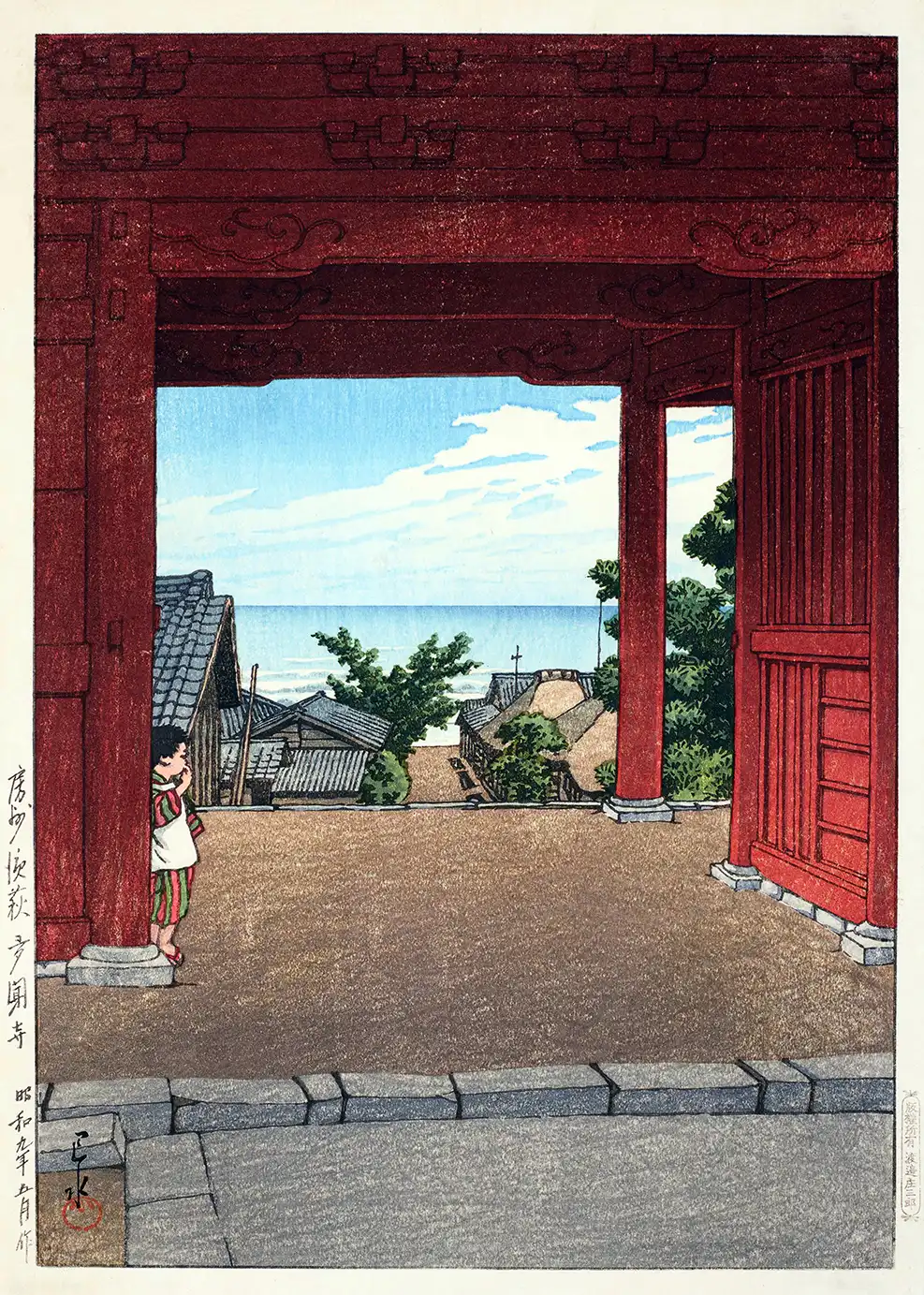
Classic Hasui Woodblock Print – Tamon Temple 1934 Japanese Wall Art
This Hasui woodblock print captures the serene atmosphere of a coastal Japanese temple framed by a bold vermilion gate. Our Shin-hanga landscape art is produced on 200 GSM museum-grade matte paper for superior longevity.
What You Will Receive
- Made to order, museum-grade art print. Frame not included unless stated.
- Printed on 200 GSM premium matte paper for crisp detail and zero glare.
- Archival giclée inks that resist fading for decades.
- Multiple size options. Use the selector above.
- Protective packaging: rigid mailer or sturdy tube.
Print Quality
Every print is produced using state-of-the-art giclée technology on heavyweight 200 GSM matte paper. The non-reflective surface eliminates glare while the archival pigment inks deliver rich, accurate colours designed to last a lifetime.
Size Guide
For walls above furniture, choose a print roughly two thirds to three quarters the width of the piece below it. Smaller sizes up to 11×14 inches suit gallery walls. Larger formats of 18×24 inches and above create striking focal points.
Verified Customer Reviews
Shipping
Every order is printed on demand. Processing takes 3 to 5 business days, then ships free worldwide with tracking.
| Region | Processing | Delivery | Total |
|---|---|---|---|
| USA | 3–5 days | 2–6 days | 5–11 days |
| Canada | 3–5 days | 5–10 days | 8–15 days |
| UK & Europe | 3–5 days | 5–10 days | 8–15 days |
| Australia & NZ | 3–5 days | 8–15 days | 11–20 days |
| Asia | 3–5 days | 7–15 days | 10–20 days |
| Rest of world | 3–5 days | 10–20 days | 13–25 days |
📦 Packaging
Prints up to 12×18 inches ship flat in rigid cardboard mailers with backing board. Larger prints are rolled in sturdy tubes with protective end caps. Every package includes moisture barriers and Handle With Care labels.
Returns and Replacements
- 30-day return window from delivery. No questions asked.
- Report damage within 48 hours with photos for a free replacement.
- Full refunds for eligible returns in original condition.
- Cancel before production starts for a complete refund.
- Return shipping covered for defective or incorrect items.
Need help? info.merchfuse@gmail.com
How to Care for Your Print
Follow these steps to keep your print looking gallery fresh for decades.
Handling
Allow rolled prints to relax flat for 30 to 60 minutes. Handle by the edges with clean, dry hands and avoid touching the printed surface.
Placement
Avoid direct sunlight, heat sources and high humidity areas. North-facing walls receive less UV. Use LED or incandescent lighting instead of fluorescent.
Framing
Use acid-free mats and UV protective glass or acrylic for maximum longevity. Leave a small gap between print and glazing for airflow.
Cleaning
Dust framed glass with a soft cloth. Spray the cloth, not the glass. For unframed prints, use a dry microfibre cloth and never apply liquids to the surface.
Climate
Keep temperature at 18–24 °C and humidity at 40–60%. Avoid attics, basements and garages where conditions swing widely.
Storage
Store flat in acid-free folders, interleaved with tissue paper, in a cool dark place. Never fold. Check stored prints annually.
⚠️ Avoid
- Prolonged direct sunlight or fluorescent lighting.
- Bathrooms, kitchens and areas above heat sources.
- Tape, adhesives or liquids applied directly to the print.
- Rolling with the image facing inward as this can crack the ink layer.
- Extreme or rapid temperature and humidity changes.
📊 Expected Lifespan
- 100+ years when framed with UV protective glazing and indirect light.
- 50–75 years when framed with standard glass and indirect light.
- 25–50 years when stored correctly in darkness.
The Legacy of the Hasui Woodblock Print
This Hasui woodblock print, titled ‘Tamon Temple at Hamahagi in Awa Province,’ represents a pinnacle of the Shin-hanga movement. Created in 1934, the composition utilizes a classic framing technique where a massive, weathered red temple gate (Niomon) serves as a physical border for the viewer’s eye. This structural element provides a sense of depth, pulling the observer from the shadowed foreground of the temple grounds toward the bright, sun-drenched coastal scenery of Awa Province. The contrast between the saturated earth tones of the architecture and the cool cerulean of the Pacific Ocean demonstrates the artist’s technical command over light and shadow. At the base of the left pillar, a small child stands in traditional dress, adding a human element that emphasizes the scale of the architecture while grounding the scene in a specific moment of quiet observation.
Technical Detail and Shin-hanga Landscape Art
Kawase Hasui was a central figure in the early 20th-century revival of traditional Japanese woodblock printing. Unlike earlier Ukiyo-e works, a Hasui woodblock print often focuses on mood and atmosphere rather than flat decorative patterns. In this specific piece, the use of grain and texture in the red ink of the gate suggests the aged wood of the temple, while the delicate gradations in the sky and water reflect the complex multi-block printing process. The houses visible through the gate feature traditional tiled roofs and thatch, characteristic of a vintage Japanese poster from the pre-war era. These architectural details are rendered with precise lines that define the Shin-hanga style, blending Western realism with traditional eastern techniques.
Composition and Color Theory in Japanese Wall Decor
The visual weight of this Hasui woodblock print is anchored by the deep red pillars. In Japanese culture, vermilion often signifies a sacred space, acting as a portal between the mundane and the spiritual. By positioning the viewer behind this gate, Hasui creates a meditative perspective on the village below. The cool blue of the sea provides a chromatic balance to the warm tones of the temple. This specific color palette makes the artwork a versatile addition to modern interiors, fitting well with minimalist or coastal themes. The inclusion of the child peering out from the pillar introduces a narrative element, suggesting curiosity and the passage of time within a space that feels grounded in history.
Museum-Quality Materials and Archival Standards
Every Hasui woodblock print we produce is crafted using 200 GSM museum-grade matte finish paper. This heavy-stock paper is specifically chosen to eliminate glare, allowing the deep reds and subtle blues of the 1934 original to be seen clearly from any angle. We utilize fade-resistant archival inks and professional large-format printing technology to ensure that the intricate details of the wood grain and the texture of the stone steps remain sharp for decades. Whether you choose the physical print or a 300 DPI digital download, the resolution captures the authentic look of the hand-carved blocks used in the 1930s. The Tamon Temple Hamahagi print is designed to fit standard frame sizes, making it an accessible piece of high-end art for your home gallery.
Integrating Kawase Hasui Wall Decor into Your Home
When displaying a Hasui woodblock print, consider lighting that mimics the natural daylight depicted in the scene. The archival quality of our prints ensures that the colors remain vibrant even in well-lit rooms. This piece works effectively as a focal point in a study, living room, or entryway where its architectural framing can complement the lines of your furniture. As a piece of historical Japanese wall art, it serves as a window into a bygone era of provincial Japan, offering a quiet, contemplative mood to any environment. The balance of the natural world and man-made structures in this work reflects a core tenet of Japanese aesthetic philosophy.
- Artist: Kawase Hasui (1883–1957)
- Original Publication Year: 1934
- Series: Collection of Scenic Views of Japan
- Paper: 200 GSM Museum-grade matte finish
- Inks: Archival-grade, fade-resistant pigments
- Format: Unframed, standard frame-ready sizes
This is fan-inspired artwork and an original artistic interpretation. It is not affiliated with, endorsed by, or officially licensed by any studio, production company, label, artist, photographer, or rights holder.
Price range: $3.90 through $74.90
Price range: $3.90 through $74.90
Price range: $3.90 through $74.90
Price range: $3.90 through $74.90