
Authentic Joan Miro Art Print – 1917 Portrait of Vincent Nubiola Wall Art
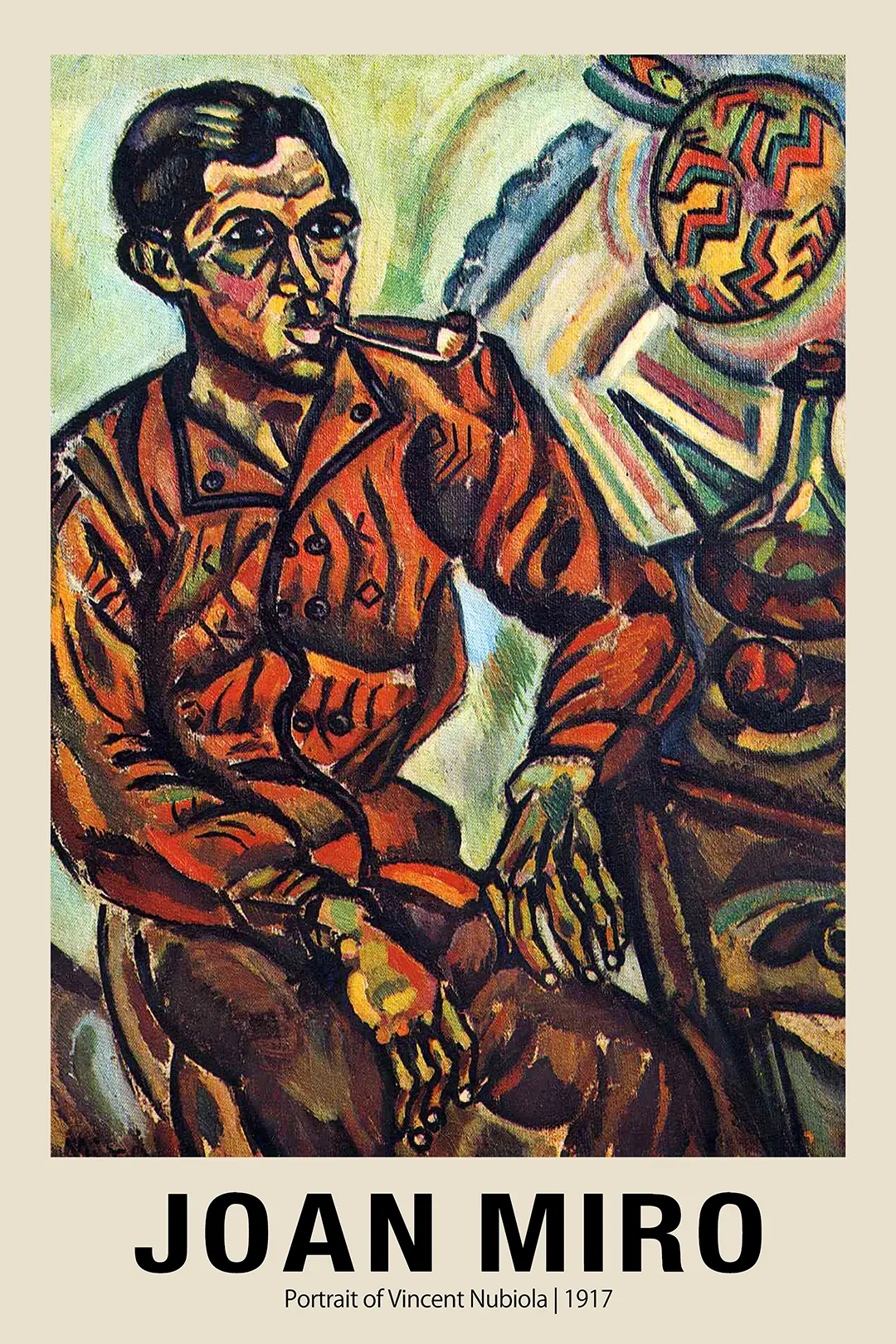
This Joan Miro art print depicts his 1917 Fauvist portrait of Vincent Nubiola with a smoking pipe. This Catalan modernism wall decor uses 200 GSM museum-grade matte paper for clarity.
What You Will Receive
- Made to order, museum-grade art print. Frame not included unless stated.
- Printed on 200 GSM premium matte paper for crisp detail and zero glare.
- Archival giclée inks that resist fading for decades.
- Multiple size options. Use the selector above.
- Protective packaging: rigid mailer or sturdy tube.
Print Quality
Every print is produced using state-of-the-art giclée technology on heavyweight 200 GSM matte paper. The non-reflective surface eliminates glare while the archival pigment inks deliver rich, accurate colours designed to last a lifetime.
Size Guide
For walls above furniture, choose a print roughly two thirds to three quarters the width of the piece below it. Smaller sizes up to 11×14 inches suit gallery walls. Larger formats of 18×24 inches and above create striking focal points.
Verified Customer Reviews
Shipping
Every order is printed on demand. Processing takes 3 to 5 business days, then ships free worldwide with tracking.
| Region | Processing | Delivery | Total |
|---|---|---|---|
| USA | 3–5 days | 2–6 days | 5–11 days |
| Canada | 3–5 days | 5–10 days | 8–15 days |
| UK & Europe | 3–5 days | 5–10 days | 8–15 days |
| Australia & NZ | 3–5 days | 8–15 days | 11–20 days |
| Asia | 3–5 days | 7–15 days | 10–20 days |
| Rest of world | 3–5 days | 10–20 days | 13–25 days |
📦 Packaging
Prints up to 12×18 inches ship flat in rigid cardboard mailers with backing board. Larger prints are rolled in sturdy tubes with protective end caps. Every package includes moisture barriers and Handle With Care labels.
Returns and Replacements
- 30-day return window from delivery. No questions asked.
- Report damage within 48 hours with photos for a free replacement.
- Full refunds for eligible returns in original condition.
- Cancel before production starts for a complete refund.
- Return shipping covered for defective or incorrect items.
Need help? info.merchfuse@gmail.com
How to Care for Your Print
Follow these steps to keep your print looking gallery fresh for decades.
Handling
Allow rolled prints to relax flat for 30 to 60 minutes. Handle by the edges with clean, dry hands and avoid touching the printed surface.
Placement
Avoid direct sunlight, heat sources and high humidity areas. North-facing walls receive less UV. Use LED or incandescent lighting instead of fluorescent.
Framing
Use acid-free mats and UV protective glass or acrylic for maximum longevity. Leave a small gap between print and glazing for airflow.
Cleaning
Dust framed glass with a soft cloth. Spray the cloth, not the glass. For unframed prints, use a dry microfibre cloth and never apply liquids to the surface.
Climate
Keep temperature at 18–24 °C and humidity at 40–60%. Avoid attics, basements and garages where conditions swing widely.
Storage
Store flat in acid-free folders, interleaved with tissue paper, in a cool dark place. Never fold. Check stored prints annually.
⚠️ Avoid
- Prolonged direct sunlight or fluorescent lighting.
- Bathrooms, kitchens and areas above heat sources.
- Tape, adhesives or liquids applied directly to the print.
- Rolling with the image facing inward as this can crack the ink layer.
- Extreme or rapid temperature and humidity changes.
📊 Expected Lifespan
- 100+ years when framed with UV protective glazing and indirect light.
- 50–75 years when framed with standard glass and indirect light.
- 25–50 years when stored correctly in darkness.
The 1917 Joan Miro art print captures a defining moment in the early career of the Spanish icon, portraying his friend and agriculture teacher, Vincent Nubiola. This reproduction showcases the raw intensity of the Fauvist movement, where color is used not merely for representation but for emotional weight. The subject sits with a pipe, surrounded by symbolic objects like a globe and a wine bottle, set against a backdrop of geometric patterns and organic shapes. Every brushstroke in this Joan Miro art print reflects the transition from classical training toward the bold experimentation that eventually led to his later surrealist works.
Historical Significance of the Joan Miro Art Print
Vincent Nubiola was a significant figure in Miro’s early life in Barcelona. This painting, created while the artist was still finding his voice, displays a heavy influence from the French Fauves. By choosing a Joan Miro art print of this era, collectors acquire a piece of art history that predates the famous abstract symbols of his later years. The portrait is renowned for its use of indumentària, or typical Catalan clothing, rendered in oranges and reds that contrast against the cool greens of the background. In 1918, this portrait was part of Miro’s first solo exhibition at the Galeries Dalmau in Barcelona. At the time, the reception was mixed, as the public was not yet accustomed to such aggressive use of color and distorted form. However, today, this period is recognized as a vital precursor to the detailist style he would later adopt. The inclusion of the pipe and the bottle of wine provides a glimpse into the social life of the Catalan intelligentsia during the early 20th century.
Color and Form in 1917
The composition is dense and structured. Nubiola’s face is chiseled with dark, heavy outlines, emphasizing the rugged character of the sitter. The hands are elongated, showing the influence of Cubist fragmentation. In the background, a globe sits atop a table, suggesting a world of intellectual exploration, which matches the studious yet firm expression on Nubiola’s face. This Joan Miro art print preserves these textures with high-fidelity reproduction techniques. The background details are particularly fascinating. The globe is not a standard map but a simplified, geometric representation, hinting at the artist’s fascination with celestial bodies. The table, rendered with skewed perspective, shows Miro’s rejection of traditional Renaissance vanishing points. This deliberate distortion invites the viewer to look at the subject through a lens of psychological intensity rather than mere physical likeness. By hanging a Joan Miro art print of this caliber, you are showcasing a work that challenged the status quo of its time.
- Paper: 200 GSM museum-grade matte finish.
- Inks: Fade-resistant archival, professional large-format.
- Framing: Ships unframed, standard frame-ready.
- Quality: High-resolution 300 DPI reproduction.
Each Joan Miro art print is produced using 200 GSM museum-grade matte paper. This heavy-duty substrate ensures that the deep reds and acidic greens remain stable over time. We utilize archival inks and professional large-format printing technology to replicate the tactile feel of the original canvas. Whether you select the physical print or the high-resolution digital download, the 300 DPI quality ensures every fine detail remains sharp. The archival nature of the materials prevents yellowing, maintaining the integrity of the 1917 color palette for decades. Placing this work in a home office or a gallery-style living room provides a sophisticated focal point. It bridges the gap between traditional portraiture and modern abstraction. The Joan Miro art print serves as an educational tool as much as a decorative one, illustrating the birth of modern art in Spain. This is fan-inspired artwork and an original artistic interpretation. It is not affiliated with, endorsed by, or officially licensed by any studio, production company, label, artist, photographer, or rights holder.
Price range: $3.90 through $59.90
Price range: $3.90 through $59.90
Price range: $3.90 through $59.90
Price range: $3.90 through $59.90