
Classic Joan Miro House with Palm Tree – 1918 Vintage Spanish Farmhouse Art
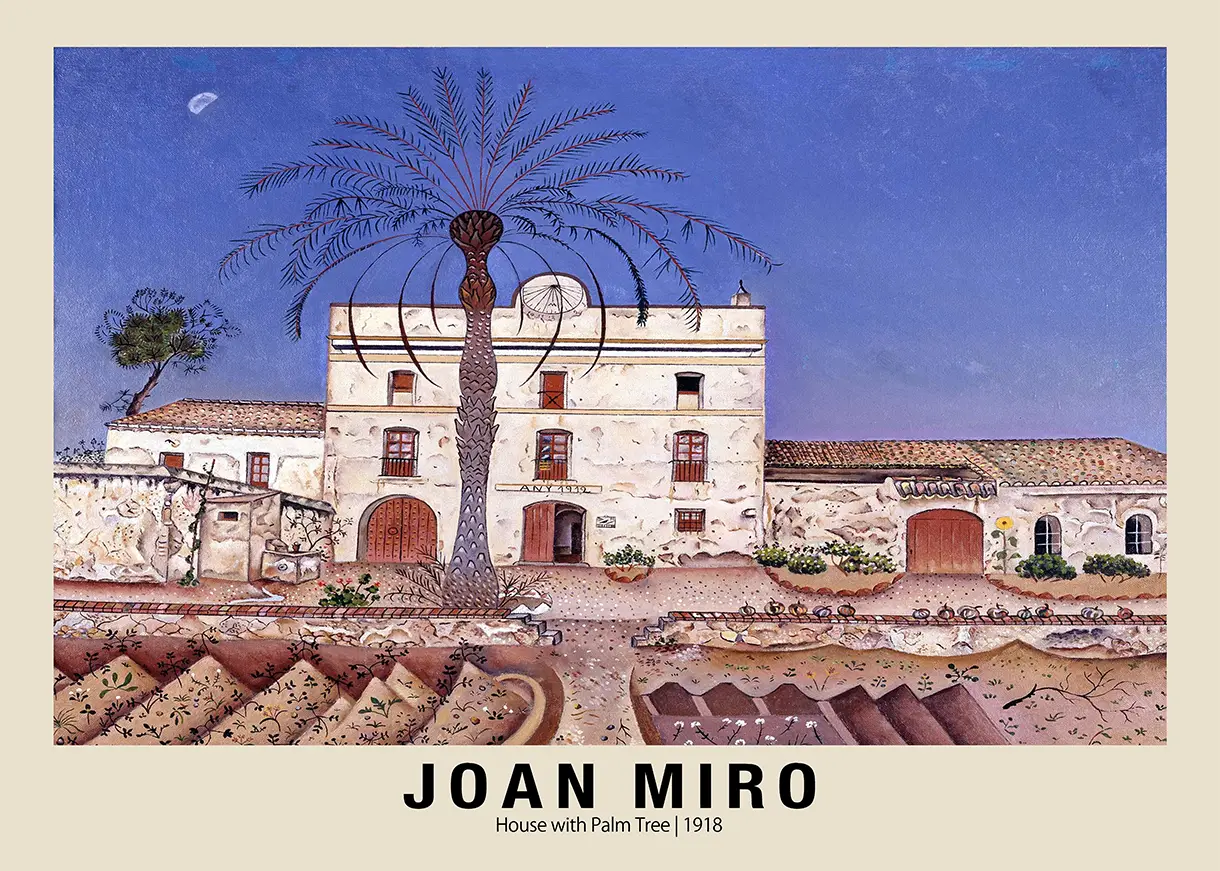
Joan Miro House with Palm Tree depicts a rural Spanish farmhouse with meticulous detail and earthy textures. This 1918 Spanish farmhouse painting is printed on museum-grade matte paper.
What You Will Receive
- Made to order, museum-grade art print. Frame not included unless stated.
- Printed on 200 GSM premium matte paper for crisp detail and zero glare.
- Archival giclée inks that resist fading for decades.
- Multiple size options. Use the selector above.
- Protective packaging: rigid mailer or sturdy tube.
Print Quality
Every print is produced using state-of-the-art giclée technology on heavyweight 200 GSM matte paper. The non-reflective surface eliminates glare while the archival pigment inks deliver rich, accurate colours designed to last a lifetime.
Size Guide
For walls above furniture, choose a print roughly two thirds to three quarters the width of the piece below it. Smaller sizes up to 11×14 inches suit gallery walls. Larger formats of 18×24 inches and above create striking focal points.
Verified Customer Reviews
Shipping
Every order is printed on demand. Processing takes 3 to 5 business days, then ships free worldwide with tracking.
| Region | Processing | Delivery | Total |
|---|---|---|---|
| USA | 3–5 days | 2–6 days | 5–11 days |
| Canada | 3–5 days | 5–10 days | 8–15 days |
| UK & Europe | 3–5 days | 5–10 days | 8–15 days |
| Australia & NZ | 3–5 days | 8–15 days | 11–20 days |
| Asia | 3–5 days | 7–15 days | 10–20 days |
| Rest of world | 3–5 days | 10–20 days | 13–25 days |
📦 Packaging
Prints up to 12×18 inches ship flat in rigid cardboard mailers with backing board. Larger prints are rolled in sturdy tubes with protective end caps. Every package includes moisture barriers and Handle With Care labels.
Returns and Replacements
- 30-day return window from delivery. No questions asked.
- Report damage within 48 hours with photos for a free replacement.
- Full refunds for eligible returns in original condition.
- Cancel before production starts for a complete refund.
- Return shipping covered for defective or incorrect items.
Need help? info.merchfuse@gmail.com
How to Care for Your Print
Follow these steps to keep your print looking gallery fresh for decades.
Handling
Allow rolled prints to relax flat for 30 to 60 minutes. Handle by the edges with clean, dry hands and avoid touching the printed surface.
Placement
Avoid direct sunlight, heat sources and high humidity areas. North-facing walls receive less UV. Use LED or incandescent lighting instead of fluorescent.
Framing
Use acid-free mats and UV protective glass or acrylic for maximum longevity. Leave a small gap between print and glazing for airflow.
Cleaning
Dust framed glass with a soft cloth. Spray the cloth, not the glass. For unframed prints, use a dry microfibre cloth and never apply liquids to the surface.
Climate
Keep temperature at 18–24 °C and humidity at 40–60%. Avoid attics, basements and garages where conditions swing widely.
Storage
Store flat in acid-free folders, interleaved with tissue paper, in a cool dark place. Never fold. Check stored prints annually.
⚠️ Avoid
- Prolonged direct sunlight or fluorescent lighting.
- Bathrooms, kitchens and areas above heat sources.
- Tape, adhesives or liquids applied directly to the print.
- Rolling with the image facing inward as this can crack the ink layer.
- Extreme or rapid temperature and humidity changes.
📊 Expected Lifespan
- 100+ years when framed with UV protective glazing and indirect light.
- 50–75 years when framed with standard glass and indirect light.
- 25–50 years when stored correctly in darkness.
The Joan Miro House with Palm Tree represents a pivotal moment in the artist’s early career, painted in 1918. It marks the transition from his earlier experiments with Fauvism to the meticulously rendered detailist style. This work depicts the Masia, or farmhouse, owned by his family in Mont-roig del Camp, Catalonia. The central focus is the singular palm tree, standing tall against the horizon, its fronds splayed with anatomical precision. This era of his work is defined by a clarity of light and a devotion to the physical reality of the Spanish soil. During the summer of 1918, Miro focused on the rural architecture of his homeland. The Joan Miro House with Palm Tree captures the rugged beauty of the Tarragona province. Unlike his later abstract surrealist works, this piece honors the structural integrity of the farmhouse. The building’s white-washed walls show signs of age and weathering, represented by fine cracks and textural shifts. This period is often called his hard-edge or detailist phase, where the artist sought to capture the essence of an object by illustrating every minute characteristic.
In the Joan Miro House with Palm Tree, the composition is divided with deliberate geometry. The foreground features furrowed earth, where small plants and seedlings grow in rhythmic rows. The palm tree acts as a vertical anchor, its trunk textured like stone and its leaves reaching toward a pale moon visible in the upper left. The sky is a gradient of deep azure, suggesting the cooling air of a Mediterranean evening. There is a sense of stillness and order here, reflecting the artist’s deep spiritual connection to the land. The colors terracotta, dusty browns, and vibrant blues create a balanced palette that feels both grounded and ethereal.
The Architectural Significance of Joan Miro House with Palm Tree
The masia depicted in the Joan Miro House with Palm Tree is more than a simple residence; it is a symbol of Catalan identity. Miro utilized a primitive perspective, flattening the space while maintaining incredible detail. The sundial on the facade, the arched doorways, and the low stone walls are all part of a traditional architectural vernacular that Miro held dear. By displaying a Joan Miro House with Palm Tree print, you bring a piece of this Mediterranean heritage into your environment. The visual rhythm of the tiles and the sandy paths provides a sophisticated focal point for any room. Miro’s obsession with detail is evident in the foreground of the work. The rhythmic, zigzag patterns in the soil represent the labor of the farmers and the organized nature of the Catalan countryside. Small, individual sprouts of vegetation and flowering plants are painted with such clarity that they appear almost botanical in nature. These elements provide a textural contrast to the sun-bleached surfaces of the house. The inclusion of decorative pottery and ceramic vessels along the low stone walls adds layers of domestic life to the agrarian setting.
Technical Specifications and Museum Quality
Our reproduction of the Joan Miro House with Palm Tree is produced using the highest standards of modern printing technology. We use 200 GSM museum-grade matte paper, which provides a heavy, premium feel and prevents glare from indoor lighting. The fade-resistant archival inks ensure that the deep blues of the sky and the warm ochres of the soil remain vivid for decades. This print is not a simple poster but a professional-grade gallery reproduction designed for those who appreciate the nuances of early 20th-century modernism. Each detail, from the brushstrokes to the canvas texture, is preserved in high resolution. This 1918 Spanish farmhouse painting works effectively in various interior settings. In a minimalist living room, its structured lines and earthy tones provide warmth. In a home office, its historical significance and calm mood foster an atmosphere of focus. As a Catalan landscape print, it serves as an excellent conversation piece for those interested in the evolution of modern art. The piece pairs well with natural wood frames, which complement the rustic subject matter. Whether you select a Joan Miro House with Palm Tree print for a gallery wall or a singular large-format display, this work offers enduring aesthetic value.
This is fan-inspired artwork and an original artistic interpretation. It is not affiliated with, endorsed by, or officially licensed by any studio, production company, label, artist, photographer, or rights holder.
Price range: $3.90 through $74.90
Price range: $3.90 through $74.90
Price range: $3.90 through $74.90
Price range: $3.90 through $74.90