
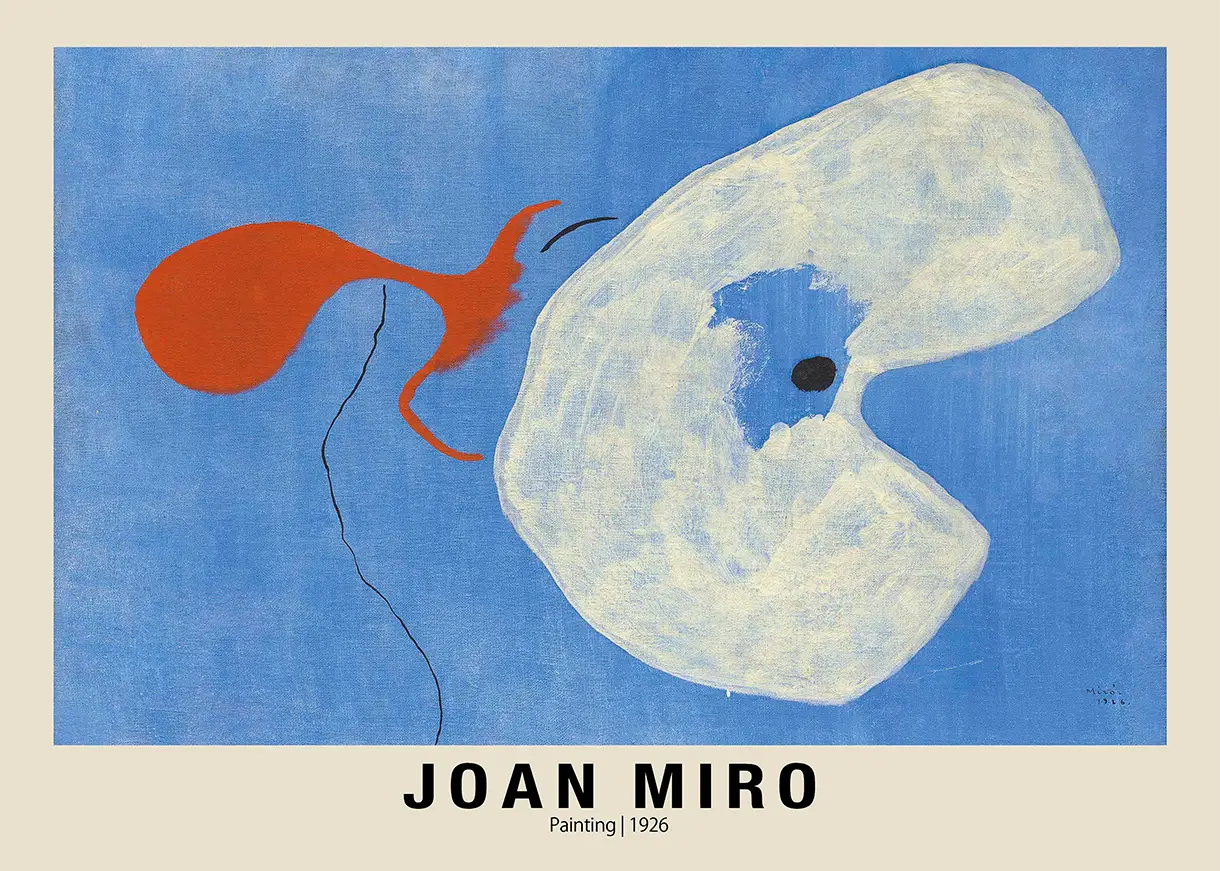
Joan Miro Painting 1926 – Surrealist Abstract Blue Fine Art Print
Joan Miro Painting 1926 features a vibrant blue backdrop populated by ethereal biomorphic shapes in white, orange, and black. This surrealist abstract wall art is produced on 200 GSM museum-grade matte paper for superior detail.
What You Will Receive
- Made to order, museum-grade art print. Frame not included unless stated.
- Printed on 200 GSM premium matte paper for crisp detail and zero glare.
- Archival giclée inks that resist fading for decades.
- Multiple size options. Use the selector above.
- Protective packaging: rigid mailer or sturdy tube.
Print Quality
Every print is produced using state-of-the-art giclée technology on heavyweight 200 GSM matte paper. The non-reflective surface eliminates glare while the archival pigment inks deliver rich, accurate colours designed to last a lifetime.
Size Guide
For walls above furniture, choose a print roughly two thirds to three quarters the width of the piece below it. Smaller sizes up to 11×14 inches suit gallery walls. Larger formats of 18×24 inches and above create striking focal points.
Verified Customer Reviews
Shipping
Every order is printed on demand. Processing takes 3 to 5 business days, then ships free worldwide with tracking.
| Region | Processing | Delivery | Total |
|---|---|---|---|
| USA | 3–5 days | 2–6 days | 5–11 days |
| Canada | 3–5 days | 5–10 days | 8–15 days |
| UK & Europe | 3–5 days | 5–10 days | 8–15 days |
| Australia & NZ | 3–5 days | 8–15 days | 11–20 days |
| Asia | 3–5 days | 7–15 days | 10–20 days |
| Rest of world | 3–5 days | 10–20 days | 13–25 days |
📦 Packaging
Prints up to 12×18 inches ship flat in rigid cardboard mailers with backing board. Larger prints are rolled in sturdy tubes with protective end caps. Every package includes moisture barriers and Handle With Care labels.
Returns and Replacements
- 30-day return window from delivery. No questions asked.
- Report damage within 48 hours with photos for a free replacement.
- Full refunds for eligible returns in original condition.
- Cancel before production starts for a complete refund.
- Return shipping covered for defective or incorrect items.
Need help? info.merchfuse@gmail.com
How to Care for Your Print
Follow these steps to keep your print looking gallery fresh for decades.
Handling
Allow rolled prints to relax flat for 30 to 60 minutes. Handle by the edges with clean, dry hands and avoid touching the printed surface.
Placement
Avoid direct sunlight, heat sources and high humidity areas. North-facing walls receive less UV. Use LED or incandescent lighting instead of fluorescent.
Framing
Use acid-free mats and UV protective glass or acrylic for maximum longevity. Leave a small gap between print and glazing for airflow.
Cleaning
Dust framed glass with a soft cloth. Spray the cloth, not the glass. For unframed prints, use a dry microfibre cloth and never apply liquids to the surface.
Climate
Keep temperature at 18–24 °C and humidity at 40–60%. Avoid attics, basements and garages where conditions swing widely.
Storage
Store flat in acid-free folders, interleaved with tissue paper, in a cool dark place. Never fold. Check stored prints annually.
⚠️ Avoid
- Prolonged direct sunlight or fluorescent lighting.
- Bathrooms, kitchens and areas above heat sources.
- Tape, adhesives or liquids applied directly to the print.
- Rolling with the image facing inward as this can crack the ink layer.
- Extreme or rapid temperature and humidity changes.
📊 Expected Lifespan
- 100+ years when framed with UV protective glazing and indirect light.
- 50–75 years when framed with standard glass and indirect light.
- 25–50 years when stored correctly in darkness.
Joan Miro Painting 1926 serves as a foundational example of the artist’s shift toward poetic abstraction during his prolific years in Paris. This specific composition captures the essence of the Catalan artist’s dream-state explorations through a deep, atmospheric blue field that suggests infinite space. By stripping away traditional perspective, the Joan Miro Painting 1926 invites a purely emotive response to color and line, acting as a portal into the subconscious mind of one of the twentieth century’s most influential creators. This print meticulously reproduces the textures and tonal nuances of the original work, ensuring that the subtle variations in the blue wash and the impasto-like appearance of the white forms are preserved for the viewer.
Historical Context of Joan Miro Painting 1926
Produced during the height of the surrealist movement, Joan Miro Painting 1926 belongs to a series often described by historians as ‘dream paintings.’ During this period, Miró moved away from the detailed, folkloric realism of his early Catalan works toward a sparse, symbolic language influenced by the poetry of his peers at the Rue Blomet. The Joan Miro Painting 1926 exemplifies this transition, where the background acts as a primordial soup for biomorphic shapes to float and interact. This work signifies the artist’s rejection of conventional bourgeois art and his embrace of a more primal, subconscious method of creation that would later influence the Abstract Expressionist movement in America. The use of a singular black dot within the white mass creates a focal point that suggests an eye, a recurring motif in the artist’s iconography that signifies the act of looking both outward and inward.
Formal Analysis and Compositional Balance
The visual weight of the Joan Miro Painting 1926 is anchored by the large, textured white organic form on the right half of the frame. This shape is not a flat silhouette; rather, it contains depth and internal contours that suggest a biological or celestial entity. Opposite this, a burst of orange-red pigment with feathered edges provides a warm counterpoint to the cool blue field. These elements are connected by a thin, meandering black line that originates from the bottom edge, providing a sense of grounding and architectural structure to the otherwise floating elements. This balanced asymmetry is a hallmark of Miró’s mid-1920s output, showing a sophisticated understanding of spatial dynamics and color theory.
Archival Quality and Material Specifications
Our reproduction of the Joan Miro Painting 1926 is executed with the highest standards of fine art printing to ensure longevity and visual fidelity. We utilize professional large-format printers equipped with fade-resistant archival inks. The substrate is a heavy 200 GSM museum-grade matte paper, chosen specifically for its ability to handle deep color saturation without glare or reflection. This ensures that the intense blue of the original composition remains vibrant even in brightly lit rooms. Each print is carefully inspected to maintain the integrity of the artist’s vision, from the sharpest line to the softest color gradient.
- Museum-grade 200 GSM matte paper for a non-reflective, professional finish.
- Archival-quality inks that prevent yellowing or fading over decades.
- High-resolution 300 DPI source imagery for sharp detail at any size.
- Standard frame-ready dimensions for convenient home or office installation.
Integrating the Joan Miro Painting 1926 into an interior design scheme offers a sophisticated anchor for diverse aesthetic styles. In a minimalist or Scandinavian setting, the bold primary colors and vast negative space provide a pop of visual interest without cluttering the room. In more eclectic or maximalist environments, the surrealist nature of the work allows it to harmonize with other historical art pieces. Whether you choose the physical print or the high-resolution digital download, the presence of Joan Miro Painting 1926 provides an enduring connection to the avant-garde spirit of the interwar years. This artwork remains a compelling subject for conversation and a significant addition to any collection of modern art history. Order your print today to bring this foundational surrealist work into your space.
This is fan-inspired artwork and an original artistic interpretation. It is not affiliated with, endorsed by, or officially licensed by any studio, production company, label, artist, photographer, or rights holder.
Price range: $3.90 through $74.90
Price range: $3.90 through $74.90
Price range: $3.90 through $74.90
Price range: $3.90 through $74.90