
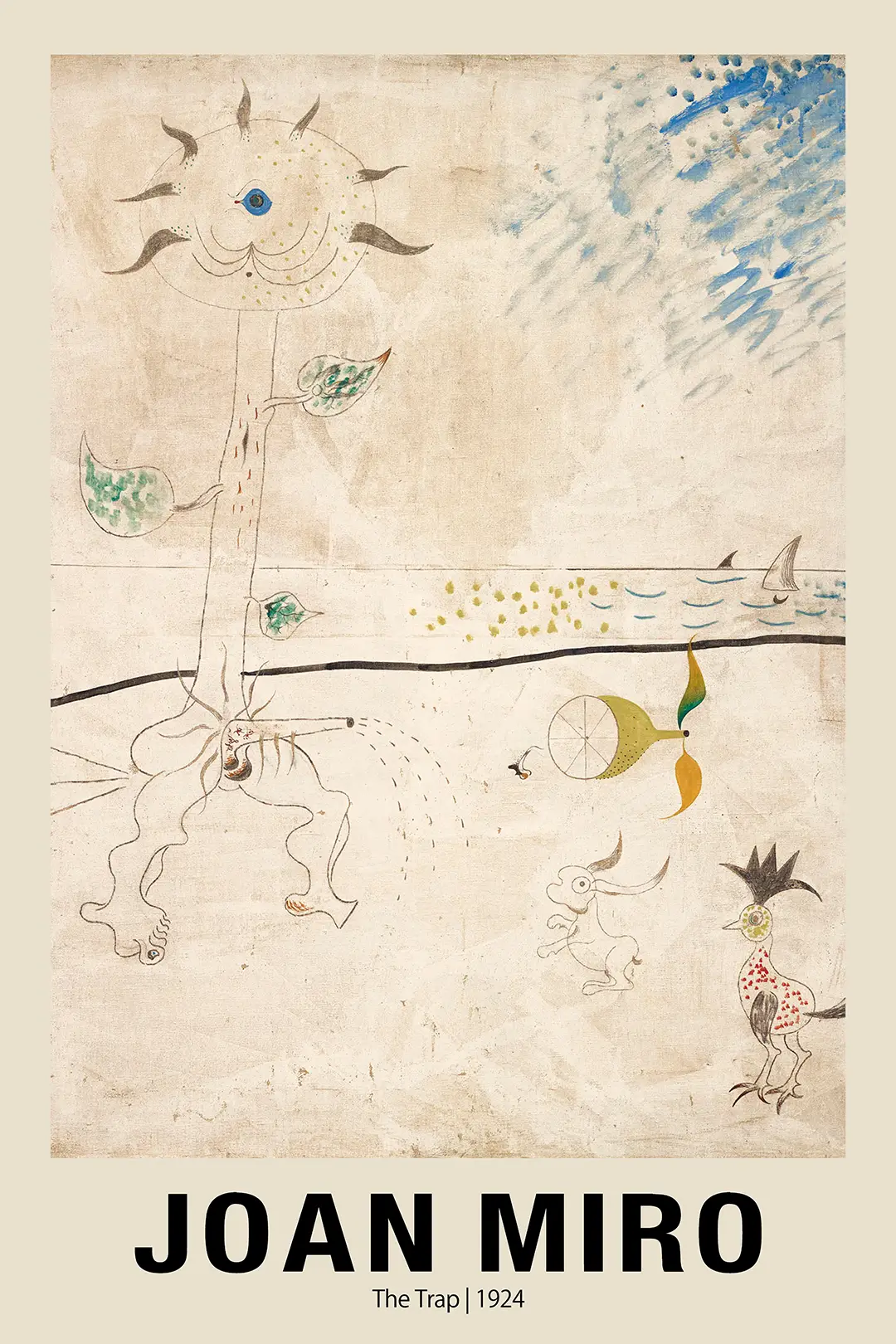
Classic Joan Miro The Trap – 1924 Surrealist Exhibition Art Print
Joan Miro The Trap displays the artist’s transition into pure surrealism through whimsical biomorphic forms and minimalist linework. This high-resolution 1920s surrealist art reproduction uses 200 GSM museum-grade matte paper for long-lasting clarity.
What You Will Receive
- Made to order, museum-grade art print. Frame not included unless stated.
- Printed on 200 GSM premium matte paper for crisp detail and zero glare.
- Archival giclée inks that resist fading for decades.
- Multiple size options. Use the selector above.
- Protective packaging: rigid mailer or sturdy tube.
Print Quality
Every print is produced using state-of-the-art giclée technology on heavyweight 200 GSM matte paper. The non-reflective surface eliminates glare while the archival pigment inks deliver rich, accurate colours designed to last a lifetime.
Size Guide
For walls above furniture, choose a print roughly two thirds to three quarters the width of the piece below it. Smaller sizes up to 11×14 inches suit gallery walls. Larger formats of 18×24 inches and above create striking focal points.
Verified Customer Reviews
Shipping
Every order is printed on demand. Processing takes 3 to 5 business days, then ships free worldwide with tracking.
| Region | Processing | Delivery | Total |
|---|---|---|---|
| USA | 3–5 days | 2–6 days | 5–11 days |
| Canada | 3–5 days | 5–10 days | 8–15 days |
| UK & Europe | 3–5 days | 5–10 days | 8–15 days |
| Australia & NZ | 3–5 days | 8–15 days | 11–20 days |
| Asia | 3–5 days | 7–15 days | 10–20 days |
| Rest of world | 3–5 days | 10–20 days | 13–25 days |
📦 Packaging
Prints up to 12×18 inches ship flat in rigid cardboard mailers with backing board. Larger prints are rolled in sturdy tubes with protective end caps. Every package includes moisture barriers and Handle With Care labels.
Returns and Replacements
- 30-day return window from delivery. No questions asked.
- Report damage within 48 hours with photos for a free replacement.
- Full refunds for eligible returns in original condition.
- Cancel before production starts for a complete refund.
- Return shipping covered for defective or incorrect items.
Need help? info.merchfuse@gmail.com
How to Care for Your Print
Follow these steps to keep your print looking gallery fresh for decades.
Handling
Allow rolled prints to relax flat for 30 to 60 minutes. Handle by the edges with clean, dry hands and avoid touching the printed surface.
Placement
Avoid direct sunlight, heat sources and high humidity areas. North-facing walls receive less UV. Use LED or incandescent lighting instead of fluorescent.
Framing
Use acid-free mats and UV protective glass or acrylic for maximum longevity. Leave a small gap between print and glazing for airflow.
Cleaning
Dust framed glass with a soft cloth. Spray the cloth, not the glass. For unframed prints, use a dry microfibre cloth and never apply liquids to the surface.
Climate
Keep temperature at 18–24 °C and humidity at 40–60%. Avoid attics, basements and garages where conditions swing widely.
Storage
Store flat in acid-free folders, interleaved with tissue paper, in a cool dark place. Never fold. Check stored prints annually.
⚠️ Avoid
- Prolonged direct sunlight or fluorescent lighting.
- Bathrooms, kitchens and areas above heat sources.
- Tape, adhesives or liquids applied directly to the print.
- Rolling with the image facing inward as this can crack the ink layer.
- Extreme or rapid temperature and humidity changes.
📊 Expected Lifespan
- 100+ years when framed with UV protective glazing and indirect light.
- 50–75 years when framed with standard glass and indirect light.
- 25–50 years when stored correctly in darkness.
The Joan Miro The Trap print remains one of the most significant entries in the early surrealist movement, marking a departure from the artist’s previous preoccupation with detail-heavy Catalan landscapes. Created in 1924, this composition highlights a pivotal shift toward a dream-like, psychological space where reality is stripped down to its essential, symbolic components. The work utilizes a monochromatic, parchment-toned background that serves as a sterile stage for a cast of enigmatic, organic figures that defy traditional categorization.
Exploring the Symbolism in Joan Miro The Trap
In this specific reproduction of Joan Miro The Trap, the viewer encounters a central, spindly vertical structure that suggests a tree or a human torso, complete with a large, singular eye at its apex. This creature features leaf-like appendages and distinct anatomical references, illustrating the artist’s interest in the intersection of botany and biology. The lines are thin and deliberate, echoing the calligraphic style that became a hallmark of his career during the mid-1920s. Every stroke contributes to a sense of weightlessness, as if the figures are floating within the beige expanse of the canvas.
Artistic Composition and Visual Narrative
The lower quadrant of Joan Miro The Trap is populated by various zoomorphic entities. To the right, a bird with a patterned chest and a spiked crest stands near a smaller, rabbit-like creature. These forms are rendered with playful but precise black outlines, emphasizing the raw, primitive energy of the subconscious. A thin, horizontal line divides the upper two-thirds of the painting from a stylized sea, where small triangular shapes representing shark fins or sails punctuate the water. This nautical element anchors the dreamscape to the Mediterranean identity that influenced so much of the painter’s early output.
Collectors seeking Joan Miro The Trap often appreciate the balance between the sparse background and the bursts of primary colors. Note the subtle application of blue in the upper right corner, which mimics a cloud or a splash of water, and the small dots of yellow and green that provide rhythmic movement across the center. This print is not merely a decorative object but a historical record of the moment when surrealism began to explore the automatic drawing techniques that would later define the decade. The tension between the title and the whimsical figures suggests a psychological depth, where the ‘trap’ might refer to the constraints of physical reality versus the freedom of the inner mind.
Technical Specifications and Print Quality
This reproduction of Joan Miro The Trap is produced on 200 GSM museum-grade matte paper to ensure a glare-free viewing experience in any lighting condition. We use professional large-format printers and fade-resistant archival inks to capture the subtle gradations of the original work. The high-resolution 300 DPI scan ensures that every fine line and texture of the original 1924 canvas is visible, providing an authentic gallery feel for your home or office. Whether you select a physical poster or a high-resolution digital download, the integrity of the original aesthetic remains preserved.
Finalizing an art collection with Joan Miro The Trap brings a sophisticated, mid-century modern aesthetic to any interior. The neutral color palette makes it an ideal fit for minimalist spaces, while the complex subject matter provides a point of intellectual interest. This print is designed to fit standard frame sizes, allowing for easy integration into your existing wall decor. Each physical order is handled with care to maintain the pristine surface of the archival paper during transit.
This is fan-inspired artwork and an original artistic interpretation. It is not affiliated with, endorsed by, or officially licensed by any studio, production company, label, artist, photographer, or rights holder.
Price range: $3.90 through $74.90
Price range: $3.90 through $74.90
Price range: $3.90 through $74.90
Price range: $3.90 through $74.90