
Authentic Matisse Jazz print – 1947 The Knife Thrower Abstract Wall Art
This Matisse Jazz print showcases the bold gouache-decoupe style of the 1947 circus-themed series. French fauvism wall art rendered with archival inks on museum-grade matte paper.
What You Will Receive
- Made to order, museum-grade art print. Frame not included unless stated.
- Printed on 200 GSM premium matte paper for crisp detail and zero glare.
- Archival giclée inks that resist fading for decades.
- Multiple size options. Use the selector above.
- Protective packaging: rigid mailer or sturdy tube.
Print Quality
Every print is produced using state-of-the-art giclée technology on heavyweight 200 GSM matte paper. The non-reflective surface eliminates glare while the archival pigment inks deliver rich, accurate colours designed to last a lifetime.
Size Guide
For walls above furniture, choose a print roughly two thirds to three quarters the width of the piece below it. Smaller sizes up to 11×14 inches suit gallery walls. Larger formats of 18×24 inches and above create striking focal points.
Verified Customer Reviews
Shipping
Every order is printed on demand. Processing takes 3 to 5 business days, then ships free worldwide with tracking.
| Region | Processing | Delivery | Total |
|---|---|---|---|
| USA | 3–5 days | 2–6 days | 5–11 days |
| Canada | 3–5 days | 5–10 days | 8–15 days |
| UK & Europe | 3–5 days | 5–10 days | 8–15 days |
| Australia & NZ | 3–5 days | 8–15 days | 11–20 days |
| Asia | 3–5 days | 7–15 days | 10–20 days |
| Rest of world | 3–5 days | 10–20 days | 13–25 days |
📦 Packaging
Prints up to 12×18 inches ship flat in rigid cardboard mailers with backing board. Larger prints are rolled in sturdy tubes with protective end caps. Every package includes moisture barriers and Handle With Care labels.
Returns and Replacements
- 30-day return window from delivery. No questions asked.
- Report damage within 48 hours with photos for a free replacement.
- Full refunds for eligible returns in original condition.
- Cancel before production starts for a complete refund.
- Return shipping covered for defective or incorrect items.
Need help? info.merchfuse@gmail.com
How to Care for Your Print
Follow these steps to keep your print looking gallery fresh for decades.
Handling
Allow rolled prints to relax flat for 30 to 60 minutes. Handle by the edges with clean, dry hands and avoid touching the printed surface.
Placement
Avoid direct sunlight, heat sources and high humidity areas. North-facing walls receive less UV. Use LED or incandescent lighting instead of fluorescent.
Framing
Use acid-free mats and UV protective glass or acrylic for maximum longevity. Leave a small gap between print and glazing for airflow.
Cleaning
Dust framed glass with a soft cloth. Spray the cloth, not the glass. For unframed prints, use a dry microfibre cloth and never apply liquids to the surface.
Climate
Keep temperature at 18–24 °C and humidity at 40–60%. Avoid attics, basements and garages where conditions swing widely.
Storage
Store flat in acid-free folders, interleaved with tissue paper, in a cool dark place. Never fold. Check stored prints annually.
⚠️ Avoid
- Prolonged direct sunlight or fluorescent lighting.
- Bathrooms, kitchens and areas above heat sources.
- Tape, adhesives or liquids applied directly to the print.
- Rolling with the image facing inward as this can crack the ink layer.
- Extreme or rapid temperature and humidity changes.
📊 Expected Lifespan
- 100+ years when framed with UV protective glazing and indirect light.
- 50–75 years when framed with standard glass and indirect light.
- 25–50 years when stored correctly in darkness.
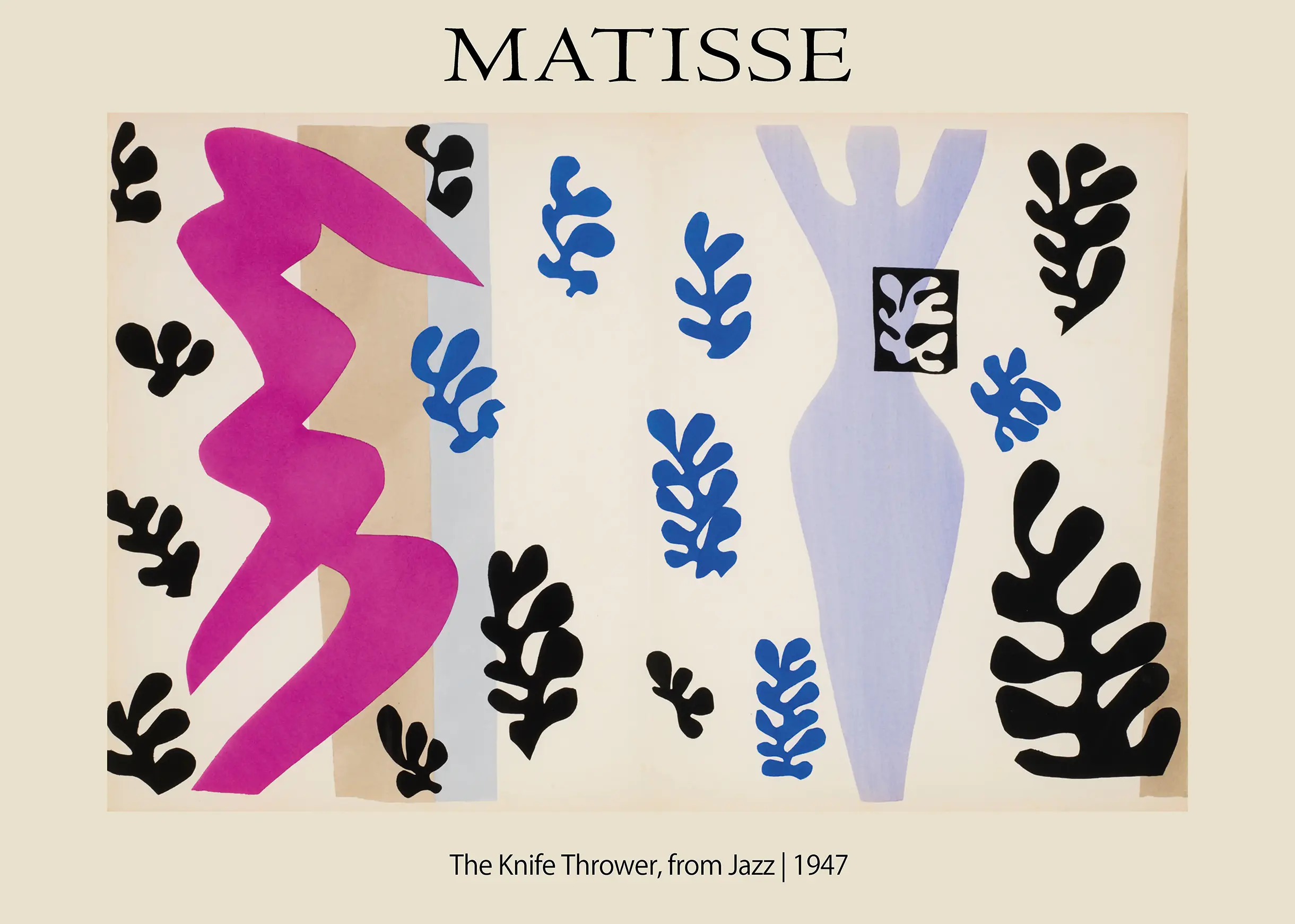
The Matisse Jazz print represents a pivotal era in mid-century modernism and the culmination of a revolutionary career. Created in 1947 by Henri Matisse during his final years in Vence, this specific plate titled The Knife Thrower (Le Lanceur de Couteaux) utilizes the gouache-decoupe method. In this process, the artist cut directly into pre-painted sheets of vibrant color, a technique he famously referred to as drawing with scissors. This particular Matisse Jazz print captures the rhythmic energy and theatricality of the circus, which served as the central theme for his twenty-five-plate portfolio.
The Visual Composition of the Matisse Jazz print
The arrangement consists of a jagged, energetic magenta form on the left side, representing the knife thrower in motion. To the right, a slender lilac silhouette denotes the assistant, standing rigid against a backdrop of organic floral and seaweed-like motifs. These shapes, rendered in deep cobalt blue and solid black, create a visual counterpoint to the negative space of the cream background. Each element in the Matisse Jazz print is meticulously placed to balance the weight of the composition without traditional perspective. The stark contrast between the sharp edges of the magenta ‘knives’ and the flowing curves of the vegetation creates a tension that defines the work’s emotional resonance.
Technical Specifications for Gallery Displays
Our reproduction of the Matisse Jazz print adheres to the highest standards of archival quality to ensure longevity and color fidelity. Each physical poster is produced using 200 GSM museum-grade matte paper, providing a non-reflective surface that allows the saturated hues to remain visible from any angle. We use fade-resistant archival inks and professional large-format printers to replicate the exact depth of the original gouache pigments. For those seeking immediate access, we offer a 300 DPI digital download option, ensuring every edge of the cut-out remains crisp when printed locally.
The Matisse Jazz print is often cited as a precursor to contemporary minimalism and pop art. The use of flat color fields and sharp edges removes the need for shading or three-dimensional modeling, focusing entirely on the interaction of form and hue. This specific plate, number XV in the original Tériade publication, is notable for its high-contrast palette. The juxtaposition of the primary and secondary colors creates a narrative that is both playful and intense. By omitting facial features and anatomical detail, Matisse invites the viewer to interpret the movement through shape alone.
Historical Context of the 1947 Jazz Series
When Matisse began working on the Jazz series, he was largely confined to his bed or a wheelchair. This physical limitation led to the birth of the cut-out technique, which allowed him to maintain his creative output on a large scale. The Knife Thrower is one of the most recognizable plates from this period, symbolizing the risk and precision of the artist’s own hand. Integrating a Matisse Jazz print into your home decor provides more than just visual appeal; it incorporates a piece of art history into your daily environment. This print works exceptionally well in mid-century modern, Scandinavian, or eclectic living spaces where bold colors are welcomed.
Maintaining the integrity of the original 1947 aesthetic is our priority. The cream-colored field of the Matisse Jazz print is not merely a background but an active participant in the composition, mimicking the look of the original hand-colored stencils. This art print arrives unframed, giving you the flexibility to choose a frame that matches your specific interior style, from natural wood to minimalist black metal. This is fan-inspired artwork and an original artistic interpretation. It is not affiliated with, endorsed by, or officially licensed by any studio, production company, label, artist, photographer, or rights holder.
Price range: $3.90 through $59.90
Price range: $3.90 through $59.90
Price range: $3.90 through $59.90
Price range: $3.90 through $59.90