
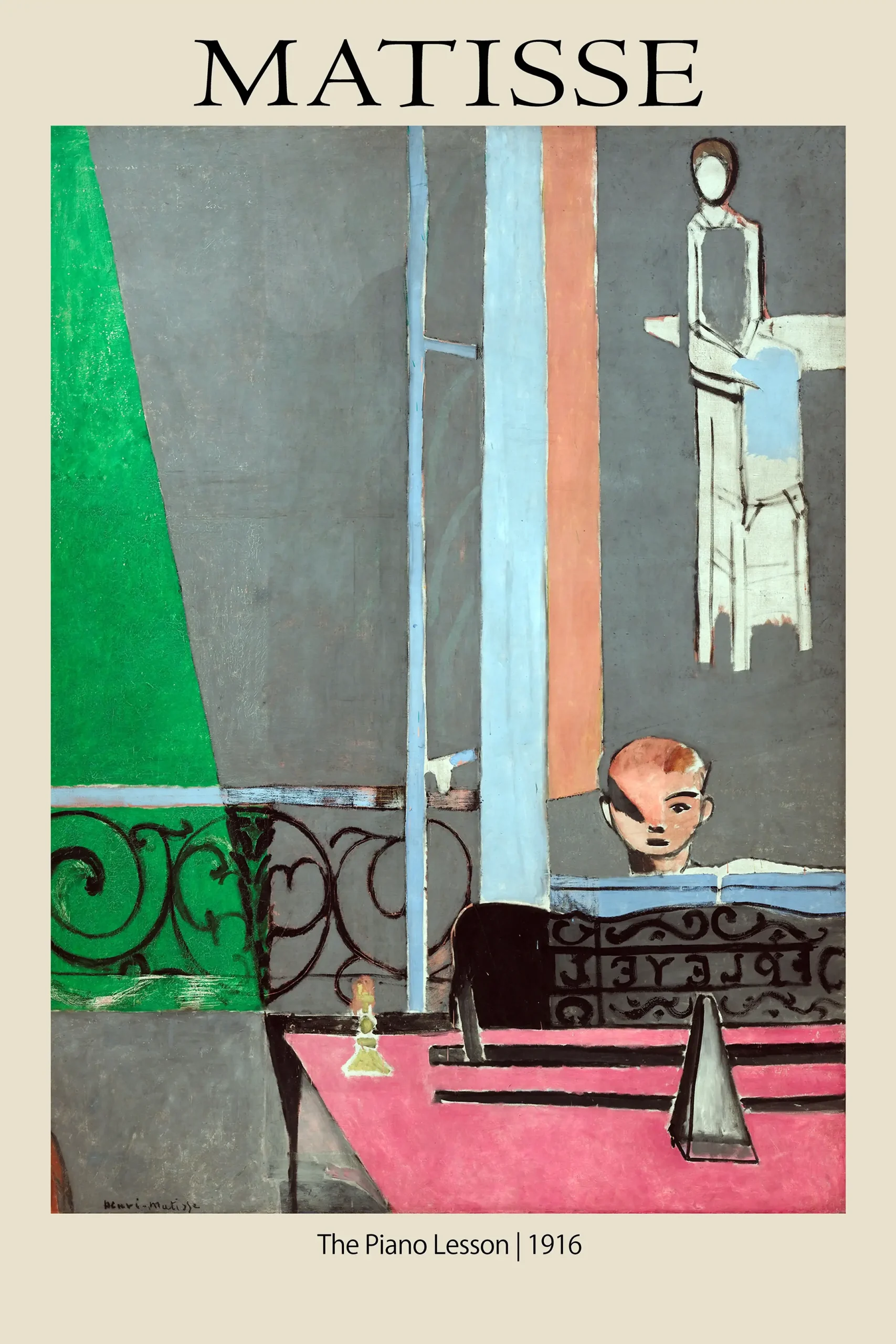
Authentic Matisse Piano Lesson – 1916 Modernist Art Exhibition Poster
The Matisse Piano Lesson depicts the artist’s son Pierre practicing at a Pleyel piano in a highly structured, geometric interior. This 1916 modern art poster is printed on museum-grade matte paper for a professional gallery finish.
What You Will Receive
- Made to order, museum-grade art print. Frame not included unless stated.
- Printed on 200 GSM premium matte paper for crisp detail and zero glare.
- Archival giclée inks that resist fading for decades.
- Multiple size options. Use the selector above.
- Protective packaging: rigid mailer or sturdy tube.
Print Quality
Every print is produced using state-of-the-art giclée technology on heavyweight 200 GSM matte paper. The non-reflective surface eliminates glare while the archival pigment inks deliver rich, accurate colours designed to last a lifetime.
Size Guide
For walls above furniture, choose a print roughly two thirds to three quarters the width of the piece below it. Smaller sizes up to 11×14 inches suit gallery walls. Larger formats of 18×24 inches and above create striking focal points.
Verified Customer Reviews
Shipping
Every order is printed on demand. Processing takes 3 to 5 business days, then ships free worldwide with tracking.
| Region | Processing | Delivery | Total |
|---|---|---|---|
| USA | 3–5 days | 2–6 days | 5–11 days |
| Canada | 3–5 days | 5–10 days | 8–15 days |
| UK & Europe | 3–5 days | 5–10 days | 8–15 days |
| Australia & NZ | 3–5 days | 8–15 days | 11–20 days |
| Asia | 3–5 days | 7–15 days | 10–20 days |
| Rest of world | 3–5 days | 10–20 days | 13–25 days |
📦 Packaging
Prints up to 12×18 inches ship flat in rigid cardboard mailers with backing board. Larger prints are rolled in sturdy tubes with protective end caps. Every package includes moisture barriers and Handle With Care labels.
Returns and Replacements
- 30-day return window from delivery. No questions asked.
- Report damage within 48 hours with photos for a free replacement.
- Full refunds for eligible returns in original condition.
- Cancel before production starts for a complete refund.
- Return shipping covered for defective or incorrect items.
Need help? info.merchfuse@gmail.com
How to Care for Your Print
Follow these steps to keep your print looking gallery fresh for decades.
Handling
Allow rolled prints to relax flat for 30 to 60 minutes. Handle by the edges with clean, dry hands and avoid touching the printed surface.
Placement
Avoid direct sunlight, heat sources and high humidity areas. North-facing walls receive less UV. Use LED or incandescent lighting instead of fluorescent.
Framing
Use acid-free mats and UV protective glass or acrylic for maximum longevity. Leave a small gap between print and glazing for airflow.
Cleaning
Dust framed glass with a soft cloth. Spray the cloth, not the glass. For unframed prints, use a dry microfibre cloth and never apply liquids to the surface.
Climate
Keep temperature at 18–24 °C and humidity at 40–60%. Avoid attics, basements and garages where conditions swing widely.
Storage
Store flat in acid-free folders, interleaved with tissue paper, in a cool dark place. Never fold. Check stored prints annually.
⚠️ Avoid
- Prolonged direct sunlight or fluorescent lighting.
- Bathrooms, kitchens and areas above heat sources.
- Tape, adhesives or liquids applied directly to the print.
- Rolling with the image facing inward as this can crack the ink layer.
- Extreme or rapid temperature and humidity changes.
📊 Expected Lifespan
- 100+ years when framed with UV protective glazing and indirect light.
- 50–75 years when framed with standard glass and indirect light.
- 25–50 years when stored correctly in darkness.
The Matisse Piano Lesson represents a rigorous exploration of structure and focus, painted during a period when the artist began to embrace more austere, geometric forms. Created in 1916 at his home in Issy-les-Moulineaux, this composition serves as a stark departure from the fluid and colorful Fauvist style that characterized his earlier career. The central figure is the artist’s son, Pierre Matisse, who appears small and concentrated against the massive architectural planes of the family living room. This work captures a specific moment in the evolution of French modernism, reflecting the broader movement toward order and stability that gripped the Parisian art scene during the First World War.
The Structural Logic of the Matisse Piano Lesson
In this 1916 composition, the Matisse Piano Lesson utilizes a sophisticated arrangement of vertical and horizontal lines to create a sense of interior depth. The large, flat grey areas that dominate the background suggest the walls of the studio, providing a neutral field that allows the specific color accents to vibrate with greater intensity. The most striking of these is the vibrant green triangle seen through the window, which represents the garden outside. This geometric abstraction of nature highlights the artist’s interest in reducing complex visual information into its most essential forms. Unlike a traditional landscape, the garden here is simplified into a singular, bold shape that balances the heavy presence of the dark piano.
Symbolism of the Metronome and Candle
Detailed examination of the Matisse Piano Lesson reveals several symbolic objects that speak to the themes of discipline and time. A small metronome sits atop the Pleyel piano, its triangular form echoing the green shape of the garden and the shadow on the boy’s face. This device represents the rhythmic, mathematical nature of musical study. Beside it, a single candle stands unlit, a common motif in art history that often signifies the passage of time or the quietude of a domestic interior. These objects are not merely decorative; they anchor the composition and provide a narrative focus for the viewer, emphasizing the solitary labor involved in artistic and musical practice.
Comparison to Later Musical Works
It is instructive to compare the Matisse Piano Lesson with his later 1917 painting, The Music Lesson. While the later work is more decorative and filled with family members and lush patterns, the 1916 version remains focused on the individual and the architecture of the space. The inclusion of the artist’s own sculpture, Decorative Figure, in the bottom left corner adds a layer of self-reflection to the work. By placing a three-dimensional form within a two-dimensional painting, the artist explores the boundaries between different artistic mediums. This minimalist geometric painting remains a favorite for those who appreciate the intersection of music history and modern art.
Technical Specifications for Gallery Display
Our reproduction of the Matisse Piano Lesson is produced with meticulous attention to detail to ensure it meets the standards of a museum quality art print. We use 200 GSM museum-grade matte paper, which offers a smooth, non-reflective finish that perfectly complements the flat color planes of the original work. The printing process involves archival, fade-resistant inks that preserve the subtle grey tones and the bright pink surface of the piano for decades. This French fauvism wall decor is designed to be frame-ready, allowing you to choose a mounting style that best fits your interior aesthetic. Whether displayed in a music room or a minimalist living space, the high-resolution detail ensures that every brushstroke and charcoal outline is visible.
- Ideal for music rooms, home offices, or minimalist gallery walls.
- Pairs well with other Henri Matisse exhibition print selections and modernist decor.
- Printed on heavy-weight 200 GSM matte paper for a premium feel.
- Ships unframed, rolled in a protective tube for safe delivery.
- Available as a 1916 modern art poster in multiple standard sizes.
By incorporating the Matisse Piano Lesson into your home, you are choosing a work that defined the transition toward the abstract logic of the 20th century. This print offers a window into the artist’s studio during a time of great creative change, making it a vital addition to any serious art collection. Order your archival print today to bring this historical French composition into your daily environment.
This is fan-inspired artwork and an original artistic interpretation. It is not affiliated with, endorsed by, or officially licensed by any studio, production company, label, artist, photographer, or rights holder.
Price range: $3.90 through $59.90
Price range: $3.90 through $59.90
Price range: $3.90 through $59.90
Price range: $3.90 through $59.90