
Authentic Nara Yakushiji Print – 1951 Hasui Japanese Woodblock Wall Art
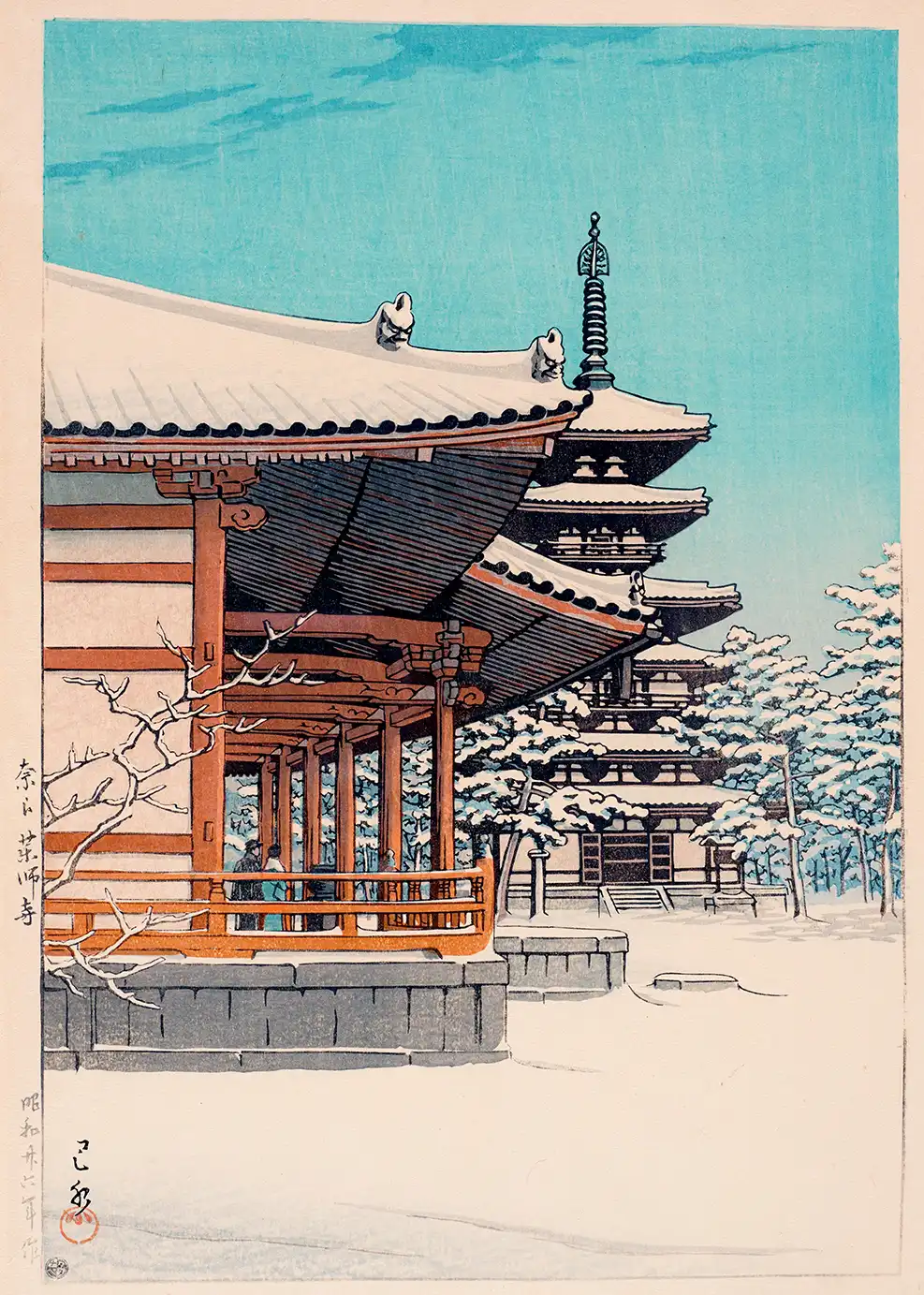
This Nara Yakushiji print features a tranquil winter scene of the ancient temple grounds in 1951. This Japanese woodblock wall art is reproduced on 200 GSM museum-grade paper for a historical gallery feel.
What You Will Receive
- Made to order, museum-grade art print. Frame not included unless stated.
- Printed on 200 GSM premium matte paper for crisp detail and zero glare.
- Archival giclée inks that resist fading for decades.
- Multiple size options. Use the selector above.
- Protective packaging: rigid mailer or sturdy tube.
Print Quality
Every print is produced using state-of-the-art giclée technology on heavyweight 200 GSM matte paper. The non-reflective surface eliminates glare while the archival pigment inks deliver rich, accurate colours designed to last a lifetime.
Size Guide
For walls above furniture, choose a print roughly two thirds to three quarters the width of the piece below it. Smaller sizes up to 11×14 inches suit gallery walls. Larger formats of 18×24 inches and above create striking focal points.
Verified Customer Reviews
Shipping
Every order is printed on demand. Processing takes 3 to 5 business days, then ships free worldwide with tracking.
| Region | Processing | Delivery | Total |
|---|---|---|---|
| USA | 3–5 days | 2–6 days | 5–11 days |
| Canada | 3–5 days | 5–10 days | 8–15 days |
| UK & Europe | 3–5 days | 5–10 days | 8–15 days |
| Australia & NZ | 3–5 days | 8–15 days | 11–20 days |
| Asia | 3–5 days | 7–15 days | 10–20 days |
| Rest of world | 3–5 days | 10–20 days | 13–25 days |
📦 Packaging
Prints up to 12×18 inches ship flat in rigid cardboard mailers with backing board. Larger prints are rolled in sturdy tubes with protective end caps. Every package includes moisture barriers and Handle With Care labels.
Returns and Replacements
- 30-day return window from delivery. No questions asked.
- Report damage within 48 hours with photos for a free replacement.
- Full refunds for eligible returns in original condition.
- Cancel before production starts for a complete refund.
- Return shipping covered for defective or incorrect items.
Need help? info.merchfuse@gmail.com
How to Care for Your Print
Follow these steps to keep your print looking gallery fresh for decades.
Handling
Allow rolled prints to relax flat for 30 to 60 minutes. Handle by the edges with clean, dry hands and avoid touching the printed surface.
Placement
Avoid direct sunlight, heat sources and high humidity areas. North-facing walls receive less UV. Use LED or incandescent lighting instead of fluorescent.
Framing
Use acid-free mats and UV protective glass or acrylic for maximum longevity. Leave a small gap between print and glazing for airflow.
Cleaning
Dust framed glass with a soft cloth. Spray the cloth, not the glass. For unframed prints, use a dry microfibre cloth and never apply liquids to the surface.
Climate
Keep temperature at 18–24 °C and humidity at 40–60%. Avoid attics, basements and garages where conditions swing widely.
Storage
Store flat in acid-free folders, interleaved with tissue paper, in a cool dark place. Never fold. Check stored prints annually.
⚠️ Avoid
- Prolonged direct sunlight or fluorescent lighting.
- Bathrooms, kitchens and areas above heat sources.
- Tape, adhesives or liquids applied directly to the print.
- Rolling with the image facing inward as this can crack the ink layer.
- Extreme or rapid temperature and humidity changes.
📊 Expected Lifespan
- 100+ years when framed with UV protective glazing and indirect light.
- 50–75 years when framed with standard glass and indirect light.
- 25–50 years when stored correctly in darkness.
This authentic Nara Yakushiji print captures the quiet solitude of the famous Nara prefecture temple following a heavy snowfall in 1951. Originally part of the Shin-hanga movement, this composition by the prolific artist Kawase Hasui showcases the intersection of traditional Japanese architecture and the atmospheric realism of the mid-20th century. The image centers on the Kondo (Main Hall) on the left, its heavy tiled roof laden with a thick layer of white snow that contrasts against the deep orange-red of the lacquered wooden beams. In the background, one of the temple’s iconic three-story pagodas rises into a crisp, cerulean sky, creating a balanced verticality that defines the spiritual geography of the site.
The Nara Yakushiji print serves as a primary example of how artists during the Showa era utilized the woodblock medium to convey mood and seasonal shifts. Unlike earlier Ukiyo-e works that often favored flat color fields, this piece employs sophisticated shading techniques to suggest the depth of the snow banks and the shadows cast by the temple eaves. The use of negative space is particularly effective here; the unprinted areas represent the pristine snow, while subtle grey and blue tones provide the necessary contour to the drifts. This specific print reflects the reconstruction period of Japanese art history, where the serenity of ancient religious sites provided a sense of continuity and peace.
Structural Elements within the Nara Yakushiji Print
Architectural precision is a hallmark of this 1951 work. The Yakushiji Temple, founded by Emperor Tenmu in the 7th century, is known for its unique ‘moshokoshi’ or hidden roofs, which give the three-story pagodas the appearance of having six levels. In this Nara Yakushiji print, the artist carefully renders these tiered roofs to emphasize the rhythm of the design. The foreground balcony of the main hall is populated by two small figures, providing a sense of scale and human connection to the vast, cold surroundings. The stark, bare branches of a tree in the left foreground add a layer of texture, framing the structural elements with organic silhouettes that are characteristic of the winter landscape.
The original Nara Yakushiji print was produced using multiple hand-carved cherry wood blocks, each corresponding to a different color or tonal layer. Our reproduction honors this legacy by maintaining the sharpness of the original linework and the vibrancy of the pigment choices. The sky transition from a deep teal at the top to a softer, warmer tone near the horizon line suggests the clearing of a winter storm, a common theme in Hasui’s oeuvre that highlights the beauty of the natural world through a lens of quiet reflection. The inclusion of the artist’s seal and the vertical title calligraphy ensures the historical integrity of the piece remains intact for the viewer.
Technical Specifications and Archival Standards
The quality of this Nara Yakushiji print ensures it meets the demands of serious collectors and interior designers alike. Printed on 200 GSM museum-grade matte paper, the surface texture prevents glare and allows the intricate details of the woodblock texture to remain visible even under direct gallery lighting. We utilize professional large-format printers and fade-resistant archival inks that provide a wide color gamut, ensuring that the specific shade of orange-verilion and the delicate blues of the sky do not degrade over time. The paper is acid-free, preventing yellowing and ensuring the print remains a durable part of your collection for decades.
Investing in a Nara Yakushiji print means bringing a piece of Nara’s 1,300-year history into your space. This artwork is particularly suited for environments that favor a minimalist or Zen-inspired aesthetic, as the cool color palette and organized geometric lines of the temple architecture promote a sense of order and calm. Whether placed in a study, a quiet hallway, or a central living area, the print acts as a window into a specific moment in Japanese history, preserved through the rigorous standards of archival printmaking. Each order is handled with care to maintain the crisp edges of the heavy-weight paper and the saturation of the ink layers.
This is fan-inspired artwork and an original artistic interpretation. It is not affiliated with, endorsed by, or officially licensed by any studio, production company, label, artist, photographer, or rights holder.
Price range: $3.90 through $74.90
Price range: $3.90 through $74.90
Price range: $3.90 through $74.90
Price range: $3.90 through $74.90