
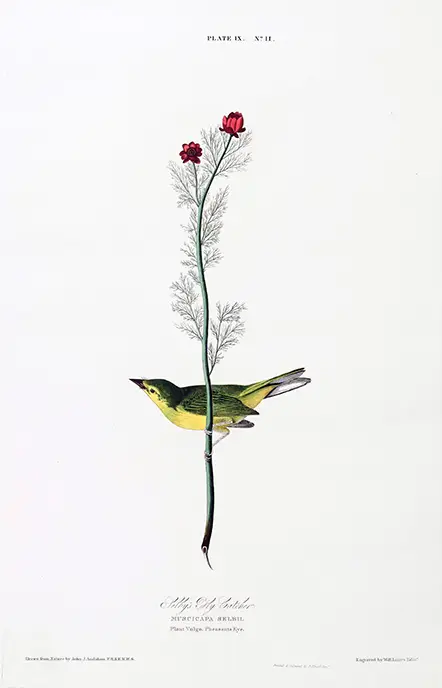
Selby bird print – 1827 Muscicapa Selbii Natural History Wall Art
This Selby bird print displays the intricate Muscicapa selbii illustration from 1827. Our vintage ornithology illustration is produced on museum-grade matte paper.
What You Will Receive
- Made to order, museum-grade art print. Frame not included unless stated.
- Printed on 200 GSM premium matte paper for crisp detail and zero glare.
- Archival giclée inks that resist fading for decades.
- Multiple size options. Use the selector above.
- Protective packaging: rigid mailer or sturdy tube.
Print Quality
Every print is produced using state-of-the-art giclée technology on heavyweight 200 GSM matte paper. The non-reflective surface eliminates glare while the archival pigment inks deliver rich, accurate colours designed to last a lifetime.
Size Guide
For walls above furniture, choose a print roughly two thirds to three quarters the width of the piece below it. Smaller sizes up to 11×14 inches suit gallery walls. Larger formats of 18×24 inches and above create striking focal points.
Verified Customer Reviews
Shipping
Every order is printed on demand. Processing takes 3 to 5 business days, then ships free worldwide with tracking.
| Region | Processing | Delivery | Total |
|---|---|---|---|
| USA | 3–5 days | 2–6 days | 5–11 days |
| Canada | 3–5 days | 5–10 days | 8–15 days |
| UK & Europe | 3–5 days | 5–10 days | 8–15 days |
| Australia & NZ | 3–5 days | 8–15 days | 11–20 days |
| Asia | 3–5 days | 7–15 days | 10–20 days |
| Rest of world | 3–5 days | 10–20 days | 13–25 days |
📦 Packaging
Prints up to 12×18 inches ship flat in rigid cardboard mailers with backing board. Larger prints are rolled in sturdy tubes with protective end caps. Every package includes moisture barriers and Handle With Care labels.
Returns and Replacements
- 30-day return window from delivery. No questions asked.
- Report damage within 48 hours with photos for a free replacement.
- Full refunds for eligible returns in original condition.
- Cancel before production starts for a complete refund.
- Return shipping covered for defective or incorrect items.
Need help? info.merchfuse@gmail.com
How to Care for Your Print
Follow these steps to keep your print looking gallery fresh for decades.
Handling
Allow rolled prints to relax flat for 30 to 60 minutes. Handle by the edges with clean, dry hands and avoid touching the printed surface.
Placement
Avoid direct sunlight, heat sources and high humidity areas. North-facing walls receive less UV. Use LED or incandescent lighting instead of fluorescent.
Framing
Use acid-free mats and UV protective glass or acrylic for maximum longevity. Leave a small gap between print and glazing for airflow.
Cleaning
Dust framed glass with a soft cloth. Spray the cloth, not the glass. For unframed prints, use a dry microfibre cloth and never apply liquids to the surface.
Climate
Keep temperature at 18–24 °C and humidity at 40–60%. Avoid attics, basements and garages where conditions swing widely.
Storage
Store flat in acid-free folders, interleaved with tissue paper, in a cool dark place. Never fold. Check stored prints annually.
⚠️ Avoid
- Prolonged direct sunlight or fluorescent lighting.
- Bathrooms, kitchens and areas above heat sources.
- Tape, adhesives or liquids applied directly to the print.
- Rolling with the image facing inward as this can crack the ink layer.
- Extreme or rapid temperature and humidity changes.
📊 Expected Lifespan
- 100+ years when framed with UV protective glazing and indirect light.
- 50–75 years when framed with standard glass and indirect light.
- 25–50 years when stored correctly in darkness.
This Selby bird print captures the 1827 engraving of the Muscicapa selbii, a species documented by Prideux John Selby during the golden age of British natural history. The illustration features a small, olive-green flycatcher with a pale yellow breast, positioned vertically on the slender, feathery stalk of a Pheasant’s Eye plant. The plant, topped with two deep crimson blooms, provides a stark vertical contrast to the bird’s horizontal posture. Every line in this reproduction is rendered with the same fidelity found in the original folio, showing the meticulous cross-hatching and stippling that Selby employed to define the texture of downy feathers and the delicate structure of botanical leaves.
The Scientific Significance of the Selby bird print
Prideux John Selby was a contemporary of John James Audubon, and a Selby bird print is often regarded as the British equivalent to the American Birds of America. Unlike many illustrators of the early 19th century who worked from taxidermy specimens, Selby was known for observing birds in their natural habitats. This commitment to realism is evident in the Muscicapa selbii plate. The bird is shown in a characteristic perching stance, its beak slightly parted and its eye rendered with a bead-like clarity that suggests a living subject. The composition avoids the stiff, heraldic poses common in earlier eras, opting instead for a dynamic botanical interaction.
Technical Engraving and 19th Century Aesthetics
The visual appeal of a Selby bird print lies in its technical execution. The 1820s marked a transition in printing technology where copperplate engraving reached its zenith before the widespread adoption of lithography. This specific print showcases the fine-line detail achievable only through metal plate etching. The subtle gradations of green on the bird’s dorsal feathers and the precise, hair-like foliage of the Pheasant’s Eye plant demonstrate the artist’s command over his medium. This reproduction maintains the off-white archival background of the original paper, preserving the historical character of the antique plate.
Museum-Grade Materials and Archival Quality
To ensure the longevity of your 1827 Muscicapa selbii reproduction, we utilize a 200 GSM museum-grade matte paper. This heavy-weight stock provides a non-reflective surface that allows the fine lines of the engraving to remain visible from any viewing angle. The application of fade-resistant archival inks ensures that the deep crimson of the Pheasant’s Eye and the muted olive tones of the flycatcher do not degrade over time. Every Selby bird print we produce is intended to meet the standards of professional galleries and private collectors who require color accuracy and structural durability.
As a piece of decor, the Selby bird print functions effectively in spaces that prioritize intellectual depth and classical design. It is particularly suited for home libraries, academic offices, or traditional dining rooms where the history of science and art intersect. The vertical orientation of the plant stem makes it an excellent choice for narrow wall spaces or as a central piece in a larger gallery wall arrangement. Because the original plate was part of the ‘Illustrations of British Ornithology’, it carries an air of formal documentation that adds a scholarly atmosphere to any interior environment.
Owning a Selby bird print allows you to appreciate the intersection of Victorian curiosity and artistic skill. The Muscicapa selbii plate remains one of the most balanced compositions in Selby’s catalog, offering a harmonious blend of botanical beauty and zoological detail. By choosing this high-resolution reproduction, you are preserving a moment from the 1827 archives, brought to life through modern large-format printing techniques that respect the integrity of the original 19th-century vision.
This is fan-inspired artwork and an original artistic interpretation. It is not affiliated with, endorsed by, or officially licensed by any studio, production company, label, artist, photographer, or rights holder.
Price range: $3.90 through $74.90
Price range: $3.90 through $74.90
Price range: $3.90 through $59.90
Price range: $3.90 through $59.90