
Tanigumi Temple print – Authentic 1947 Mino Province Japanese Wall Art
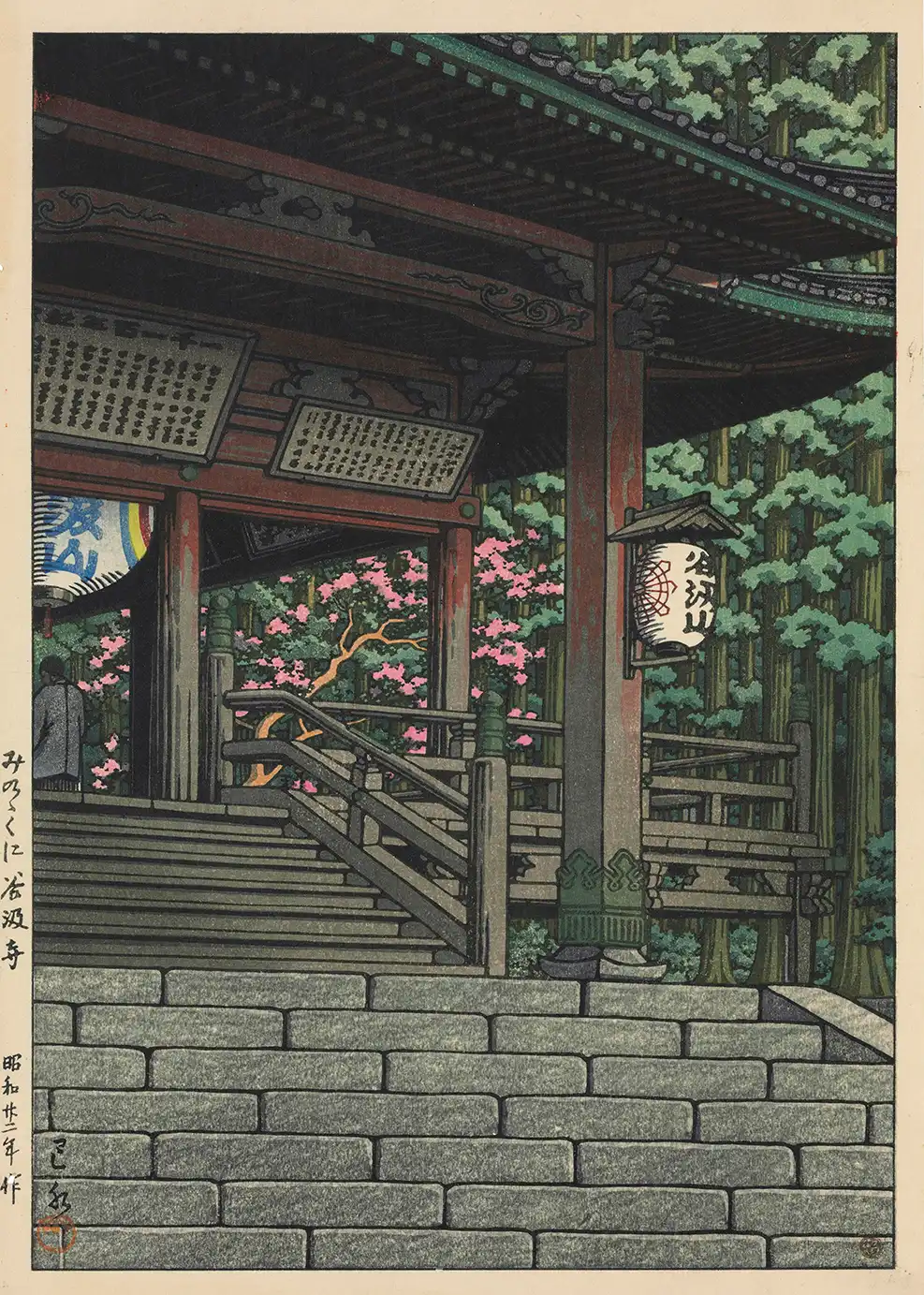
Tanigumi Temple print depicts a 1947 architectural view of Mino Province with vivid pink blossoms. This Japanese woodblock wall art is reproduced on premium archival paper for lasting detail.
What You Will Receive
- Made to order, museum-grade art print. Frame not included unless stated.
- Printed on 200 GSM premium matte paper for crisp detail and zero glare.
- Archival giclée inks that resist fading for decades.
- Multiple size options. Use the selector above.
- Protective packaging: rigid mailer or sturdy tube.
Print Quality
Every print is produced using state-of-the-art giclée technology on heavyweight 200 GSM matte paper. The non-reflective surface eliminates glare while the archival pigment inks deliver rich, accurate colours designed to last a lifetime.
Size Guide
For walls above furniture, choose a print roughly two thirds to three quarters the width of the piece below it. Smaller sizes up to 11×14 inches suit gallery walls. Larger formats of 18×24 inches and above create striking focal points.
Verified Customer Reviews
Shipping
Every order is printed on demand. Processing takes 3 to 5 business days, then ships free worldwide with tracking.
| Region | Processing | Delivery | Total |
|---|---|---|---|
| USA | 3–5 days | 2–6 days | 5–11 days |
| Canada | 3–5 days | 5–10 days | 8–15 days |
| UK & Europe | 3–5 days | 5–10 days | 8–15 days |
| Australia & NZ | 3–5 days | 8–15 days | 11–20 days |
| Asia | 3–5 days | 7–15 days | 10–20 days |
| Rest of world | 3–5 days | 10–20 days | 13–25 days |
📦 Packaging
Prints up to 12×18 inches ship flat in rigid cardboard mailers with backing board. Larger prints are rolled in sturdy tubes with protective end caps. Every package includes moisture barriers and Handle With Care labels.
Returns and Replacements
- 30-day return window from delivery. No questions asked.
- Report damage within 48 hours with photos for a free replacement.
- Full refunds for eligible returns in original condition.
- Cancel before production starts for a complete refund.
- Return shipping covered for defective or incorrect items.
Need help? info.merchfuse@gmail.com
How to Care for Your Print
Follow these steps to keep your print looking gallery fresh for decades.
Handling
Allow rolled prints to relax flat for 30 to 60 minutes. Handle by the edges with clean, dry hands and avoid touching the printed surface.
Placement
Avoid direct sunlight, heat sources and high humidity areas. North-facing walls receive less UV. Use LED or incandescent lighting instead of fluorescent.
Framing
Use acid-free mats and UV protective glass or acrylic for maximum longevity. Leave a small gap between print and glazing for airflow.
Cleaning
Dust framed glass with a soft cloth. Spray the cloth, not the glass. For unframed prints, use a dry microfibre cloth and never apply liquids to the surface.
Climate
Keep temperature at 18–24 °C and humidity at 40–60%. Avoid attics, basements and garages where conditions swing widely.
Storage
Store flat in acid-free folders, interleaved with tissue paper, in a cool dark place. Never fold. Check stored prints annually.
⚠️ Avoid
- Prolonged direct sunlight or fluorescent lighting.
- Bathrooms, kitchens and areas above heat sources.
- Tape, adhesives or liquids applied directly to the print.
- Rolling with the image facing inward as this can crack the ink layer.
- Extreme or rapid temperature and humidity changes.
📊 Expected Lifespan
- 100+ years when framed with UV protective glazing and indirect light.
- 50–75 years when framed with standard glass and indirect light.
- 25–50 years when stored correctly in darkness.
The Tanigumi Temple print captures the serene atmosphere of one of the most respected pilgrimage sites in Japan. Dated to 1947, this visual record reflects the transition of Japanese art in the mid-twentieth century. The perspective is set from the base of the stone steps, leading the eye upward toward the heavy, dark timber of the temple structure. This specific Tanigumi Temple print is a reproduction of the original woodblock medium, characterized by rich textures and deep shadows.
Historical Significance of the Tanigumi Temple print
The Tanigumi Temple print depicts the final station of the Saigoku Kannon Pilgrimage. In 1947, Japan was undergoing significant cultural shifts, yet the endurance of these sacred spaces remained a focus for artists using the Shin-hanga technique. The print illustrates the heavy, weathered wood of the temple, with traditional lanterns hanging prominently from the eaves. Each Tanigumi Temple print reflects the meticulous layering of colors that defined the era, from the cool grays of the masonry to the vibrant pinks of the flora.
Architectural Detail and Composition
The composition of the Tanigumi Temple print relies on strong vertical and horizontal lines. The massive support columns are rendered in a dark, saturated wood tone, contrasting with the detailed calligraphic panels mounted above the entrance. These elements provide a sense of weight and permanence. A solitary figure is visible on the left, partially obscured, adding a human scale to the vastness of the temple grounds. The lighting suggests an overcast or late afternoon setting, where the colors are deep and the contrast is high.
In this Mino Province landscape, the use of white lanterns with black calligraphy creates focal points that guide the viewer through the frame. The forest behind the temple consists of densely packed cedar trees, rendered in varying shades of forest green and moss. The interplay between the man-made structure and the natural world is a recurring theme in Japanese woodblock wall art. The use of shadow under the deep eaves emphasizes the shelter provided by the sacred architecture.
Museum-Quality Technical Specifications
Our Tanigumi Temple print is produced using 200 GSM museum-grade matte paper, providing a smooth, non-reflective surface that mimics the original washi paper used in the 1940s. We utilize professional large-format printers and fade-resistant archival inks. This process ensures that the subtle gradients in the stone steps and the delicate outlines of the pink blossoms remain sharp for decades. The high-resolution 300 DPI source file allows for crisp reproduction at various sizes, making the Tanigumi Temple print suitable for both intimate studies and large gallery displays.
For collectors interested in vintage Shin-hanga decor, the color accuracy of this reproduction is paramount. The dark shadows under the roof tiles are deep without losing detail, while the highlights on the paper lanterns maintain their brilliance. This Japanese architecture poster offers a window into a specific moment in Mino Province history, preserved through modern printing technology. The paper choice ensures that the ink absorption remains consistent, providing a finish that avoids the sheen of modern photographic papers.
Integration into Interior Design
Whether displayed in a professional office or a quiet home library, the Tanigumi Temple print introduces a sense of order and historical depth. The muted palette of the stone and wood is complemented by the sudden burst of pink, allowing it to work within both minimalist and traditional interior schemes. The print arrives unframed, allowing you to choose a mounting style that fits your personal aesthetic. The standard sizing makes it easy to find a frame that complements the work, whether you prefer a dark walnut or a simple black metal edge.
By ordering a Tanigumi Temple print, you are acquiring a piece of art that respects the heritage of the original woodblock carvers and printers. The visual weight of the architecture provides a grounding element for any room, while the natural forest background adds a layer of depth and texture. This is an ideal selection for those who appreciate the intersection of history, religion, and fine art. The attention to detail in the masonry steps and the wood grain provides a tactile quality that enriches the visual experience.
This is fan-inspired artwork and an original artistic interpretation. It is not affiliated with, endorsed by, or officially licensed by any studio, production company, label, artist, photographer, or rights holder.
Price range: $3.90 through $74.90
Price range: $3.90 through $74.90
Price range: $3.90 through $74.90
Price range: $3.90 through $74.90