
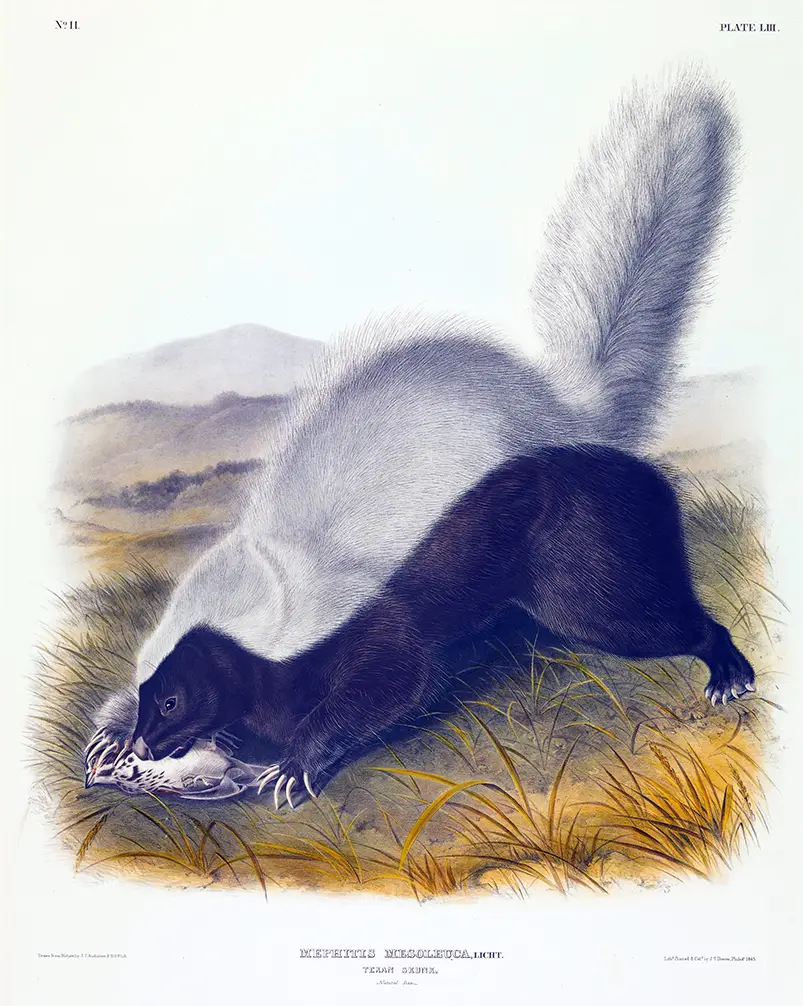
Authentic Texan Skunk Print – 1845 Mephitis Mesoleuca Nature Wall Art
This Texan Skunk Print showcases the detailed 1845 lithograph of the Mephitis mesoleuca in its natural habitat. This antique wildlife lithograph is produced on 200 GSM museum-grade matte paper.
What You Will Receive
- Made to order, museum-grade art print. Frame not included unless stated.
- Printed on 200 GSM premium matte paper for crisp detail and zero glare.
- Archival giclée inks that resist fading for decades.
- Multiple size options. Use the selector above.
- Protective packaging: rigid mailer or sturdy tube.
Print Quality
Every print is produced using state-of-the-art giclée technology on heavyweight 200 GSM matte paper. The non-reflective surface eliminates glare while the archival pigment inks deliver rich, accurate colours designed to last a lifetime.
Size Guide
For walls above furniture, choose a print roughly two thirds to three quarters the width of the piece below it. Smaller sizes up to 11×14 inches suit gallery walls. Larger formats of 18×24 inches and above create striking focal points.
Verified Customer Reviews
Shipping
Every order is printed on demand. Processing takes 3 to 5 business days, then ships free worldwide with tracking.
| Region | Processing | Delivery | Total |
|---|---|---|---|
| USA | 3–5 days | 2–6 days | 5–11 days |
| Canada | 3–5 days | 5–10 days | 8–15 days |
| UK & Europe | 3–5 days | 5–10 days | 8–15 days |
| Australia & NZ | 3–5 days | 8–15 days | 11–20 days |
| Asia | 3–5 days | 7–15 days | 10–20 days |
| Rest of world | 3–5 days | 10–20 days | 13–25 days |
📦 Packaging
Prints up to 12×18 inches ship flat in rigid cardboard mailers with backing board. Larger prints are rolled in sturdy tubes with protective end caps. Every package includes moisture barriers and Handle With Care labels.
Returns and Replacements
- 30-day return window from delivery. No questions asked.
- Report damage within 48 hours with photos for a free replacement.
- Full refunds for eligible returns in original condition.
- Cancel before production starts for a complete refund.
- Return shipping covered for defective or incorrect items.
Need help? info.merchfuse@gmail.com
How to Care for Your Print
Follow these steps to keep your print looking gallery fresh for decades.
Handling
Allow rolled prints to relax flat for 30 to 60 minutes. Handle by the edges with clean, dry hands and avoid touching the printed surface.
Placement
Avoid direct sunlight, heat sources and high humidity areas. North-facing walls receive less UV. Use LED or incandescent lighting instead of fluorescent.
Framing
Use acid-free mats and UV protective glass or acrylic for maximum longevity. Leave a small gap between print and glazing for airflow.
Cleaning
Dust framed glass with a soft cloth. Spray the cloth, not the glass. For unframed prints, use a dry microfibre cloth and never apply liquids to the surface.
Climate
Keep temperature at 18–24 °C and humidity at 40–60%. Avoid attics, basements and garages where conditions swing widely.
Storage
Store flat in acid-free folders, interleaved with tissue paper, in a cool dark place. Never fold. Check stored prints annually.
⚠️ Avoid
- Prolonged direct sunlight or fluorescent lighting.
- Bathrooms, kitchens and areas above heat sources.
- Tape, adhesives or liquids applied directly to the print.
- Rolling with the image facing inward as this can crack the ink layer.
- Extreme or rapid temperature and humidity changes.
📊 Expected Lifespan
- 100+ years when framed with UV protective glazing and indirect light.
- 50–75 years when framed with standard glass and indirect light.
- 25–50 years when stored correctly in darkness.
This Texan Skunk Print is a precise reproduction of Plate LIII from the legendary nineteenth-century natural history series, The Viviparous Quadrupeds of North America. Originally documented in 1845, this illustration captures the hog-nosed skunk, then referred to as Mephitis mesoleuca, with the meticulous anatomical accuracy characteristic of the era’s naturalist movements. The composition depicts the animal in a low, predatory stance, clutching an avian prey within its sharp claws. The contrast between the dense black fur of the underbelly and the broad, creamy white dorsal stripe highlights the distinct markings of this North American mammal. Collectors of historic wildlife documentation will find the level of detail in the fur texture and the sharp rendering of the facial features particularly significant for archival displays.
The Legacy of the Texan Skunk Print
The historical weight of the Texan Skunk Print stems from its origins in the collaborative efforts of John James Audubon and John Bachman. During the mid-1840s, these pioneers sought to catalog the fauna of the American West with the same rigor previously applied to ornithology. This antique wildlife lithograph was intended to serve as a scientific record, noted on the original plate as being shown at natural size. The artistic execution avoids the romanticism often found in later prints, instead opting for a cold, descriptive realism that documents the predator-prey relationship in the wild. The Texan Skunk Print remains a primary example of how early American scientists used lithography to educate the public on the biodiversity of the frontier.
Technical Specifications and Visual Composition
Visually, the Texan Skunk Print is anchored by a high-contrast palette. The primary subject is set against a muted terrain of dry grasses and soft, rolling hills, which provides a sense of depth without distracting from the central figure. The use of stippling and fine-line etching in the original plate is faithfully preserved in our reproduction, ensuring that the bristling guard hairs and the leathery texture of the snout are clearly visible. By utilizing professional large-format printers, this Texan Skunk Print maintains the tonal integrity of the original sepias, ochres, and charcoal blacks. This makes the print an effective focal point for rooms with traditional or academic decor styles.
Museum-Grade Material Standards
Quality control is central to the production of each Texan Skunk Print we offer. We utilize 200 GSM museum-grade matte paper, which offers a substantial weight and a smooth, non-reflective surface that enhances the visibility of fine lithographic details. The archival inks used are formulated to resist UV degradation, ensuring the deep blacks do not fade into blue or grey over time. For those interested in digital archiving, the 300 DPI high-resolution download option provides a crisp file suitable for various personal printing applications. Every physical Texan Skunk Print is shipped ready for framing, meeting the high standards required for gallery-style wall art.
Historical Context and Home Decor
Incorporating a Texan Skunk Print into an interior design scheme adds a layer of historical depth and intellectual curiosity. It is particularly well-suited for a library, home office, or any space that celebrates natural history and scientific discovery. The rugged nature of the subject matter pairs effectively with dark wood furniture, leather upholstery, and brass accents. Beyond its aesthetic value, the Texan Skunk Print serves as a conversation piece regarding the evolution of zoological classification and the history of American lithography. Whether displayed as a standalone piece or as part of a larger collection of vintage animal illustrations, it brings an air of archivist precision to the modern home.
- Paper: 200 GSM museum-grade matte finish.
- Inks: Fade-resistant archival, professional large-format.
- Framing: Ships unframed, standard frame-ready.
- Digital download: 300 DPI PDF/JPG high-resolution.
This is fan-inspired artwork and an original artistic interpretation. It is not affiliated with, endorsed by, or officially licensed by any studio, production company, label, artist, photographer, or rights holder.
Price range: $3.90 through $74.90
Price range: $3.90 through $59.90
Price range: $3.90 through $74.90
Price range: $3.90 through $74.90