
Authentic Tiger woodblock print – 1900s Vintage Japanese Animal Art
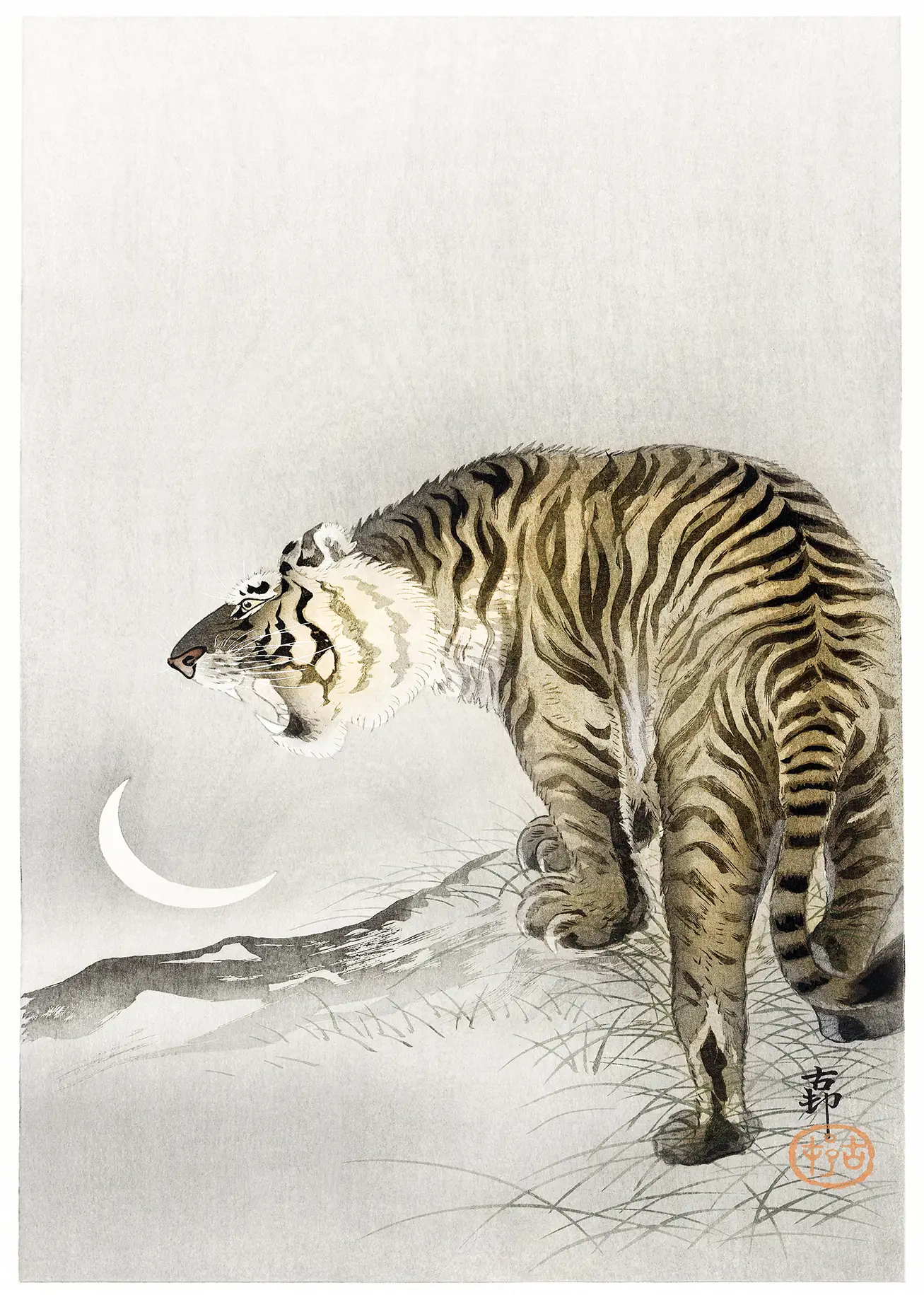
This Tiger woodblock print features a powerful feline silhouette against a nocturnal sky. This vintage Japanese tiger art is printed on museum-grade matte paper.
What You Will Receive
- Made to order, museum-grade art print. Frame not included unless stated.
- Printed on 200 GSM premium matte paper for crisp detail and zero glare.
- Archival giclée inks that resist fading for decades.
- Multiple size options. Use the selector above.
- Protective packaging: rigid mailer or sturdy tube.
Print Quality
Every print is produced using state-of-the-art giclée technology on heavyweight 200 GSM matte paper. The non-reflective surface eliminates glare while the archival pigment inks deliver rich, accurate colours designed to last a lifetime.
Size Guide
For walls above furniture, choose a print roughly two thirds to three quarters the width of the piece below it. Smaller sizes up to 11×14 inches suit gallery walls. Larger formats of 18×24 inches and above create striking focal points.
Verified Customer Reviews
Shipping
Every order is printed on demand. Processing takes 3 to 5 business days, then ships free worldwide with tracking.
| Region | Processing | Delivery | Total |
|---|---|---|---|
| USA | 3–5 days | 2–6 days | 5–11 days |
| Canada | 3–5 days | 5–10 days | 8–15 days |
| UK & Europe | 3–5 days | 5–10 days | 8–15 days |
| Australia & NZ | 3–5 days | 8–15 days | 11–20 days |
| Asia | 3–5 days | 7–15 days | 10–20 days |
| Rest of world | 3–5 days | 10–20 days | 13–25 days |
📦 Packaging
Prints up to 12×18 inches ship flat in rigid cardboard mailers with backing board. Larger prints are rolled in sturdy tubes with protective end caps. Every package includes moisture barriers and Handle With Care labels.
Returns and Replacements
- 30-day return window from delivery. No questions asked.
- Report damage within 48 hours with photos for a free replacement.
- Full refunds for eligible returns in original condition.
- Cancel before production starts for a complete refund.
- Return shipping covered for defective or incorrect items.
Need help? info.merchfuse@gmail.com
How to Care for Your Print
Follow these steps to keep your print looking gallery fresh for decades.
Handling
Allow rolled prints to relax flat for 30 to 60 minutes. Handle by the edges with clean, dry hands and avoid touching the printed surface.
Placement
Avoid direct sunlight, heat sources and high humidity areas. North-facing walls receive less UV. Use LED or incandescent lighting instead of fluorescent.
Framing
Use acid-free mats and UV protective glass or acrylic for maximum longevity. Leave a small gap between print and glazing for airflow.
Cleaning
Dust framed glass with a soft cloth. Spray the cloth, not the glass. For unframed prints, use a dry microfibre cloth and never apply liquids to the surface.
Climate
Keep temperature at 18–24 °C and humidity at 40–60%. Avoid attics, basements and garages where conditions swing widely.
Storage
Store flat in acid-free folders, interleaved with tissue paper, in a cool dark place. Never fold. Check stored prints annually.
⚠️ Avoid
- Prolonged direct sunlight or fluorescent lighting.
- Bathrooms, kitchens and areas above heat sources.
- Tape, adhesives or liquids applied directly to the print.
- Rolling with the image facing inward as this can crack the ink layer.
- Extreme or rapid temperature and humidity changes.
📊 Expected Lifespan
- 100+ years when framed with UV protective glazing and indirect light.
- 50–75 years when framed with standard glass and indirect light.
- 25–50 years when stored correctly in darkness.
This Tiger woodblock print, dating from the early 20th century between 1900 and 1945, captures the raw power and spiritual presence of the apex predator in East Asian art. The composition follows the traditions of Japanese animal painting, where the animal is not merely a biological specimen but a symbol of strength, protection, and warding off bad fortune. The feline is depicted in a dynamic stance upon a jagged ridge, its mouth open in a silent roar that commands the surrounding void. This specific piece reflects the transition of Japanese art during the Meiji and Taisho eras, where traditional sumi-e ink techniques met a renewed interest in anatomical realism and atmospheric depth.
Historical Significance of the Tiger woodblock print
In the history of Japanese graphics, the tiger has long held a position of reverence. Although tigers are not indigenous to Japan, artists became fascinated with their form through imported Chinese paintings and skins. By the early 1900s, the Tiger woodblock print became a staple of the Nihonga animal painting movement, emphasizing the use of natural pigments and traditional subjects handled with a modern sense of space. The crescent moon, placed low in the frame near the tiger’s paws, suggests a vantage point high in the mountains, reinforcing the solitary and dominant nature of the subject. The use of negative space—known as ‘ma’ in Japanese aesthetics—allows the viewer to focus entirely on the rhythmic pattern of the tiger’s stripes and the tension in its muscular frame.
Visual Composition and Nihonga Aesthetics
The visual language of this vintage Japanese tiger art is characterized by its restrained color palette. Predominantly monochrome with subtle ochre and earth tones in the fur, the piece relies on line weight and texture to convey form. The grass on the ridge is rendered with sharp, calligraphic strokes, providing a tactile contrast to the softer ink washes used for the distant sky. Collectors seeking an authentic Tiger woodblock print often look for this specific balance of fine detail in the fur and bold, sweeping lines in the overall silhouette. The artist’s seal and signature in the lower right corner serve as a hallmark of the era’s craftsmanship, grounding the piece in a specific lineage of Asian printmaking.
Technical Specifications and Archival Quality
Our reproduction of this Tiger woodblock print preserves the subtle gradients and fine-line work of the original 20th-century woodblock or painting. We utilize 200 GSM museum-grade matte paper, which provides a non-reflective surface that allows the deep blacks and muted greys to be seen clearly from any angle. The archival inks used for this print are formulated to resist fading over time, ensuring that the intricate details of the tiger’s whiskers and the sharp points of the crescent moon remain crisp for decades. This Meiji era wall decor is a significant addition for those who value the intersection of natural history and classical art styles.
Interior Styling and Placement
When displaying your Tiger woodblock print, consider a simple black wood frame or a natural oak finish to complement the organic tones of the ink. This archival Asian artwork functions exceptionally well as a central focus in a study, home library, or a minimalist living area. The vertical orientation and high-contrast subject matter make it ideal for narrow wall spaces or as part of a larger gallery wall featuring other historical Japanese prints. Its neutral palette ensures it integrates with various interior styles, from mid-century modern to traditional Zen-inspired environments. Owning a reproduction of a Tiger woodblock print allows you to bring a sense of historical gravity and feline grace into your personal space.
This is fan-inspired artwork and an original artistic interpretation. It is not affiliated with, endorsed by, or officially licensed by any studio, production company, label, artist, photographer, or rights holder.
Price range: $3.90 through $74.90
Price range: $3.90 through $74.90
Price range: $3.90 through $74.90
Price range: $3.90 through $74.90