
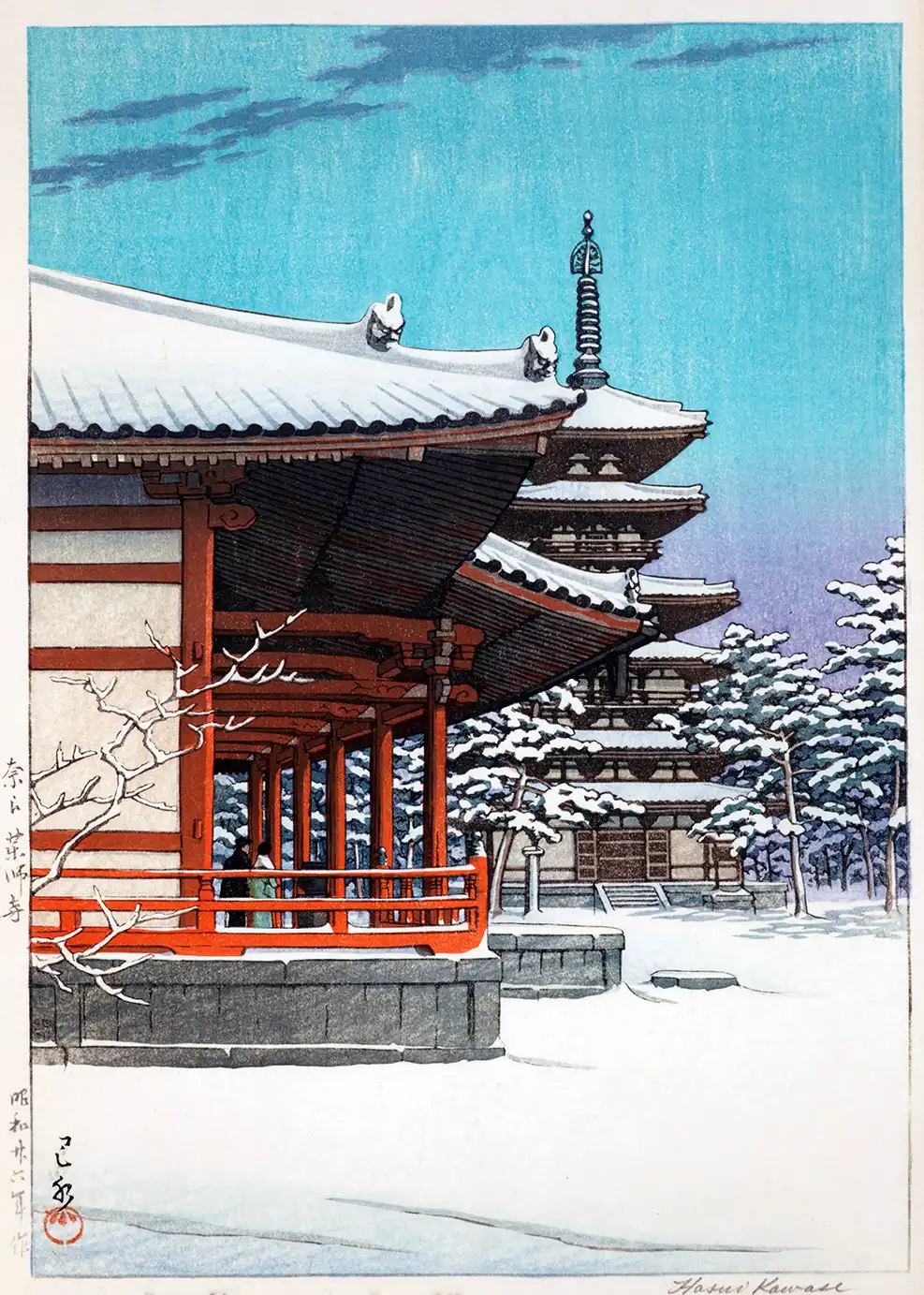
Classic Yakushiji Temple Print – 1951 Hasui Kawase Nara Snow Scene
This Yakushiji Temple Print presents a meticulous woodblock depiction of Nara’s iconic architecture blanketed in winter snow. This authentic Hasui Kawase Nara woodblock is rendered on 200 GSM museum-grade matte paper.
What You Will Receive
- Made to order, museum-grade art print. Frame not included unless stated.
- Printed on 200 GSM premium matte paper for crisp detail and zero glare.
- Archival giclée inks that resist fading for decades.
- Multiple size options. Use the selector above.
- Protective packaging: rigid mailer or sturdy tube.
Print Quality
Every print is produced using state-of-the-art giclée technology on heavyweight 200 GSM matte paper. The non-reflective surface eliminates glare while the archival pigment inks deliver rich, accurate colours designed to last a lifetime.
Size Guide
For walls above furniture, choose a print roughly two thirds to three quarters the width of the piece below it. Smaller sizes up to 11×14 inches suit gallery walls. Larger formats of 18×24 inches and above create striking focal points.
Verified Customer Reviews
Shipping
Every order is printed on demand. Processing takes 3 to 5 business days, then ships free worldwide with tracking.
| Region | Processing | Delivery | Total |
|---|---|---|---|
| USA | 3–5 days | 2–6 days | 5–11 days |
| Canada | 3–5 days | 5–10 days | 8–15 days |
| UK & Europe | 3–5 days | 5–10 days | 8–15 days |
| Australia & NZ | 3–5 days | 8–15 days | 11–20 days |
| Asia | 3–5 days | 7–15 days | 10–20 days |
| Rest of world | 3–5 days | 10–20 days | 13–25 days |
📦 Packaging
Prints up to 12×18 inches ship flat in rigid cardboard mailers with backing board. Larger prints are rolled in sturdy tubes with protective end caps. Every package includes moisture barriers and Handle With Care labels.
Returns and Replacements
- 30-day return window from delivery. No questions asked.
- Report damage within 48 hours with photos for a free replacement.
- Full refunds for eligible returns in original condition.
- Cancel before production starts for a complete refund.
- Return shipping covered for defective or incorrect items.
Need help? info.merchfuse@gmail.com
How to Care for Your Print
Follow these steps to keep your print looking gallery fresh for decades.
Handling
Allow rolled prints to relax flat for 30 to 60 minutes. Handle by the edges with clean, dry hands and avoid touching the printed surface.
Placement
Avoid direct sunlight, heat sources and high humidity areas. North-facing walls receive less UV. Use LED or incandescent lighting instead of fluorescent.
Framing
Use acid-free mats and UV protective glass or acrylic for maximum longevity. Leave a small gap between print and glazing for airflow.
Cleaning
Dust framed glass with a soft cloth. Spray the cloth, not the glass. For unframed prints, use a dry microfibre cloth and never apply liquids to the surface.
Climate
Keep temperature at 18–24 °C and humidity at 40–60%. Avoid attics, basements and garages where conditions swing widely.
Storage
Store flat in acid-free folders, interleaved with tissue paper, in a cool dark place. Never fold. Check stored prints annually.
⚠️ Avoid
- Prolonged direct sunlight or fluorescent lighting.
- Bathrooms, kitchens and areas above heat sources.
- Tape, adhesives or liquids applied directly to the print.
- Rolling with the image facing inward as this can crack the ink layer.
- Extreme or rapid temperature and humidity changes.
📊 Expected Lifespan
- 100+ years when framed with UV protective glazing and indirect light.
- 50–75 years when framed with standard glass and indirect light.
- 25–50 years when stored correctly in darkness.
This Yakushiji Temple Print serves as a window into the serene winter of 1951 Nara, as seen through the eyes of the prolific artist Hasui Kawase. The composition focuses on the architectural structuralism of the temple complex, specifically highlighting the vibrant vermilion railings that provide a sharp chromatic contrast against the muted whites of the fresh snow. As a late-era addition to the Shin-hanga movement, this print demonstrates the movement’s commitment to light, mood, and realistic spatial depth while maintaining the traditional woodblock printing techniques developed during the Edo period.
Historical Context of the Yakushiji Temple Print
The Yakushiji Temple Print captures one of Japan’s most significant Buddhist sites during a period of post-war cultural preservation. Founded in the late 7th century, Yakushiji is known for its unique layout and architectural symmetry. Hasui Kawase, often hailed as a hero of the Japanese woodblock revival, visited Nara multiple times to document its historic landmarks. In this 1951 rendering, he chooses a perspective that emphasizes the corridor of the main hall, leading the viewer’s eye toward the towering East Pagoda in the background. This specific pagoda is the only original structure from the temple’s founding to survive multiple fires over the centuries, making its inclusion here a symbol of endurance and historical continuity.
Visual Composition and Color Palette
The visual weight of the Yakushiji Temple Print is balanced between the heavy, snow-laden roofs and the intricate wooden lattice work of the temple structures. The artist uses a palette dominated by cool blues in the sky and soft violets in the distant treeline, which helps to isolate the warmth of the temple’s red columns. The snow is not merely white space; it is rendered with subtle gray shading to suggest volume and the weight of the accumulation. Small figures dressed in traditional winter attire are visible within the temple corridor, providing a sense of scale and human connection to the massive spiritual architecture. The blue sky above features long, horizontal cloud streaks, a common stylistic trope in Shin-hanga that adds a sense of calm and stillness to the cold environment.
Technical Printing and Material Excellence
Every Yakushiji Temple Print we produce adheres to the highest standards of archival reproduction. We utilize 200 GSM museum-grade matte paper, which provides a non-reflective surface that perfectly mimics the texture of original washi paper. The use of fade-resistant archival inks ensures that the deep indigo sky and the bright vermilion columns remain saturated for decades. Unlike standard posters, our printing process focuses on capturing the fine grain of the original woodblock, including the subtle indentations and color gradients known as bokashi. This attention to detail ensures that the intricate snow patterns on the pagoda roofs are sharp and distinct, preserving the integrity of Kawase’s original 1951 vision.
Interior Design and Placement
Incorporating a Yakushiji Temple Print into your living space or office brings an element of quiet contemplation and architectural order. The vertical orientation and balanced color scheme make it an ideal choice for a gallery wall or as a standalone focal point in a minimalist room. The contrast between the cold winter scenery and the warm architectural elements allows this print to coordinate with various decor styles, from traditional Japanese interiors to modern industrial settings. For those who appreciate Japanese history, this print serves as an educational artifact that documents the specific aesthetic of Nara in the mid-20th century. Whether displayed in a study, a hallway, or a bedroom, the stillness of the snow-covered temple creates a focused atmosphere.
The Legacy of Hasui Kawase
By selecting this Yakushiji Temple Print, you are celebrating the legacy of an artist who spent his life traveling across Japan to find beauty in the ordinary and the sacred. Kawase’s work was so highly regarded that he was named a Living National Treasure by the Japanese government. His ability to capture the specific atmosphere of a place—the dampness of the snow, the chill in the air, and the silence of the temple grounds—is what makes his prints remain relevant and sought after by collectors worldwide. This print is a faithful reproduction that honors that legacy, providing a high-resolution window into a vanished era of Japanese artistic production.
This is fan-inspired artwork and an original artistic interpretation. It is not affiliated with, endorsed by, or officially licensed by any studio, production company, label, artist, photographer, or rights holder.
Price range: $3.90 through $74.90
Price range: $3.90 through $74.90
Price range: $3.90 through $74.90
Price range: $3.90 through $74.90