
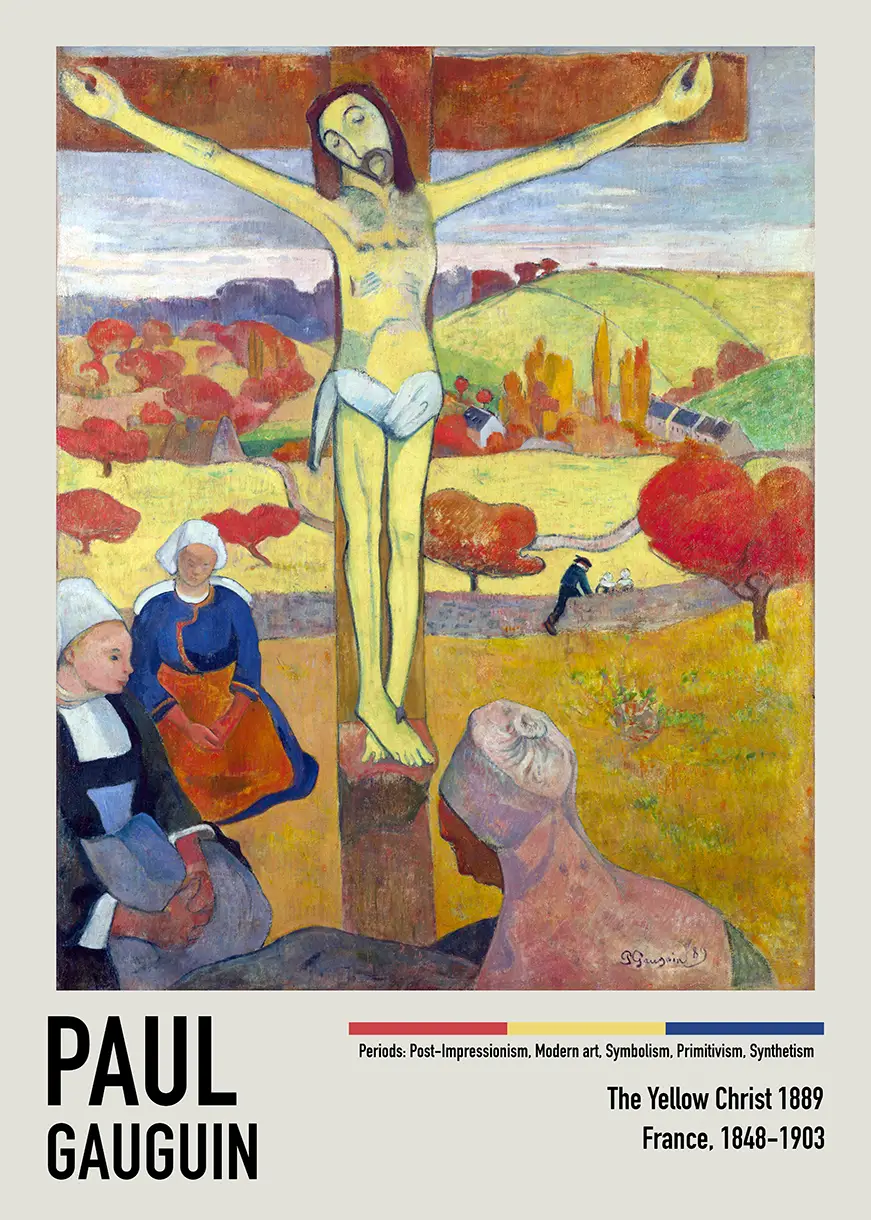
Authentic Yellow Christ print – Paul Gauguin 1889 Symbolist Wall Art
Yellow Christ print featuring Paul Gauguin’s 1889 Post-Impressionist study of Breton religious life. This French Symbolist painting is produced on museum-grade matte paper.
What You Will Receive
- Made to order, museum-grade art print. Frame not included unless stated.
- Printed on 200 GSM premium matte paper for crisp detail and zero glare.
- Archival giclée inks that resist fading for decades.
- Multiple size options. Use the selector above.
- Protective packaging: rigid mailer or sturdy tube.
Print Quality
Every print is produced using state-of-the-art giclée technology on heavyweight 200 GSM matte paper. The non-reflective surface eliminates glare while the archival pigment inks deliver rich, accurate colours designed to last a lifetime.
Size Guide
For walls above furniture, choose a print roughly two thirds to three quarters the width of the piece below it. Smaller sizes up to 11×14 inches suit gallery walls. Larger formats of 18×24 inches and above create striking focal points.
Verified Customer Reviews
Shipping
Every order is printed on demand. Processing takes 3 to 5 business days, then ships free worldwide with tracking.
| Region | Processing | Delivery | Total |
|---|---|---|---|
| USA | 3–5 days | 2–6 days | 5–11 days |
| Canada | 3–5 days | 5–10 days | 8–15 days |
| UK & Europe | 3–5 days | 5–10 days | 8–15 days |
| Australia & NZ | 3–5 days | 8–15 days | 11–20 days |
| Asia | 3–5 days | 7–15 days | 10–20 days |
| Rest of world | 3–5 days | 10–20 days | 13–25 days |
📦 Packaging
Prints up to 12×18 inches ship flat in rigid cardboard mailers with backing board. Larger prints are rolled in sturdy tubes with protective end caps. Every package includes moisture barriers and Handle With Care labels.
Returns and Replacements
- 30-day return window from delivery. No questions asked.
- Report damage within 48 hours with photos for a free replacement.
- Full refunds for eligible returns in original condition.
- Cancel before production starts for a complete refund.
- Return shipping covered for defective or incorrect items.
Need help? info.merchfuse@gmail.com
How to Care for Your Print
Follow these steps to keep your print looking gallery fresh for decades.
Handling
Allow rolled prints to relax flat for 30 to 60 minutes. Handle by the edges with clean, dry hands and avoid touching the printed surface.
Placement
Avoid direct sunlight, heat sources and high humidity areas. North-facing walls receive less UV. Use LED or incandescent lighting instead of fluorescent.
Framing
Use acid-free mats and UV protective glass or acrylic for maximum longevity. Leave a small gap between print and glazing for airflow.
Cleaning
Dust framed glass with a soft cloth. Spray the cloth, not the glass. For unframed prints, use a dry microfibre cloth and never apply liquids to the surface.
Climate
Keep temperature at 18–24 °C and humidity at 40–60%. Avoid attics, basements and garages where conditions swing widely.
Storage
Store flat in acid-free folders, interleaved with tissue paper, in a cool dark place. Never fold. Check stored prints annually.
⚠️ Avoid
- Prolonged direct sunlight or fluorescent lighting.
- Bathrooms, kitchens and areas above heat sources.
- Tape, adhesives or liquids applied directly to the print.
- Rolling with the image facing inward as this can crack the ink layer.
- Extreme or rapid temperature and humidity changes.
📊 Expected Lifespan
- 100+ years when framed with UV protective glazing and indirect light.
- 50–75 years when framed with standard glass and indirect light.
- 25–50 years when stored correctly in darkness.
The Yellow Christ print represents a pivotal shift in modern art history, capturing Paul Gauguin’s 1889 exploration of Breton piety and the Synthetist style. This specific work, created during his stay in Pont-Aven, marks a departure from traditional naturalism in favor of emotional color and bold outlines. By rejecting the constraints of academic realism, Gauguin provided a foundation for the development of modernism, focusing on the internal spiritual experience rather than mere outward observation.
Analyzing the Visual Elements of the Yellow Christ print
In this Yellow Christ print, the central figure is depicted with a jaundiced, saturated hue that mirrors the surrounding autumnal fields of the French countryside. Gauguin drew direct inspiration from a 17th-century wooden crucifix found in the Trmalo Chapel near Pont-Aven. The flat planes of color and heavy dark contours are characteristic of Cloisonnism, a style that prioritized bold graphic impact over three-dimensional perspective. The Breton women seated at the base of the cross are rendered in traditional 19th-century attire, including their distinct white coiffes, emphasizing the deep-rooted folk Catholicism of the region.
The Influence of Synthetism and Symbolism
The Yellow Christ print serves as a primary example of Synthetism. This movement sought to reconcile the outward appearance of the natural world, the artist’s feelings about the subject, and the pure aesthetic considerations of line and color. By utilizing a non-naturalistic palette—where trees are represented in deep oranges and reds—Gauguin moved away from the scientific observation of light found in Impressionism. Instead, he leaned into Symbolism, where the yellow skin of Christ suggests a spiritual aura that connects the divine with the literal harvest of the land. This artistic choice evokes a sense of primitive sincerity that Gauguin believed was lost in urban industrial society.
When you display this Yellow Christ print, you are showcasing a piece of art that challenged the Parisian establishment of the late 1800s. The composition is divided by the stark vertical and horizontal lines of the wooden cross, which anchors the fluid shapes of the surrounding hills. This contrast creates a structured yet primitive aesthetic that defined Gauguin’s career before his eventual departure for Tahiti. The integration of local peasant life with high religious iconography provides a window into the cultural tensions of the era, where ancient traditions met the dawning of modern abstraction.
Archival Quality and Production Standards
Every Yellow Christ print produced by MerchFuse adheres to the highest gallery standards. We utilize 200 GSM museum-grade matte paper, which provides a non-reflective surface that allows the saturated yellows and earth tones of Gauguin’s palette to remain visible from any angle. The archival inks used in the printing process ensure that the bold colors do not fade over time, preserving the integrity of the original 1889 brushwork. Our technical process ensures that every detail, from the textured application of oil paint to the fine grain of the canvas, is reproduced with precision.
- Paper Weight: 200 GSM premium museum-grade matte.
- Ink Type: Archival-grade pigment inks for long-term color stability.
- Format: Available as a physical print or high-resolution 300 DPI digital download.
- Sizing: Standard dimensions compatible with most off-the-shelf frames.
- Origin: Inspired by the Pont-Aven School of France.
Whether intended for a dedicated art history collection or as a focal point in a minimalist living space, the Yellow Christ print offers a profound connection to the roots of modernism. The interaction between the figures and the stylized landscape reflects a unique moment in 19th-century art where the boundaries between the real and the imagined began to dissolve. This reproduction ensures that the intensity of Gauguin’s vision remains accessible to contemporary collectors seeking historical depth and aesthetic rigor.
This is fan-inspired artwork and an original artistic interpretation. It is not affiliated with, endorsed by, or officially licensed by any studio, production company, label, artist, photographer, or rights holder.
Price range: $3.90 through $59.90
Price range: $3.90 through $59.90
Price range: $3.90 through $59.90
Price range: $3.90 through $59.90